
Pulp Fiction, 1914 · page 45 of 228
Adventure, December 1914 — page 45: what you’re looking at
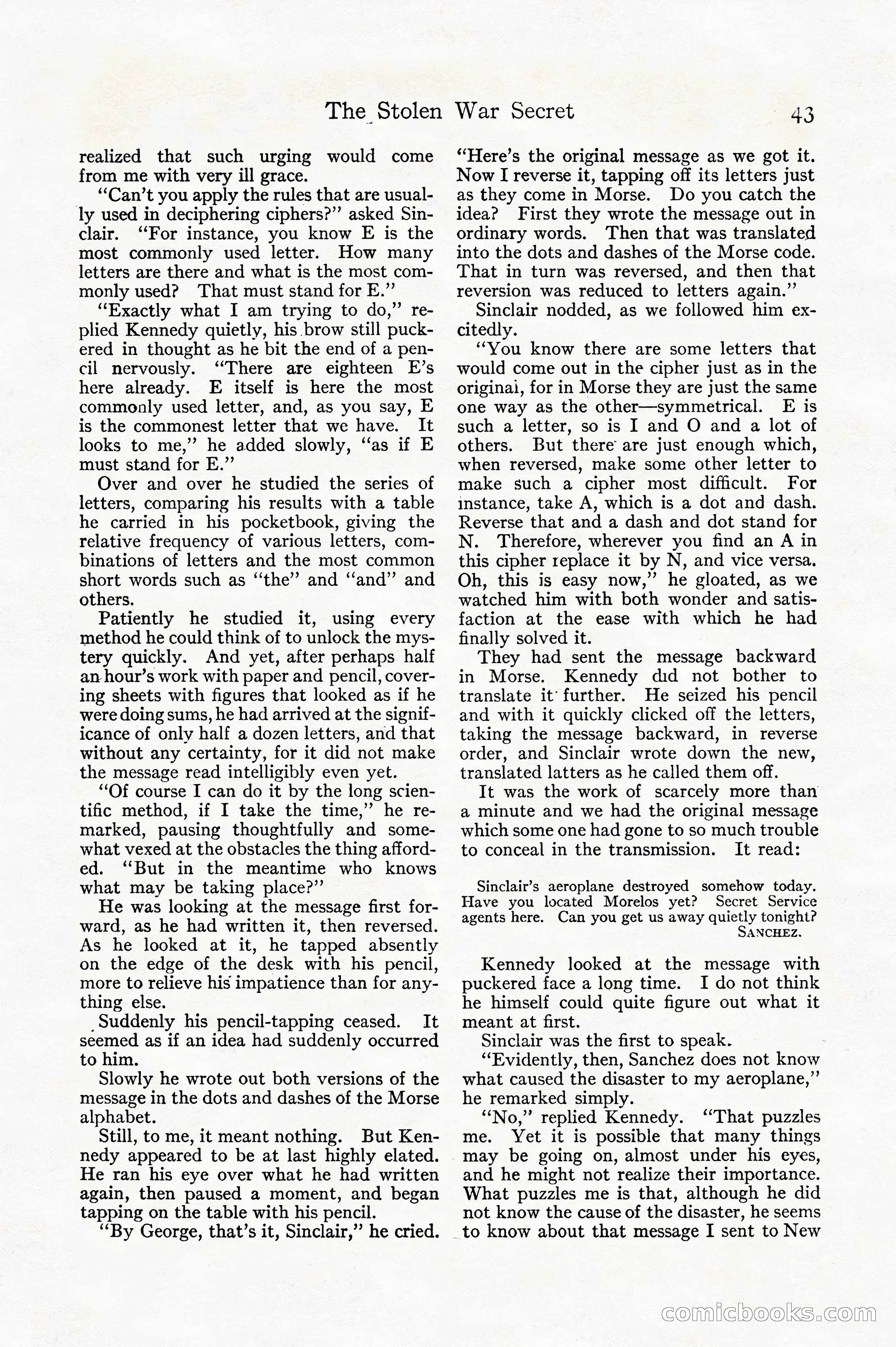
A restored page from Pulp Fiction, 1914. Page through the whole issue in the reader above.
📄 Transcribed text from this page (OCR, searchable)
Machine-transcribed from the original scan — historical spelling and the odd misread are preserved.
The Stolen realized that such urging would come from me with very ill grace. ‘“‘Can’t you apply the rules that are usual- ly used in deciphering ciphers?” asked Sin- clair. ‘‘For instance, you know E is the most commonly used letter. How many letters are there and what is the most com- monly used? That must stand for E.” “Exactly what I am trying to do,” re- plied Kennedy quietly, his brow still puck- ered in thought as he bit the end of a pen- cil nervously. ‘‘There are eighteen E’s here already. E itself is here the most commonly used letter, and, as you say, E is the commonest letter that we have. It looks to me,” he added slowly, “as if E must stand for E.”’ Over and over he studied the series of letters, comparing his results with a table he carried in his pocketbook, giving the relative frequency of various letters, com- binations of letters and the most common short words such as “the” and ‘“‘and”’ and others. Patiently he studied it, using every method he could think of to unlock the mys- tery quickly. And yet, after perhaps half an hour’s work with paper and pencil, cover- ing sheets with figures that looked as if he were doing sums, he had arrived at the signif- icance of only half a dozen letters, and that without any certainty, for it did not make the message read intelligibly even yet. “Of course I can do it by the long scien- tific method, if I take the time,” he re- marked, pausing thoughtfully and some- what vexed at the obstacles the thing afford- ed. “But in the meantime who knows what may be taking place?” He was looking at the message first for- ward, as he had written it, then reversed. As he looked at it, he tapped absently on the edge of the desk with his pencil, more to relieve his impatience than for any- thing else. Suddenly his pencil-tapping ceased. It seemed as if an idea had suddenly occurred to him. Slowly he wrote out both versions of the message in the dots and dashes of the Morse alphabet. Still, to me, it meant nothing. But Ken- nedy appeared to be at last highly elated. He ran his eye over what he had written again, then paused a moment, and began tapping on the table with his pencil. “By George, that’s it, Sinclair,” he cried. War bdSecret 43 ‘“‘Here’s the original message as we got it. Now I reverse it, tapping off its letters just as they come in Morse. Do you catch the idea? First they wrote the message out in ordinary words. Then that was translated into the dots and dashes of the Morse code. That in turn was reversed, and then that reversion was reduced to letters again.”’ Sinclair nodded, as we followed him ex- citedly. ‘“‘You know there are some letters that would come out in the cipher just as in the originai, for in Morse they are just the same one way as the other—symmetrical. E is such a letter, so is I and O and a lot of others. But there are just enough which, when reversed, make some other letter to make such a cipher most difficult. For instance, take A, which is a dot and dash. Reverse that and a dash and dot stand for N. Therefore, wherever you find an A in this cipher replace it by N, and vice versa. Oh, this is easy now,” he gloated, as we watched him with both wonder and satis- faction at the ease with which he had finally solved it. They had sent the message backward in Morse. Kennedy did not bother to translate it’ further. He seized his pencil and with it quickly clicked off the letters, taking the message backward, in reverse order, and Sinclair wrote down the new, translated latters as he called them off. It was the work of scarcely more than a minute and we had the original message which some one had gone to so much trouble to conceal in the transmission. It read: Sinclair’s aeroplane destroyed somehow today. Have you located Morelos yet? Secret Service agents here. Can you get us away quietly tonight? SANCHEZ. Kennedy looked at the message with puckered face a long time. I do not think he himself could quite figure out what it meant at first. Sinclair was the first to speak. “Evidently, then, Sanchez does not know what caused the disaster to my aeroplane,”’ he remarked simply. ‘“‘No,” replied Kennedy. me. “That puzzles Yet it is possible that many things may be going on, almost under his eyes, and he might not realize their importance. What puzzles me is that, although he did not know the cause of the disaster, he seems _to know about that message I sent to New MICLOOOK C@