
Pulp Fiction, 1914 · page 183 of 228
Adventure, December 1914 — page 183: what you’re looking at
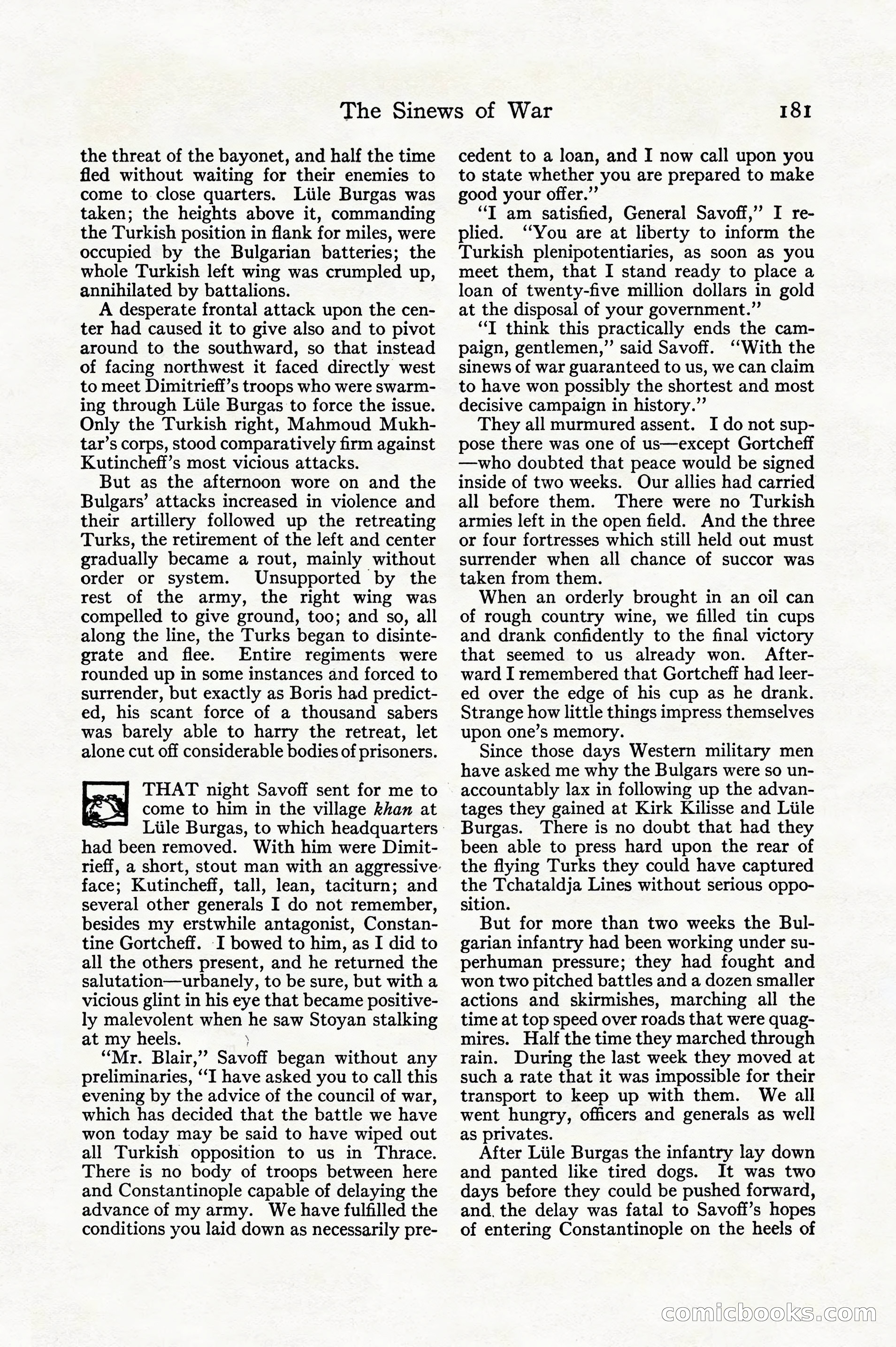
A restored page from Pulp Fiction, 1914. Page through the whole issue in the reader above.
📄 Transcribed text from this page (OCR, searchable)
Machine-transcribed from the original scan — historical spelling and the odd misread are preserved.
The Sinews of War the threat of the bayonet, and half the time fled without waiting for their enemies to come to close quarters. Liile Burgas was taken; the heights above it, commanding the Turkish position in flank for miles, were occupied by the Bulgarian batteries; the whole Turkish left wing was crumpled up, annihilated by battalions. A desperate frontal attack upon the cen- ter had caused it to give also and to pivot around to the southward, so that instead of facing northwest it faced directly west to meet Dimitrieff’s troops who were swarm- ing through Liile Burgas to force the issue. Only the Turkish right, Mahmoud Mukh- tar’s corps, stood comparatively firm against Kutincheff’s most vicious attacks. But as the afternoon wore on and the Bulgars’ attacks increased in violence and their artillery followed up the retreating Turks, the retirement of the left and center gradually became a rout, mainly without order or system. Unsupported by the rest of the army, the right wing was compelled to give ground, too; and so, all along the line, the Turks began to disinte- grate and flee. Entire regiments were rounded up in some instances and forced to surrender, but exactly as Boris had predict- ed, his scant force of a thousand sabers was barely able to harry the retreat, let alone cut off considerable bodies of prisoners. ea -_= THAT night Savoff sent for me to come to him in the village khan at — had been removed. With him were Dimit- rieff, a short, stout man with an aggressive: face; Kutincheff, tall, lean, taciturn; and several other generals I do not remember, besides my erstwhile antagonist, Constan- tine Gortcheff. -I bowed to him, as I did to all the others present, and he returned the salutation—urbanely, to be sure, but with a vicious glint in his eye that became positive- Iy malevolent when he saw Stoyan stalking at my heels. ) “Mr. Blair,” Savoff began without any preliminaries, ‘‘I have asked you to call this evening by the advice of the council of war, which has decided that the battle we have won today may be said to have wiped out all Turkish opposition to us in Thrace. There is no body of troops between here and Constantinople capable of delaying the advance of my army. We have fulfilled the conditions you laid down as necessarily pre- Liile Burgas, to which headquarters » 181 cedent to a loan, and I now call upon you to state whether you are prepared to make good your offer.” “TI am satisfied, General Savoff,” I re- plied. ‘You are at liberty to inform the Turkish plenipotentiaries, as soon as you meet them, that I stand ready to place a loan of twenty-five million dollars in gold at the disposal of your government.” “I think this practically ends the cam- paign, gentlemen,” said Savoff. ‘“‘With the sinews of war guaranteed to us, we can claim to have won possibly the shortest and most decisive campaign in history.” They all murmured assent. I do not sup- pose there was one of us—except Gortcheff —who doubted that peace would be signed inside of two weeks. Our allies had carried all before them. There were no Turkish armies left in the open field. And the three or four fortresses which still held out must surrender when all chance of succor was taken from them. When an orderly brought in an oil can of rough country wine, we filled tin cups and drank confidently to the final victory that seemed to us already won. After- ward I remembered that Gortcheff had leer- ed over the edge of his cup as he drank. Strange how little things impress themselves upon one’s memory. Since those days Western military men have asked me why the Bulgars were so un- accountably lax in following up the advan- tages they gained at Kirk Kilisse and Liile Burgas. There is no doubt that had they been able to press hard upon the rear of the flying Turks they could have captured the Tchataldja Lines without serious oppo- sition. But for more than two weeks the Bul- garian infantry had been working under su- perhuman pressure; they had fought and won two pitched battles and a dozen smaller actions and skirmishes, marching all the time at top speed over roads that were quag- mires. Half the time they marched through rain. During the last week they moved at such a rate that it was impossible for their transport to keep up with them. We all went hungry, officers and generals as well as privates. After Liile Burgas the infantry lay down and panted like tired dogs. It was two days before they could be pushed forward, and. the delay was fatal to Savoff’s hopes of entering Constantinople on the heels of NOOK C©