
Pulp Fiction, 1914 · page 182 of 228
Adventure, December 1914 — page 182: what you’re looking at
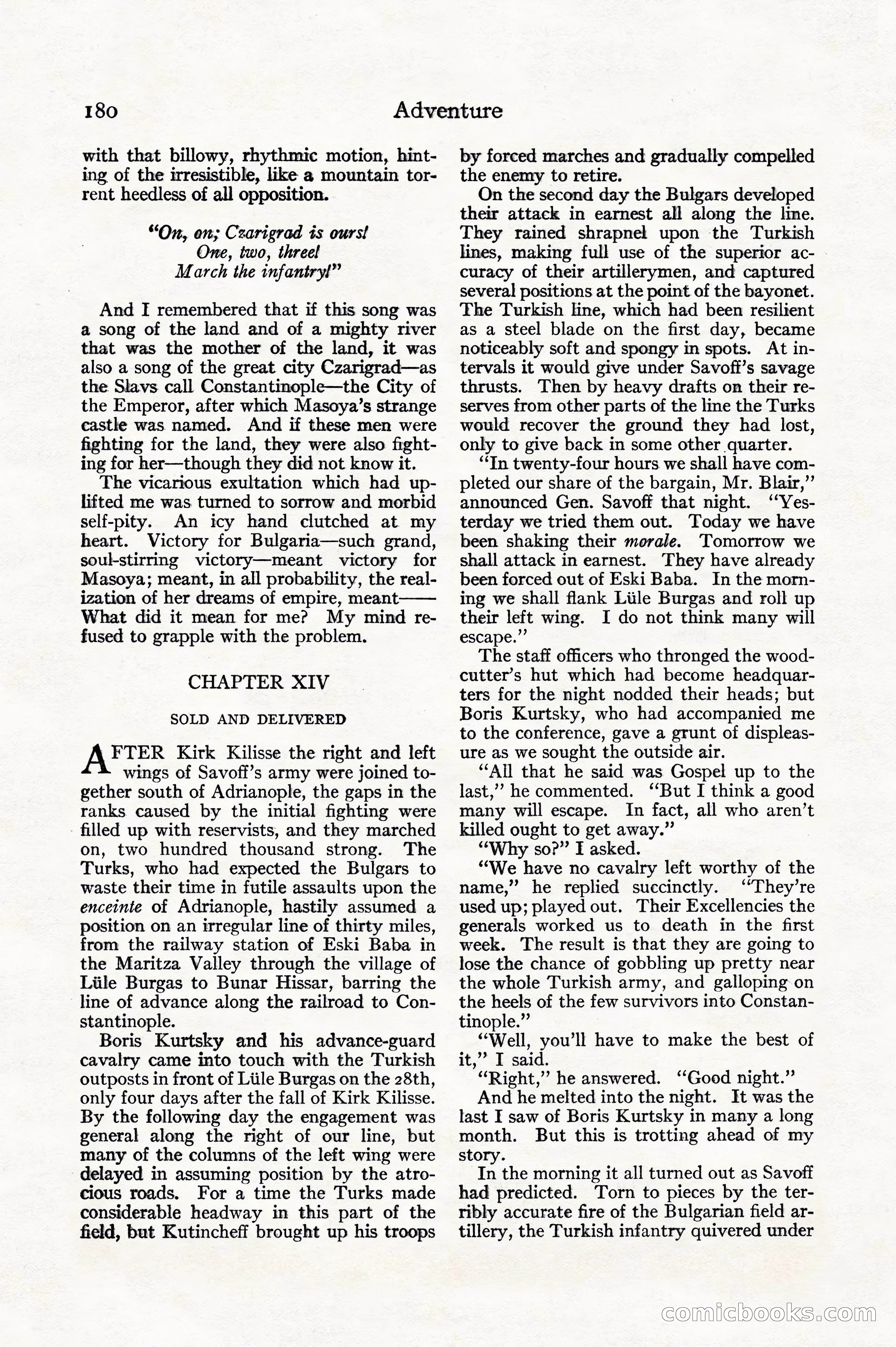
A restored page from Pulp Fiction, 1914. Page through the whole issue in the reader above.
📄 Transcribed text from this page (OCR, searchable)
Machine-transcribed from the original scan — historical spelling and the odd misread are preserved.
180 with that billowy, rhythmic motion, hint- ing of the irresistible, like a mountain tor- rent heedless of all opposition. “On, on; Czarigrad ts oursl One, two, threel March the infantryl” And I remembered that if this song was a song of the land and of a mighty river that was the mother of the land, it was also a song of the great city Czarigrad—as the Slavs call Constantmople—the City of the Emperor, after which Masoya’s strange castle was named. And if these men were fighting for the land, they were also fight- ing for her—though they did not know it. The vicarious exultation which had up- lifted me was turned to sorrow and morbid self-pity. An icy hand clutched at my heart. Victory for Bulgaria—such grand, soul-stirring victory—meant victory for Masoya; meant, in all probability, the real- ization of her dreams of empire, meant—— What did it mean for me? My mind re- fused to grapple with the problem. CHAPTER XIV SOLD AND DELIVERED AFIER Kirk Kilisse the right and left wings of Savoff’s army were joined to- gether south of Adrianople, the gaps in the ranks caused by the initial fighting were - filled up with reservists, and they marched on, two hundred thousand strong. The Turks, who had expected the Bulgars to waste their time in futile assaults upon the enceinte of Adrianople, hastily assumed a position on an irregular line of thirty miles, from the railway station of Eski Baba in the Maritza Valley through the village of Liile Burgas to Bunar Hissar, barring the line of advance along the railroad to Con- stantinople. Boris Kurtsky and his advance-guard cavalry came into touch with the Turkish outposts in front of Liile Burgas on the 28th, only four days after the fall of Kirk Kilisse. By the following day the engagement was general along the right of our line, but many of the columns of the left wing were delayed in assuming position by the atro- cious roads. For a time the Turks made considerable headway in this part of the field, but Kutincheff brought up his troops Adventure by forced marches and gradually compelled the enemy to retire. On the second day the Bulgars developed their attack in earnest all along the line. They rained shrapnel upon the Turkish lines, making full use of the superior ac- curacy of their artillerymen, and captured several positions at the point of the bayonet. The Turkish line, which had been resilient as a steel blade on the first day, became noticeably soft and spongy in spots. At in- tervals it would give under Savofi’s savage thrusts. Then by heavy drafts on their re- serves from other parts of the line the Turks would recover the ground they had lost, only to give back in some other quarter. “In twenty-four hours we shall have com- pleted our share of the bargain, Mr. Blair,” announced Gen. Savoff that night. ‘Yes- terday we tried them out. Today we have been shaking their morale. Tomorrow we shall attack in earnest. They have already been forced out of Eski Baba. In the morn- ing we shall flank Liile Burgas and roll up their left wing. I do not think many will escape.” The staff officers who thronged the wood- cutter’s hut which had become headquar- ters for the night nodded their heads; but Boris Kurtsky, who had accompanied me to the conference, gave a grunt of displeas- ure as we sought the outside air. ‘“‘All that he said was Gospel up to the last,” he commented. ‘‘But I think a good many will escape. In fact, all who aren’t killed ought to get away.” ‘“‘Why so?” I asked. ‘““We have no cavalry left worthy of the name,” he replied succinctly. ‘They’re used up; played out. Their Excellencies the generals worked us to death in the first week. The result is that they are going to lose the chance of gobbling up pretty near the whole Turkish army, and galloping on the heels of the few survivors into Constan- tinople.” “Well, you’ll have to make the best of it,” I said. “Right,” he answered. ‘Good night.” And he melted into the night. It was the last I saw of Boris Kurtsky in many a long month. But this is trotting ahead of my story. In the morning it all turned out as Savoff had predicted. Torn to pieces by the ter- ribly accurate fire of the Bulgarian field ar- tillery, the Turkish infantry quivered under MICLOOOK C©