
Pulp Fiction, 1911 · page 187 of 196
Adventure Magazine Cover, October 1911 — page 187: what you’re looking at
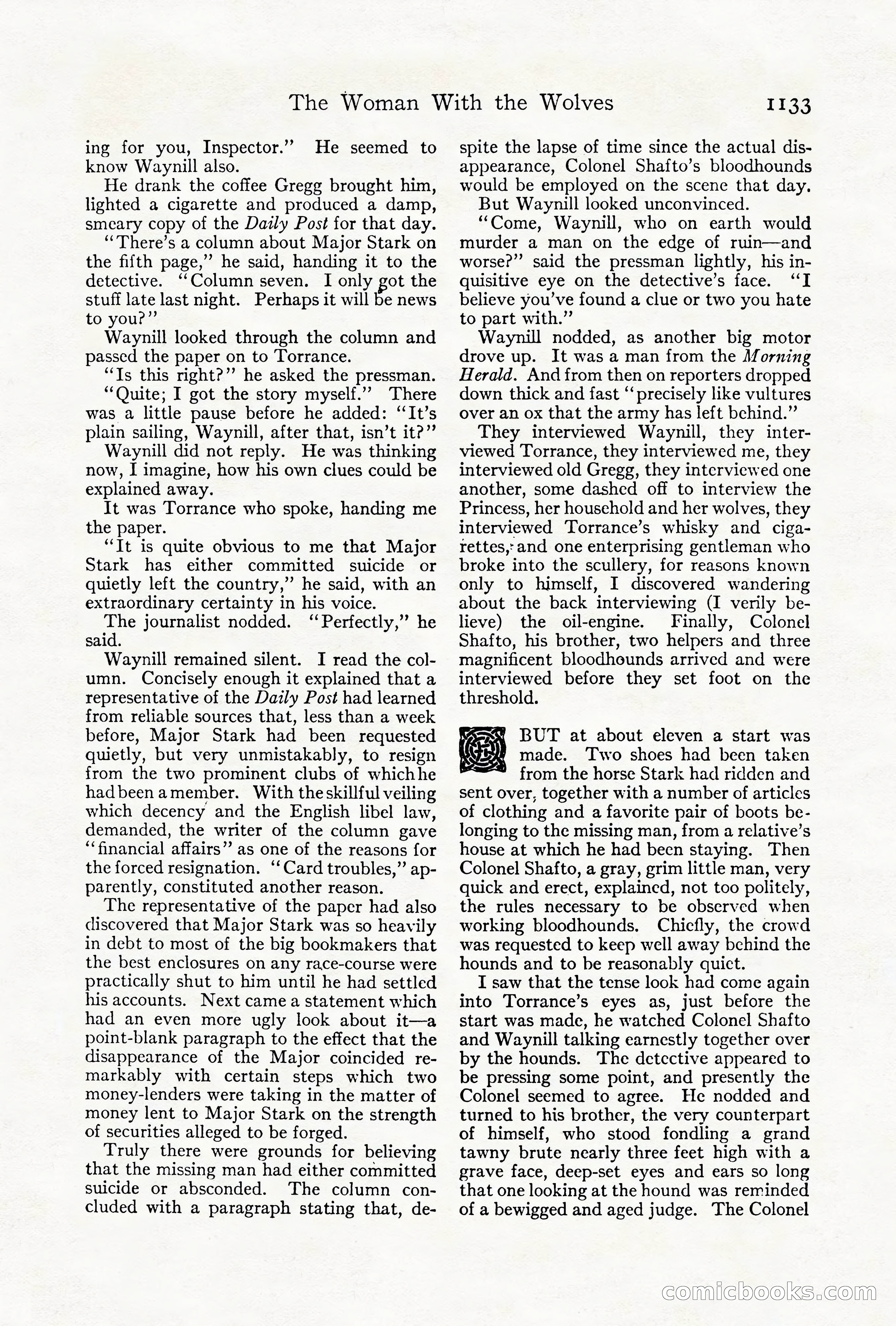
A restored page from Pulp Fiction, 1911. Page through the whole issue in the reader above.
📄 Transcribed text from this page (OCR, searchable)
Machine-transcribed from the original scan — historical spelling and the odd misread are preserved.
The Woman With the Wolves ing for you, Inspector.’”? He seemed to know Waynill also. He drank the coffee Gregg brought him, lighted a cigarette and produced a damp, smeary copy of the Dazly Post for that day. ‘““There’s a column about Major Stark on the fifth page,” he said, handing it to the detective. ‘‘Column seven. I only got the stuff late last night. Perhaps it will be news to you?” Waynill looked through the column and passed the paper on to Torrance. “Ts this right?’’ he asked the pressman. ‘Quite; I got the story myself.”’ There was a little pause before he added: ‘‘It’s plain sailing, Waynill, after that, isn’t it?”’ Waynill did not reply. He was thinking now, I imagine, how his own clues could be explained away. It was Torrance who spoke, handing me the paper. “It is quite obvious to me that Major Stark has either committed suicide or quietly left the country,” he said, with an extraordinary certainty in his voice. The journalist nodded. ‘‘Perfectly,” he said. Waynill remained silent. I read the col- umn. Concisely enough it explained that a representative of the Daily Post had learned from reliable sources that, less than a week before, Major Stark had been requested quietly, but very unmistakably, to resign from the two prominent clubs of whichhe hadbeenamember. With theskillful veiling which decency and the English libel law, demanded, the writer of the column gave ‘financial affairs” as one of the reasons for the forced resignation. “Card troubles,” ap- parently, constituted another reason. The representative of the paper had also ciscovered that Major Stark was so heavily in debt to most of the big bookmakers that the best enclosures on any race-course were practically shut to him until he had settled his accounts. Next came a statement which had an even more ugly look about it—a point-blank paragraph to the effect that the disappearance of the Major coincided re- markably with certain steps which two money-lenders were taking in the matter of money lent to Major Stark on the strength of securities alleged to be forged. Truly there were grounds for believing that the missing man had either committed suicide or absconded. The column con- cluded with a paragraph stating that, de- 1133 spite the lapse of time since the actual dis- appearance, Colonel Shafto’s bloodhounds would be employed on the scene that day. But Waynill looked unconvinced. ““Come, Waynill, who on earth would murder a man on the edge of ruin—and worse?” said the pressman lightly, his in- quisitive eye on the detective’s face. ‘I believe you’ve found a clue or two you hate to part with.” Waynill nodded, as another big motor drove up. It was a man from the Morning Herald. And from then on reporters dropped down thick and fast “‘precisely like vultures over an ox that the army has left behind.” They interviewed Waynill, they inter- viewed Torrance, they interviewed me, they interviewed old Gregg, they interviewed one another, some dashed off to interview the Princess, her household and her wolves, they interviewed Torrance’s whisky and ciga- rettes,:and one enterprising gentleman who broke into the scullery, for reasons known only to himself, I discovered wandering about the back interviewing (I venly be- lieve) the oil-engine. Finally, Colonel Shafto, his brother, two helpers and three magnificent bloodhounds arrived and were interviewed before they set foot on the threshold. BUT at about eleven a start was as made. ‘Two shoes had been taken " from the horse Stark had ridden and sent over, together with a number of articles of clothing and a favorite pair of boots be- longing to the missing man, from a relative’s house at which he had been staying. Then Colonel Shafto, a gray, grim little man, very quick and erect, explaincd, not too politely, the rules necessary to be observed when working bloodhounds. Chicfly, the crowd was requested to keep well away bchind the hounds and to be reasonably quict. I saw that the tense look had come again into Torrance’s eyes as, just before the start was made, he watched Colonel Shafto and Waynill talking earnestly together over by the hounds. The detcctive appeared to be pressing some point, and presently the Colonel seemed to agree. He nodded and turned to his brother, the very counterpart of himself, who stood fondling a grand tawny brute nearly three feet high with a grave face, deep-set eyes and ears so long that one looking at the hound was reminded of a bewigged and aged judge. The Colonel C© MICLOOKS CO