
Pulp Fiction, 1911 · page 186 of 196
Adventure Magazine Cover, October 1911 — page 186: what you’re looking at
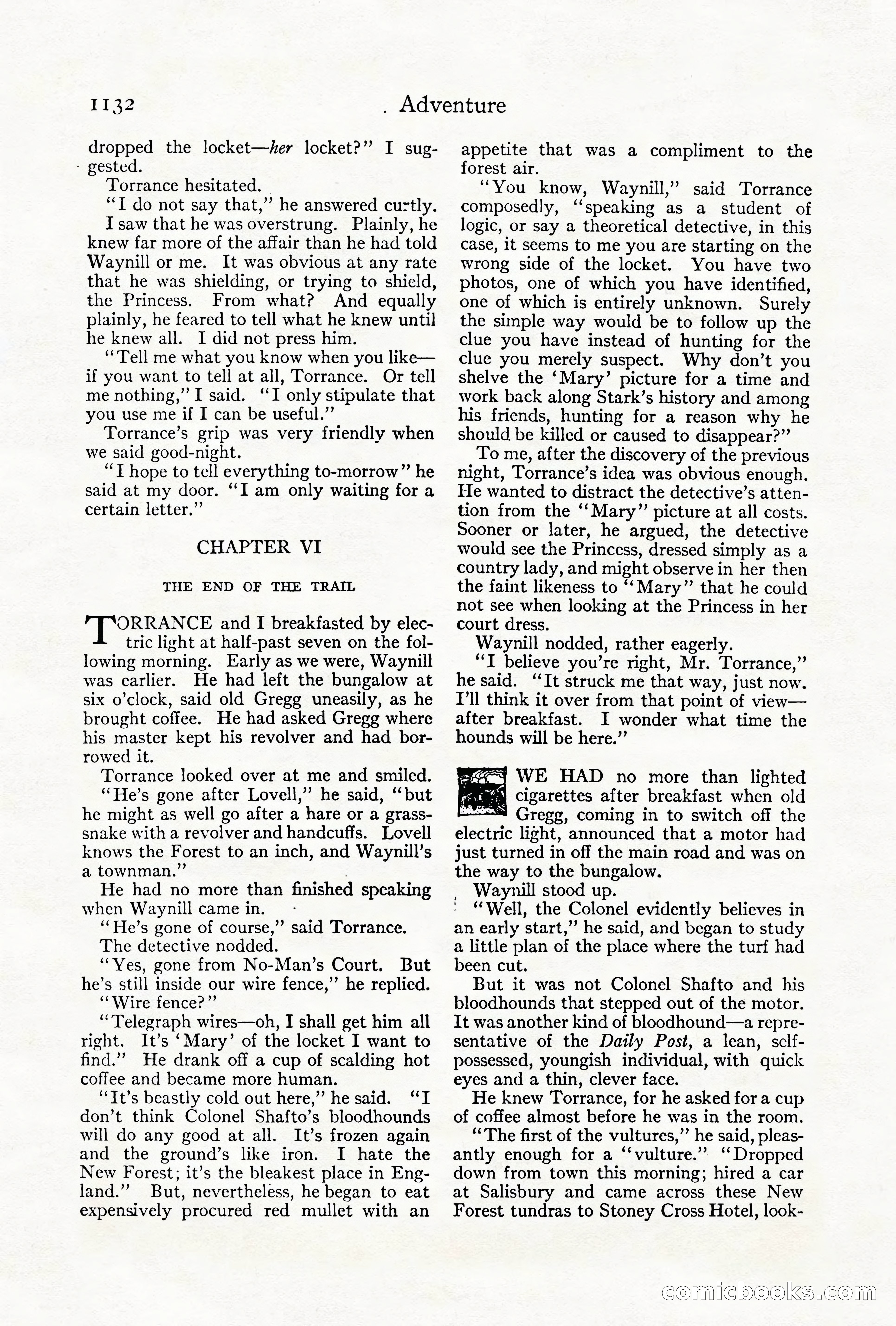
A restored page from Pulp Fiction, 1911. Page through the whole issue in the reader above.
📄 Transcribed text from this page (OCR, searchable)
Machine-transcribed from the original scan — historical spelling and the odd misread are preserved.
1132 dropped the locket—her locket?” I sug- - gested. Torrance hesitated. “I do not say that,” he answered curtly. I saw that he was overstrung. Plainly, he knew far more of the affair than he had told Waynill or me. It was obvious at any rate that he was shielding, or trying to shield, the Princess. From what? And equally plainly, he feared to tell what he knew until he knew all. I did not press him. ‘Tell me what you know when you like— if you want to tell at all, Torrance. Or tell me nothing,’ I said. “I only stipulate that you use me if I can be useful.” Torrance’s grip was very friendly when we said good-night. “T hope to tell everything to-morrow” he said at my door. “‘I am only waiting for a certain letter.” CHAPTER VI THE END OF THE TRAIL Ope Ae and I breakfasted by elec- tric light at half-past seven on the fol- lowing morning. Early as we were, Waynill was earlier. He had left the bungalow at six o’clock, said old Gregg uneasily, as he brought coffee. He had asked Gregg where his master kept his revolver and had bor- rowed it. Torrance looked over at me and smiled. “He’s gone after Lovell,” he said, “but he might as well go after a hare or a grass- snake with a revolver and handcuffs. Lovell knows the Forest to an inch, and Waynill’s a townman.”’ He had no more than finished speaking when Waynill came in. ‘““He’s gone of course,”’ said Torrance. The detective nodded. “Yes, gone from No-Man’s Court. But he’s still inside our wire fence,” he replied. ‘Wire fence?” “Telegraph wires—oh, I shall get him all right. It’s ‘Mary’ of the locket I want to find.”” He drank off a cup of scalding hot coffee and became more human. ‘It’s beastly cold out here,” he said. ‘‘I don’t think Colonel Shafto’s bloodhounds will do any good at all. It’s frozen again and the ground’s like iron. I hate the New Forest; it’s the bleakest place in Eng- land.” But, nevertheless, he began to eat expensively procured red mullet with an _ Adventure appetite that was a compliment to the forest air. “You know, Waynill,’’ said Torrance composedly, “‘speaking as a student of logic, or say a theoretical detective, in this case, it seems to me you are starting on the wrong side of the locket. You have two photos, one of which you have identified, one of which is entirely unknown. Surely the simple way would be to follow up the clue you have instead of hunting for the clue you merely suspect. Why don’t you shelve the ‘Mary’ picture for a time and work back along Stark’s history and among his friends, hunting for a reason why he should be killed or caused to disappear?” To me, after the discovery of the previous night, Torrance’s idea was obvious enough. He wanted to distract the detective’s atten- tion from the “‘Mary”’ picture at all costs. Sooner or later, he argued, the detective would see the Princess, dressed simply as a country lady, and might observe in her then the faint likeness to ‘‘Mary” that he could not see when looking at the Princess in her court dress. Waynill nodded, rather eagerly. “I believe you’re right, Mr. Torrance,” he said. “It struck me that way, just now. Tl think it over from that point of view— after breakfast. I wonder what time the hounds will be here.” zy WE HAD no more than lighted amen cigarettes after breakfast when old " Gregg, coming in to switch off the electric light, announced that a motor had just turned in off the main road and was on the way to the bungalow. Waynill stood up. ‘Well, the Colonel evidently believes in an early start,” he said, and began to study a little plan of the place where the turf had been cut. But it was not Colonel Shafto and his bloodhounds that stepped out of the motor. It was another kind of bloodhound—a repre- sentative of the Daily Post, a lean, sclf- possessed, youngish individual, with quick eyes and a thin, clever face. He knew Torrance, for he asked for a cup of coffee almost before he was in the room. “The first of the vultures,”’ he said, pleas- antly enough for a “‘vulture.”. ‘Dropped down from town this morning; hired a car at Salisbury and came across these New Forest tundras to Stoney Cross Hotel, look- COL cloookxS C©