
Pulp Fiction, 1911 · page 127 of 196
Adventure Magazine Cover, October 1911 — page 127: what you’re looking at
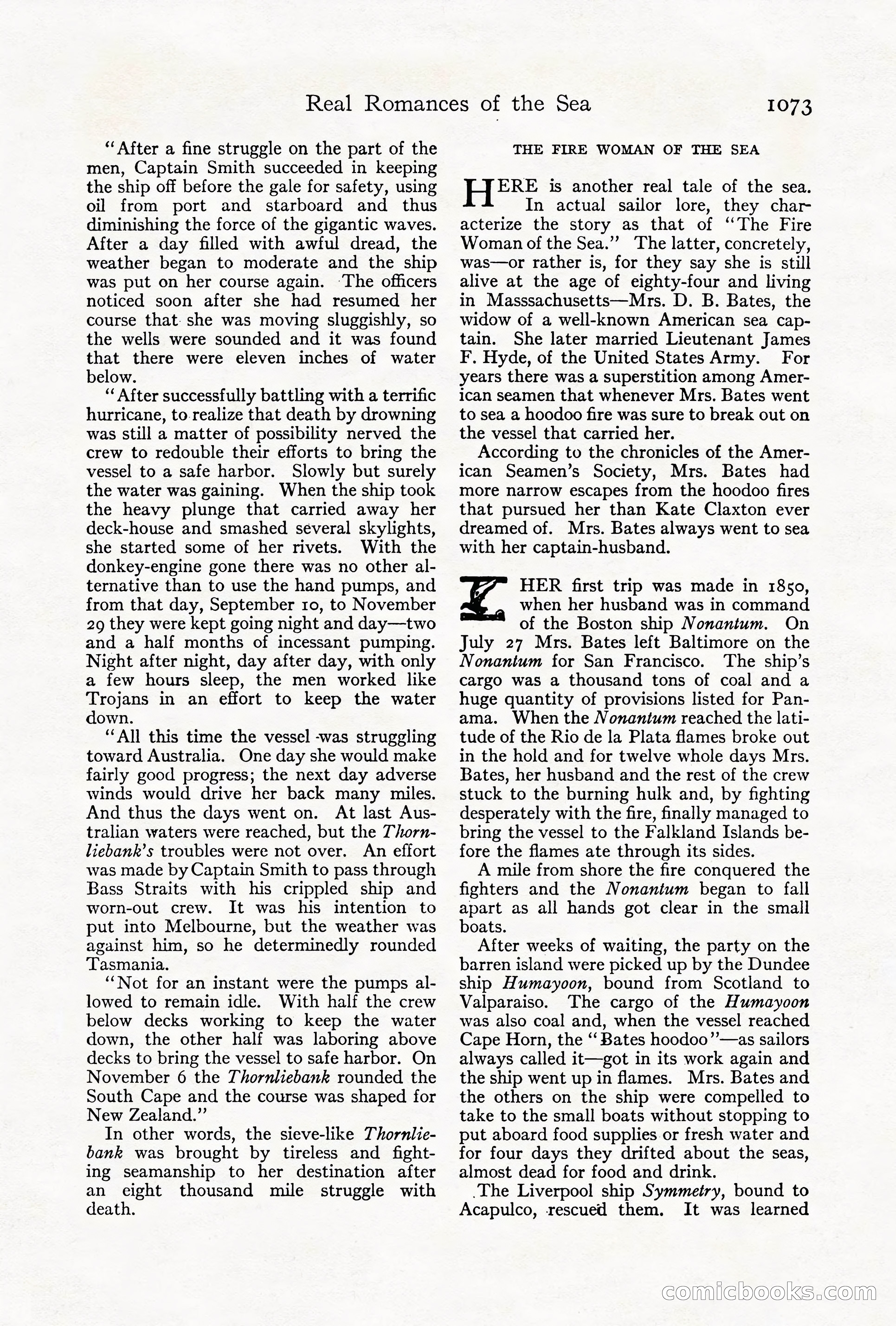
A restored page from Pulp Fiction, 1911. Page through the whole issue in the reader above.
📄 Transcribed text from this page (OCR, searchable)
Machine-transcribed from the original scan — historical spelling and the odd misread are preserved.
Real Romances of the Sea ‘After a fine struggle on the part of the men, Captain Smith succeeded in keeping the ship off before the gale for safety, using oil from port and starboard and thus diminishing the force of the gigantic waves. After a day filled with awful dread, the weather began to moderate and the ship was put on her course again. ‘The officers noticed soon after she had resumed her course that: she was moving sluggishly, so the wells were sounded and it was found that there were eleven inches of water below. ‘After successfully battling with a terrific hurricane, to realize that death by drowning was still a matter of possibility nerved the crew to redouble their efforts to bring the vessel to a safe harbor. Slowly but surely the water was gaining. When the ship took the heavy plunge that carried away her deck-house and smashed several skylights, she started some of her rivets. With the donkey-engine gone there was no other al- ternative than to use the hand pumps, and from that day, September 10, to November 29 they were kept going night and day—two and a half months of incessant pumping. Night after night, day after day, with only a few hours sleep, the men worked like Trojans in an effort to keep the water down. ‘‘All this time the vessel -was struggling toward Australia. One day she would make fairly good progress; the next day adverse winds would drive her back many miles. And thus the days went on. At last Aus- tralian waters were reached, but the T/orn- liebank’s troubles were not over. An effort was made by Captain Smith to pass through Bass Straits with his crippled ship and worn-out crew. It was his intention to put into Melbourne, but the weather was against him, so he determinedly rounded ‘Tasmania. ‘“‘Not for an instant were the pumps al- lowed to remain idle. With half the crew below decks working to keep the water down, the other half was laboring above decks to bring the vessel to safe harbor. On November 6 the Thornliebank rounded the South Cape and the course was shaped for New Zealand.” In other words, the sieve-like Thornlie- bank was brought by tireless and fight- ing seamanship to her destination after an eight thousand mile struggle with death. 1073 THE FIRE WOMAN OF THE SEA ERE is another real tale of the sea. In actual sailor lore, they char- acterize the story as that of ‘The Fire Woman of the Sea.”’ The latter, concretely, was—or rather is, for they say she is still alive at the age of eighty-four and living in Masssachusetts—Mrs. D. B. Bates, the widow of a well-known American sea cap- tain. She later married Lieutenant James F. Hyde, of the United States Army. For years there was a superstition among Amer- ican seamen that whenever Mrs. Bates went to sea a hoodoo fire was sure to break out on the vessel that carried her. According to the chronicles of the Amer- ican Seamen’s Society, Mrs. Bates had more narrow escapes from the hoodoo fires that pursued her than Kate Claxton ever dreamed of. Mrs. Bates always went to sea with her captain-husband. iS when her husband was in command of the Boston ship Nonantum. On July 27 Mrs. Bates left Baltimore on the Nonantum for San Francisco. The ship’s cargo was a thousand tons of coal and a huge quantity of provisions listed for Pan- ama. When the Nonantum reached the lati- tude of the Rio de la Plata flames broke out in the hold and for twelve whole days Mrs. Bates, her husband and the rest of the crew stuck to the burning hulk and, by fighting desperately with the fire, finally managed to bring the vessel to the Falkland Islands be- fore the flames ate through its sides. A mile from shore the fire conquered the fighters and the Nonantum began to fall apart as all hands got clear in the small boats. After weeks of waiting, the party on the barren island were picked up by the Dundee ship Humayoon, bound from Scotland to Valparaiso. The cargo of the Humayoon was also coal and, when the vessel reached Cape Horn, the “‘ Bates hoodoo’’—as sailors always called it—got in its work again and the ship went up in flames. Mrs. Bates and the others on the ship were compelled to take to the small boats without stopping to put aboard food supplies or fresh water and for four days they drifted about the seas, almost dead for food and drink. The Liverpool ship Symmetry, bound to Acapulco, rescued them. It was learned HER first trip was made in 1850, C© MICLOOKS CO