
Pulp Fiction, 1911 · page 126 of 196
Adventure Magazine Cover, October 1911 — page 126: what you’re looking at
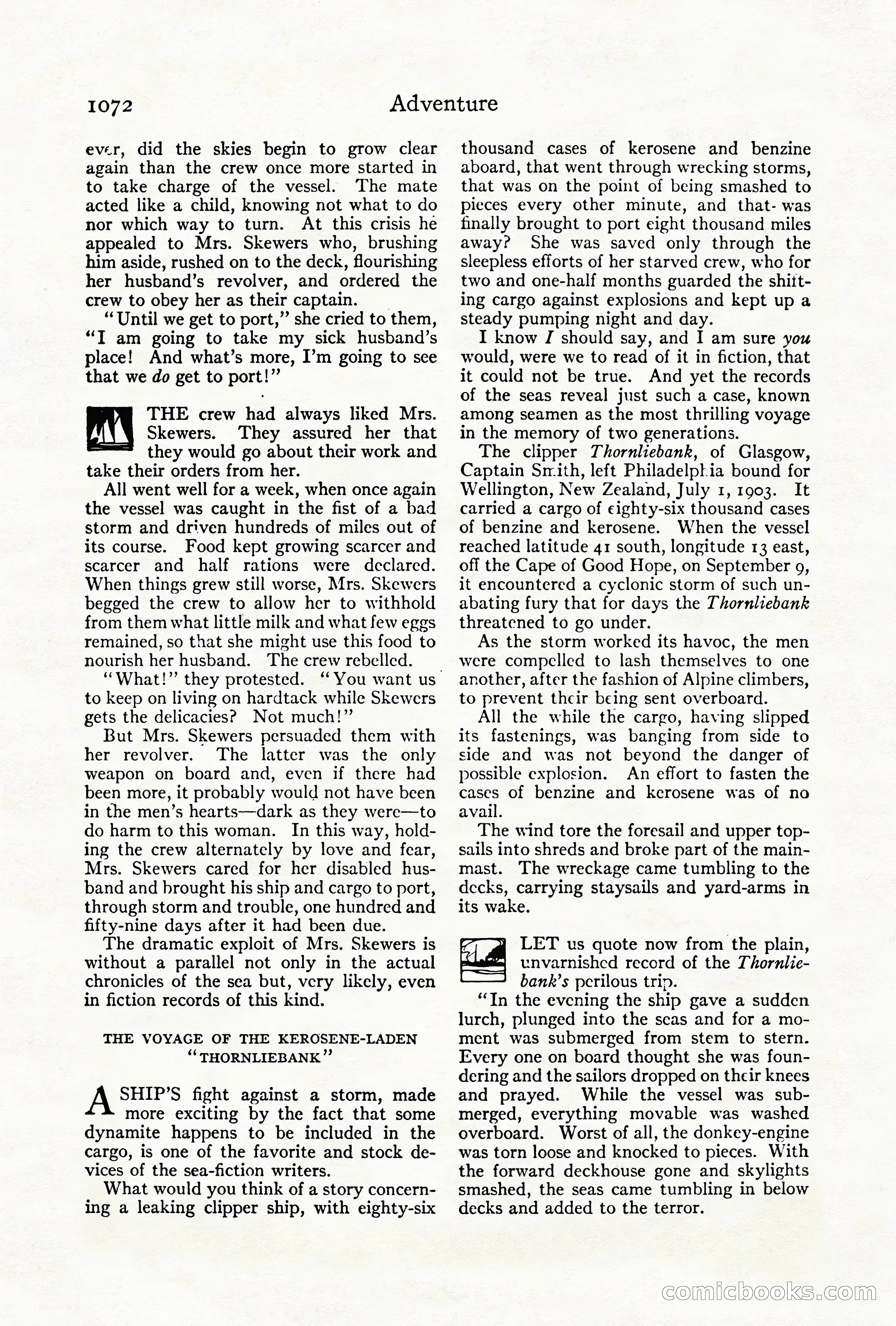
A restored page from Pulp Fiction, 1911. Page through the whole issue in the reader above.
📄 Transcribed text from this page (OCR, searchable)
Machine-transcribed from the original scan — historical spelling and the odd misread are preserved.
1072 ever, did the skies begin to grow clear again than the crew once more started in to take charge of the vessel. The mate acted like a child, knowing not what to do nor which way to turn. At this crisis he appealed to Mrs. Skewers who, brushing him aside, rushed on to the deck, flourishing her husband’s revolver, and ordered the crew to obey her as their captain. _ “Until we get to port,” she cried to them, “TI am going to take my sick husband’s place! And what’s more, I’m going to see that we do get to port!” THE crew had always liked Mrs. Skewers. They assured her that they would go about their work and take their orders from her. All went well for a week, when once again the vessel was caught in the fist of a bad storm and driven hundreds of miles out of its course. Food kept growing scarcer and scarcer and half rations were declared. When things grew still worse, Mrs. Skewers begged the crew to allow her to withhold from them what little milk and what few eggs remained, so that she might use this food to nourish her husband. The crew rebelled. “What!” they protested. to keep on living on hardtack while Skewers gets the delicacies? Not much!” But Mrs. Skewers persuaded them with her revolver. The latter was the only weapon on board and, even if there had been more, it probably would not have been in the men’s hearts—dark as they were—to do harm to this woman. In this way, hold- ing the crew alternately by love and fear, Mrs. Skewers cared for her disabled hus- band and brought his ship and cargo to port, through storm and trouble, one hundred and fifty-nine days after it had been due. The dramatic exploit of Mrs. Skewers is without a parallel not only in the actual chronicles of the sea but, very likely, even in fiction records of this kind. uhh THE VOYAGE OF THE KEROSENE-LADEN “THORNLIEBANK”? A SHIP’S fight against a storm, made more exciting by the fact that some dynamite happens to be included in the cargo, is one of the favorite and stock de- vices of the sea-fiction writers. What would you think of a story concern- ing a leaking clipper ship, with eighty-six “Vou want us” Adventure thousand cases of kerosene and benzine aboard, that went through wrecking storms, that was on the point of being smashed to pleces every other minute, and that- was finally brought to port eight thousand miles away? She was saved only through the sleepless efforts of her starved crew, who for two and one-half months guarded the shiit- ing cargo against explosions and kept up a steady pumping night and day. I know TZ should say, and I am sure you would, were we to read of it in fiction, that it could not be true. And yet the records of the seas reveal just such a case, known among seamen as the most thrilling voyage in the memory of two generations. The clipper Thornliebank, of Glasgow, Captain Smith, left Philadelpiia bound for Wellington, New Zealand, July 1, 1903. It carried a cargo of eighty-six thousand cases of benzine and kerosene. When the vessel reached latitude 41 south, longitude 13 east, off the Cape of Good Hope, on September 9, it encountered a cyclonic storm of such un- abating fury that for days the Thornliebank threatened to go under. As the storm worked its havoc, the men were compclled to lash themselves to one another, after the fashion of Alpine climbers, to prevent thcir being sent overboard. All the while the cargo, having slipped its fastenings, was banging from side to side and was not beyond the danger of possible explosion. An effort to fasten the cases of benzine and kerosene was of no avail. The wind tore the foresail and upper top- sails into shreds and broke part of the main- mast. The wreckage came tumbling to the decks, carrying staysails and yard-arms in its wake. av LET us quote now from the plain, pedals! Unvarnishcd record of the Thornlie- -—J bank’s perilous trip. “In the evening the ship gave a sudden lurch, plunged into the seas and for a mo- ment was submerged from stem to stern. Every one on board thought she was foun- dering and the sailors dropped on their knees and prayed. While the vessel was sub- merged, everything movable was washed overboard. Worst of all, the donkey-engine was torn loose and knocked to pieces. With the forward deckhouse gone and skylights smashed, the seas came tumbling in below decks and added to the terror. CO MICLOOKS ©