
Pulp Fiction, 1911 · page 6 of 196
Adventure Magazine Cover — page 6: what you’re looking at
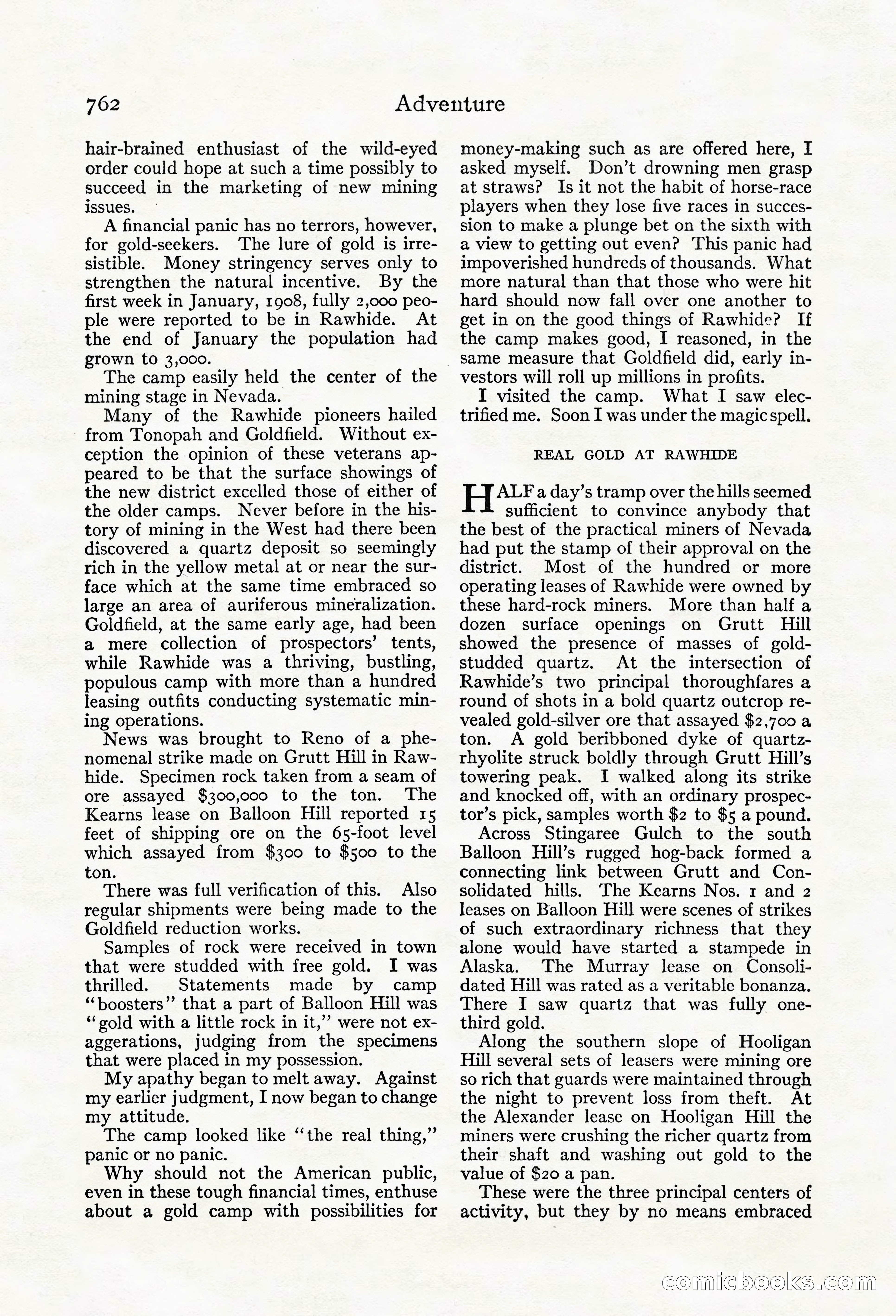
A restored page from Pulp Fiction, 1911. Page through the whole issue in the reader above.
📄 Transcribed text from this page (OCR, searchable)
Machine-transcribed from the original scan — historical spelling and the odd misread are preserved.
762 hair-brained enthusiast of the wild-eyed order could hope at such a time possibly to succeed in the marketing of new mining issues. A financial panic has no terrors, however, for gold-seekers. The lure of gold is irre- sistible. Money stringency serves only to strengthen the natural incentive. By the first week in January, 1908, fully 2,000 peo- ple were reported to be in Rawhide. At the end of January the population had grown to 3,000. The camp easily held the center of the mining stage in Nevada. Many of the Rawhide pioneers hailed from Tonopah and Goldfield. Without ex- ception the opinion of these veterans ap- peared to be that the surface showings of the new district excelled those of either of the older camps. Never before in the his- tory of mining in the West had there been discovered a quartz deposit so seemingly rich in the yellow metal at or near the sur- face which at the same time embraced so large an area of auriferous mineralization. Goldfield, at the same early age, had been a mere collection of prospectors’ tents, while Rawhide was a thriving, bustling, populous camp with more than a hundred leasing outfits conducting systematic min- ing operations. News was brought to Reno of a phe- nomenal strike made on Grutt Hill in Raw- hide. Specimen rock taken from a seam of ore assayed $300,000 to the ton. The Kearns lease on Balloon Hill reported 15 feet of shipping ore on the 65-foot level which assayed from $300 to $500 to the ton. There was full verification of this. Also regular shipments were being made to the Goldfield reduction works. Samples of rock were received in town that were studded with free gold. I was thrilled. Statements made by camp “boosters” that a part of Balloon Hill was “gold with a little rock in it,’’ were not ex- aggerations, judging from the specimens that were placed in my possession. My apathy began to melt away. Against my earlier judgment, I now began to change my attitude. The camp looked like “‘the real thing,” panic or no panic. Why should not the American public, even in these tough financial times, enthuse about a gold camp with possibilities for Adventure money-making such as are offered here, I asked myself. Don’t drowning men grasp at straws? Is it not the habit of horse-race players when they lose five races in succes- sion to make a plunge bet on the sixth with a view to getting out even? This panic had impoverished hundreds of thousands. What more natural than that those who were hit hard should now fall over one another to get in on the good things of Rawhide? If the camp makes good, I reasoned, in the same measure that Goldfield did, early in- vestors will roll up millions in profits. I visited the camp. What I saw elec- trified me. Soon I was under the magicspell. REAL GOLD AT RAWHIDE Babee a day’s tramp over the hills seemed sufficient to convince anybody that the best of the practical miners of Nevada had put the stamp of their approval on the district. Most of the hundred or more operating leases of Rawhide were owned by these hard-rock miners. More than half a dozen surface openings on Grutt Hill showed the presence of masses of gold- studded quartz. At the intersection of Rawhide’s two principal thoroughfares a round of shots in a bold quartz outcrop re- vealed gold-silver ore that assayed $2,700 a ton. A gold beribboned dyke of quartz- rhyolite struck boldly through Grutt Hill’s towering peak. I walked along its strike and knocked off, with an ordinary prospec- tor’s pick, samples worth $2 to $5 a pound. Across Stingaree Gulch to the south Balloon Hill’s rugged hog-back formed a connecting link between Grutt and Con- solidated hills. The Kearns Nos. 1 and 2 leases on Balloon Hill were scenes of strikes of such extraordinary richness that they alone would have started a stampede in Alaska. The Murray lease on Consoli- dated Hill was rated as a veritable bonanza. There I saw quartz that was fully one- third gold. Along the southern slope of Hooligan Hill several sets of leasers were mining ore so rich that guards were maintained through the night to prevent loss from theft. At the Alexander lease on Hooligan Hill the miners were crushing the richer quartz from their shaft and washing out gold to the value of $20 a pan. These were the three principal centers of activity, but they by no means embraced oO comiclbooks ©