
Pulp Fiction, 1911 · page 19 of 196
Adventure Magazine Cover — page 19: what you’re looking at
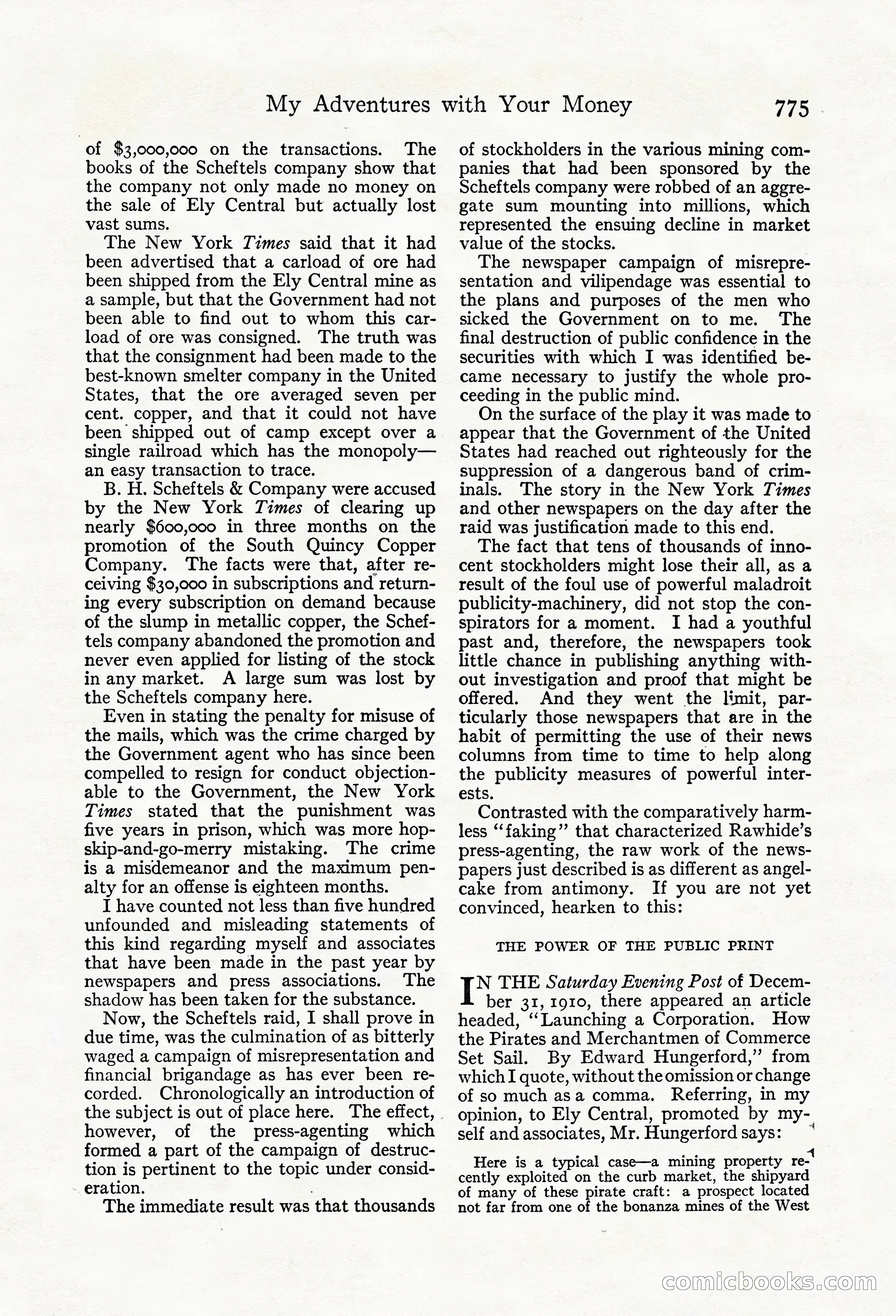
A restored page from Pulp Fiction, 1911. Page through the whole issue in the reader above.
📄 Transcribed text from this page (OCR, searchable)
Machine-transcribed from the original scan — historical spelling and the odd misread are preserved.
My Adventures with Your Money of $3,000,000 on the transactions. The books of the Scheftels company show that the company not only made no money on the sale of Ely Central but actually lost vast sums. The New York Times said that it had been advertised that a carload of ore had been shipped from the Ely Central mine as a sample, but that the Government had not been able to find out to whom this car- load of ore was consigned. The truth was that the consignment had been made to the best-known smelter company in the United States, that the ore averaged seven per cent. copper, and that it could not have been shipped out of camp except over a single railroad which has the monopoly— an easy transaction to trace. B. H. Scheftels & Company were accused by the New York Times of clearing up nearly $600,000 in three months on the promotion of the South Quincy Copper Company. ‘The facts were that, after re- ceiving $30,000 in subscriptions and return- ing every subscription on demand because of the slump in metallic copper, the Schef- tels company abandoned the promotion and never even applied for listing of the stock in any market. A large sum was lost by the Scheftels company here. Even in stating the penalty for misuse of the mails, which was the crime charged by the Government agent who has since been compelled to resign for conduct objection- able to the Government, the New York Times stated that the punishment was five years in prison, which was more hop- skip-and-go-merry mistaking. The crime is a misdemeanor and the maximum pen- alty for an offense is eighteen months. I have counted not less than five hundred unfounded and misleading statements of this kind regarding myself and associates that have been made in the past year by newspapers and press associations. The shadow has been taken for the substance. Now, the Scheftels raid, I shall prove in due time, was the culmination of as bitterly waged a campaign of misrepresentation and financial brigandage as has ever been re- corded. Chronologically an introduction of the subject is out of place here. The effect, . however, of the press-agenting which formed a part of the campaign of destruc- tion is pertinent to the topic under consid- - eration. The immediate result was that thousands of stockholders in the various mining com- panies that had been sponsored by the Scheftels company were robbed of an aggre- gate sum mounting into millions, which represented the ensuing decline in market value of the stocks. The newspaper campaign of misrepre- sentation and vilipendage was essential to the plans and purposes of the men who sicked the Government on to me. The final destruction of public confidence in the securities with which I was identified be- came necessary to justify the whole pro- ceeding in the public mind. On the surface of the play it was made to appear that the Government of the United States had reached out righteously for the suppression of a dangerous band of crim- inals. The story in the New York Times and other newspapers on the day after the raid was justification made to this end. The fact that tens of thousands of inno- cent stockholders might lose their all, as a result of the foul use of powerful maladroit publicity-machinery, did not stop the con- spirators for a moment. I had a youthful past and, therefore, the newspapers took little chance in publishing anything with- out investigation and proof that might be offered. And they went the limit, par- ticularly those newspapers that are in the habit of permitting the use of their news columns from time to time to help along the publicity measures of powerful inter- ests. Contrasted with the comparatively harm- less “faking” that characterized Rawhide’s press-agenting, the raw work of the news- papers just described is as different as angel- cake from antimony. If you are not yet convinced, hearken to this: THE POWER OF THE PUBLIC PRINT | THE Saturday Evening Post of Decem- ber 31, 1910, there appeared an article headed, ‘“‘Launching a Corporation. How the Pirates and Merchantmen of Commerce Set Sail. By Edward Hungerford,” from which I quote, without the omission or change of so much asa comma. Referring, in my opinion, to Ely Central, promoted by my- self and associates, Mr. Hungerford says: * Here is a typical case—a mining property re-! cently exploited on the curb market, the shipyard of many of these pirate craft: a prospect located not far from one of the bonanza mines of the West comicloooks 775 - CO