
Pulp Fiction, 1911 · page 18 of 196
Adventure Magazine Cover — page 18: what you’re looking at
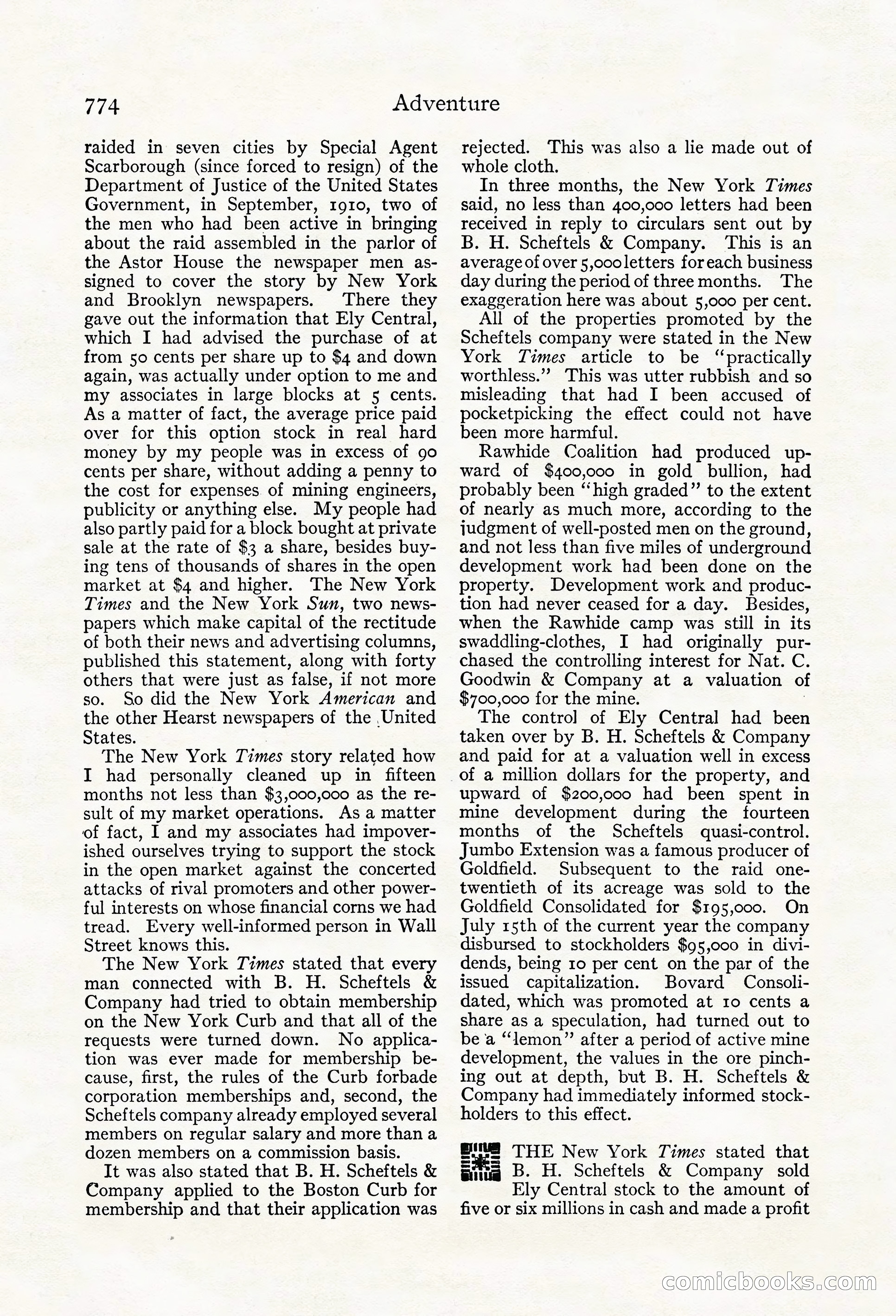
A restored page from Pulp Fiction, 1911. Page through the whole issue in the reader above.
📄 Transcribed text from this page (OCR, searchable)
Machine-transcribed from the original scan — historical spelling and the odd misread are preserved.
774 raided in seven cities by Special Agent Scarborough (since forced to resign) of the Department of Justice of the United States Government, in September, 1910, two of the men who had been active in bringing about the raid assembled in the parlor of the Astor House the newspaper men as- signed to cover the story by New York and Brooklyn newspapers. There they gave out the information that Ely Central, which I had advised the purchase of at from 50 cents per share up to $4 and down again, was actually under option to me and my associates in large blocks at 5 cents. As a matter of fact, the average price paid over for this option stock in real hard money by my people was in excess of go cents per share, without adding a penny to the cost for expenses. of mining engineers, publicity or anything else. My people had also partly paid for a block bought at private sale at the rate of $3 a share, besides buy- ing tens of thousands of shares in the open market at $4 and higher. The New York Times and the New York Sun, two news- papers which make capital of the rectitude of both their news and advertising columns, published this statement, along with forty others that were just as false, if not more so. So did the New York American and the other Hearst newspapers of the United States. The New York Times story related how I had personally cleaned up in fifteen months not less than $3,000,000 as the re- sult of my market operations. As a matter of fact, I and my associates had impover- ished ourselves trying to support the stock in the open market against the concerted attacks of rival promoters and other power- ful interests on whose financial corns we had tread. Every well-informed person in Wall Street knows this. The New York Times stated that every man connected with B. H. Scheftels & Company had tried to obtain membership on the New York Curb and that all of the requests were turned down. No applica- tion was ever made for membership be- cause, first, the rules of the Curb forbade corporation memberships and, second, the Scheftels company already employed several members on regular salary and more than a dozen members on a commission basis. It was also stated that B. H. Scheftels & Company applied to the Boston Curb for membership and that their application was Adventure rejected. This was also a lie made out of whole cloth. In three months, the New York Times said, no less than 400,000 letters had been received in reply to circulars sent out by B. H. Scheftels & Company. This is an average of over 5,oooletters foreach business day during the period of threemonths. The exaggeration here was about 5,000 per cent. All of the properties promoted by the Scheftels company were stated in the New York Times article to be “practically worthless.”” This was utter rubbish and so misleading that had I been accused of pocketpicking the effect could not have been more harmful. Rawhide Coalition had produced up- ward of $400,000 in gold bullion, had probably been “high graded” to the extent of nearly as much more, according to the judgment of well-posted men on the ground, and not less than five miles of underground development work had been done on the property. Development work and produc- tion had never ceased for a day. Besides, when the Rawhide camp was still in its swaddling-clothes, I had originally pur- chased the controlling interest for Nat. C. Goodwin & Company at a valuation of $700,000 for the mine. The control of Ely Central had been taken over by B. H. Scheftels & Company and paid for at a valuation well in excess of a million dollars for the property, and upward of $200,000 had been spent in mine development during the fourteen months of the Scheftels quasi-control. Jumbo Extension was a famous producer of Goldfield. Subsequent to the raid one- twentieth of its acreage was sold to the Goldfield Consolidated for $195,000. On July 15th of the current year the company disbursed to stockholders $95,000 in divi- dends, being 10 per cent on the par of the issued capitalization. Bovard Consoli- dated, which was promoted at 10 cents a share as a speculation, had turned out to be a “lemon” after a period of active mine development, the values in the ore pinch- ing out at depth, but B. H. Scheftels & Company had immediately informed stock- holders to this effect. re THE New York Times stated that miiitg B. H. Scheftels & Company sold Ely Central stock to the amount of five or six millions in cash and made a profit COmiclbook ©