
Pulp Fiction, 1911 · page 189 of 196
Adventure Magazine Cover — page 189: what you’re looking at
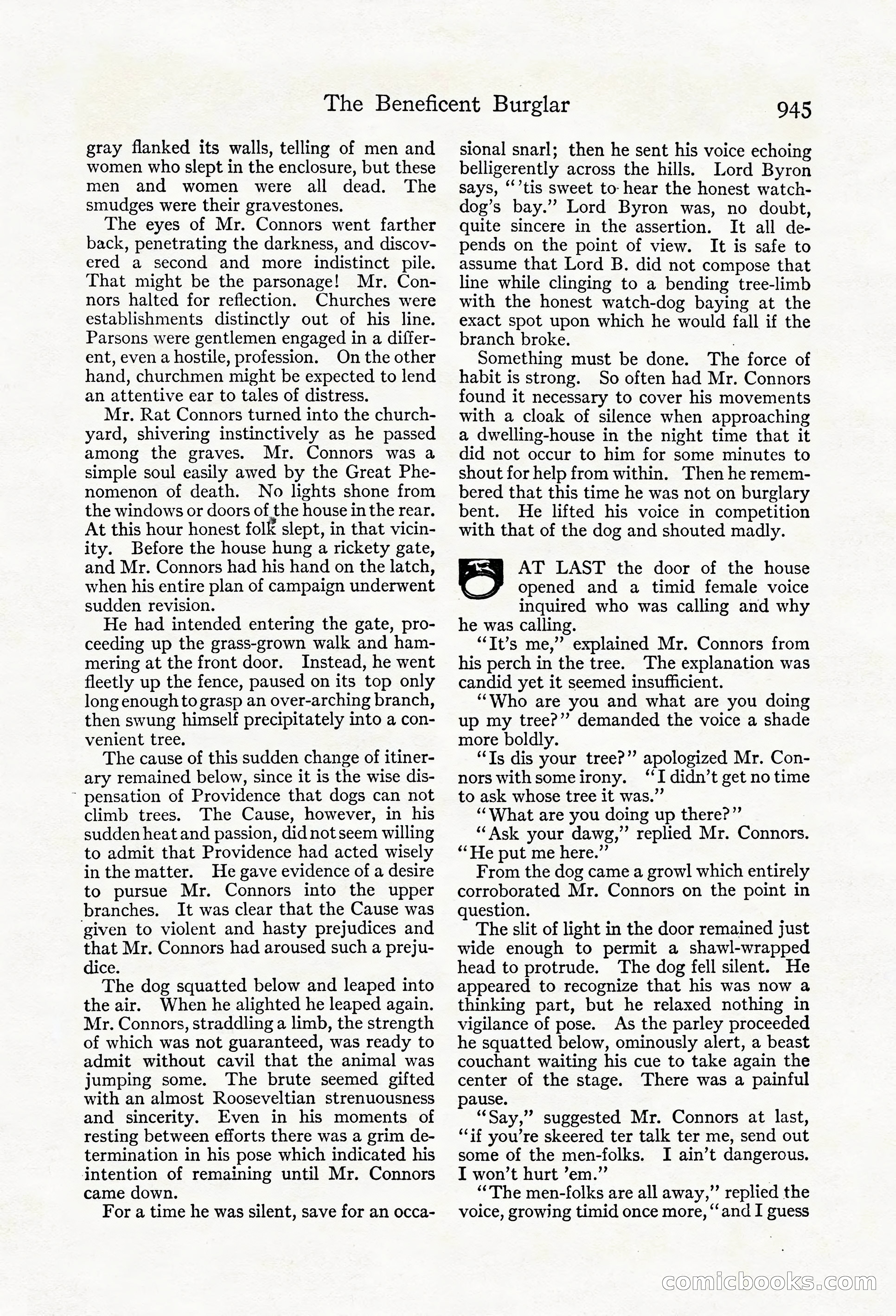
A restored page from Pulp Fiction, 1911. Page through the whole issue in the reader above.
📄 Transcribed text from this page (OCR, searchable)
Machine-transcribed from the original scan — historical spelling and the odd misread are preserved.
The Beneficent Burglar gray flanked its walls, telling of men and women who slept in the enclosure, but these men and women were all dead. The smudges were their gravestones. The eyes of Mr. Connors went farther back, penetrating the darkness, and discov- ered a second and more indistinct pile. That might be the parsonage! Mr. Con- nors halted for reflection. Churches were establishments distinctly out of his line. Parsons were gentlemen engaged in a differ- ent, even a hostile, profession. On the other hand, churchmen might be expected to lend an attentive ear to tales of distress. Mr. Rat Connors turned into the church- yard, shivering instinctively as he passed among the graves. Mr. Connors was a simple soul easily awed by the Great Phe- nomenon of death. No lights shone from the windows or doors of the house in the rear. At this hour honest folk slept, in that vicin- ity. Before the house hung a rickety gate, and Mr. Connors had his hand on the latch, when his entire plan of campaign underwent sudden revision. He had intended entering the gate, pro- ceeding up the grass-grown walk and ham- mering at the front door. Instead, he went fleetly up the fence, paused on its top only long enough to grasp an over-arching branch, then swung himself precipitately into a con- venient tree. The cause of this sudden change of itiner- ary remained below, since it is the wise dis- ~ pensation of Providence that dogs can not climb trees. The Cause, however, in his sudden heat and passion, did not seem willing to admit that Providence had acted wisely in the matter. He gave evidence of a desire to pursue Mr. Connors into the upper branches. It was clear that the Cause was given to violent and hasty prejudices and that Mr. Connors had aroused such a preju- dice. The dog squatted below and leaped into the air. When he alighted he leaped again. Mr. Connors, straddling a limb, the strength of which was not guaranteed, was ready to admit without cavil that the animal was jumping some. The brute seemed gifted with an almost Rooseveltian strenuousness and sincerity. Even in his moments of resting between efforts there was a grim de- termination in his pose which indicated his intention of remaining until Mr. Connors came down. For a time he was silent, save for an occa- 945 sional snarl; then he sent his voice echoing belligerently across the hills. Lord Byron says, “‘’tis sweet to hear the honest watch- dog’s bay.”’ Lord Byron was, no doubt, quite sincere in the assertion. It all de- pends on the point of view. It is safe to assume that Lord B. did not compose that line while clinging to a bending tree-limb with the honest watch-dog baying at the exact spot upon which he would fall if the branch broke. Something must be done. The force of habit is strong. So often had Mr. Connors found it necessary to cover his movements with a cloak of silence when approaching a dwelling-house in the night time that it did not occur to him for some minutes to shout for help from within. Then he remem- bered that this time he was not on burglary bent. He lifted his voice in competition with that of the dog and shouted madly. m= AT LAST the door of the house opened and a timid female voice inquired who was calling and why he was calling. “It’s me,” explained Mr. Connors from his perch in the tree. The explanation was candid yet it seemed insufficient. “‘Who are you and what are you doing up my tree?”? demanded the voice a shade more boldly. “Ts dis your tree?” apologized Mr. Con- nors withsomeirony. ‘‘I didn’t get no time to ask whose tree it was.” “What are you doing up there?”’ “Ask your dawg,” replied Mr. Connors. “He put me here.” From the dog came a growl which entirely corroborated Mr. Connors on the point in question. The slit of light in the door remained just wide enough to permit a shawl-wrapped head to protrude. The dog fell silent. He appeared to recognize that his was now a thinking part, but he relaxed nothing in vigilance of pose. As the parley proceeded he squatted below, ominously alert, a beast couchant waiting his cue to take again the center of the stage. There was a painful pause. “Say,” suggested Mr. Connors at last, “if you’re skeered ter talk ter me, send out some of the men-folks. I ain’t dangerous. I won’t hurt ’em.” : “The men-folks are all away,” replied the voice, growing timid once more, ‘‘and I guess oO C© MICLOOOKS CO