
Pulp Fiction, 1911 · page 188 of 196
Adventure Magazine Cover — page 188: what you’re looking at
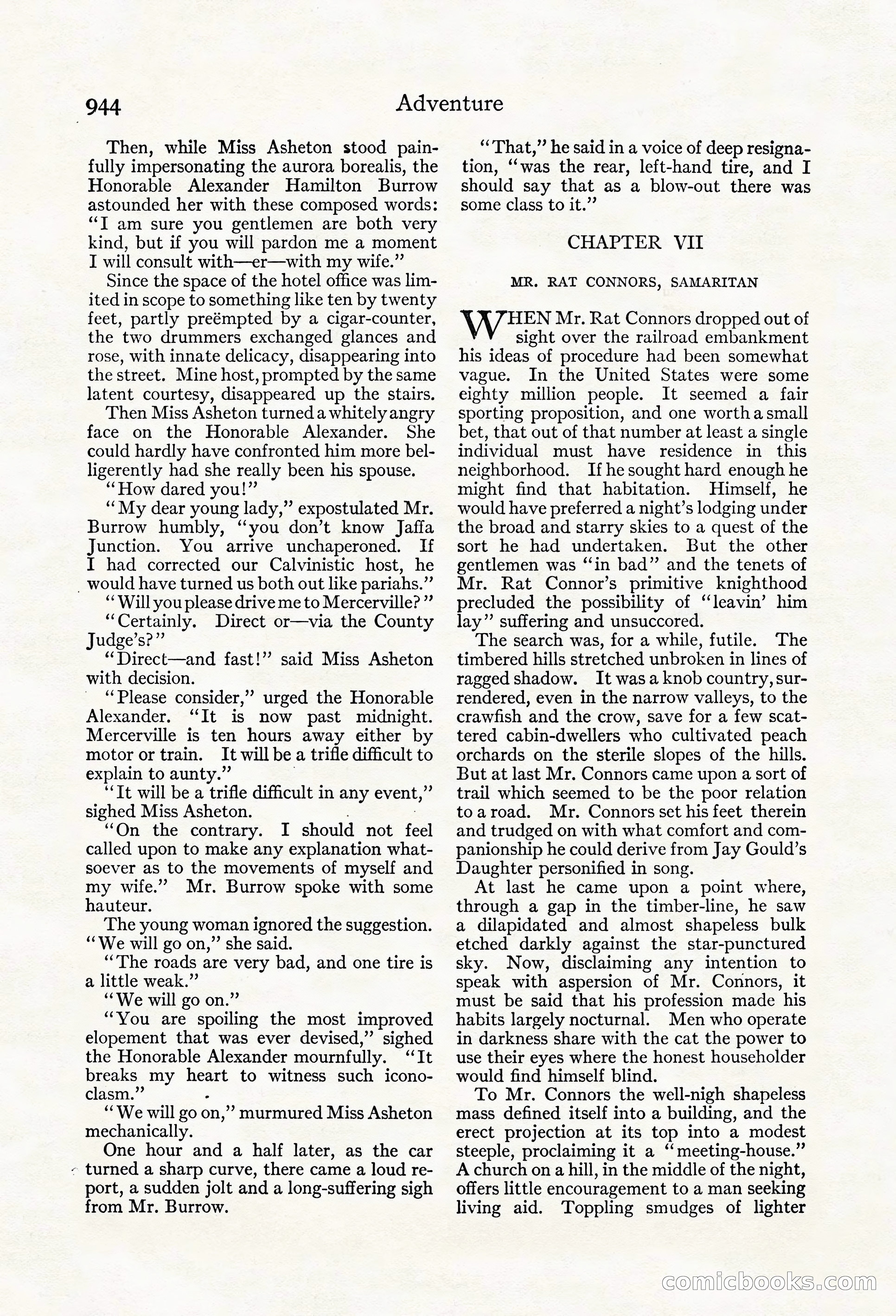
A restored page from Pulp Fiction, 1911. Page through the whole issue in the reader above.
📄 Transcribed text from this page (OCR, searchable)
Machine-transcribed from the original scan — historical spelling and the odd misread are preserved.
944 Then, while Miss Asheton stood pain- fully impersonating the aurora borealis, the Honorable Alexander Hamilton Burrow astounded her with these composed words: “T am sure you gentlemen are both very kind, but if you will pardon me a moment I will consult with—er—with my wife.” Since the space of the hotel office was lim- ited in scope to something like ten by twenty feet, partly preémpted by a cigar-counter, the two drummers exchanged glances and rose, with innate delicacy, disappearing into the street. Mine host, prompted by the same latent courtesy, disappeared up the stairs. Then Miss Asheton turned a whitely angry face on the Honorable Alexander. She could hardly have confronted him more bel- ligerently had she really been his spouse. “How dared you!” ‘““My dear young lady,” expostulated Mr. Burrow humbly, ‘you don’t know Jaffa Junction. You arrive unchaperoned. If I had corrected our Calvinistic host, he _ would have turned us both out like pariahs.”’ ‘Will you please drive me to Mercerville? ”’ “Certainly. Direct or—via the County Judge’s?”’ “Direct—and fast!”’ said Miss Asheton with decision. ‘‘Please consider,’ urged the Honorable Alexander. “It is now past midnight. Mercerville is ten hours away either by motor or train. It will be a trifle difficult to explain to aunty.” ‘Tt will be a trifle difficult in any event,” sighed Miss Asheton. “On the contrary. I should not feel called upon to make any explanation what- soever as to the movements of myself and my wife.” Mr. Burrow spoke with some hauteur. The young woman ignored the suggestion. “We will go on,” she said. “The roads are very bad, and one tire is a little weak.” ‘“We will go on.” “You are spoiling the most improved elopement that was ever devised,” sighed the Honorable Alexander mournfully. “It breaks my heart to witness such icono- clasm.” “We will 60.0 on,’ murmured Miss Asheton mechanically. One hour and a half later, as the car - turned a sharp curve, there came a loud re- port, a sudden jolt and a long-suffering sigh from Mr. Burrow. 9) Adventure “That,” he said in a voice of deep resigna- tion, ‘was the rear, left-hand tire, and I should say that as a blow-out there was some class to it.” CHAPTER VII MR. RAT CONNORS, SAMARITAN Vi Mr. Rat Connors dropped out of sight over the railroad embankment his ideas of procedure had been somewhat vague. In the United States were some eighty million people. It seemed a fair sporting proposition, and one wortha small bet, that out of that number at least a single individual must have residence in this neighborhood. If hesought hard enough he might find that habitation. Himself, he would have preferred a night’s lodging under the broad and starry skies to a quest of the sort he had undertaken. But the other gentlemen was “in bad” and the tenets of Mr. Rat Connor’s primitive knighthood precluded the possibility of “‘leavin’ him lay”’ suffering and unsuccored. The search was, for a while, futile. The timbered hills stretched unbroken in lines of ragged shadow. It wasa knob country, sur- rendered, even in the narrow valleys, to the crawfish and the crow, save for a few scat- tered cabin-dwellers who cultivated peach orchards on the sterile slopes of the hills. But at last Mr. Connors came upon a sort of trail which seemed to be the poor relation toaroad. Mr. Connors set his feet therein and trudged on with what comfort and com- panionship he could derive from Jay Gould’s Daughter personified in song. At last he came upon a point where, through a gap in the timber-line, he saw a dilapidated and almost shapeless bulk etched darkly against the star-punctured sky. Now, disclaiming any intention to speak with aspersion of Mr. Connors, it must be said that his profession made his habits largely nocturnal. Men who operate in darkness share with the cat the power to use their eyes where the honest householder would find himself blind. To Mr. Connors the well-nigh shapeless mass defined itself into a building, and the erect projection at its top into a modest steeple, proclaiming it a ‘‘meeting-house.”’ A church on a hill, in the middle of the night, offers little encouragement to a man seeking living aid. Toppling smudges of lighter Comiclbooks C©