
Pulp Fiction, 1911 · page 130 of 196
Adventure Magazine Cover — page 130: what you’re looking at
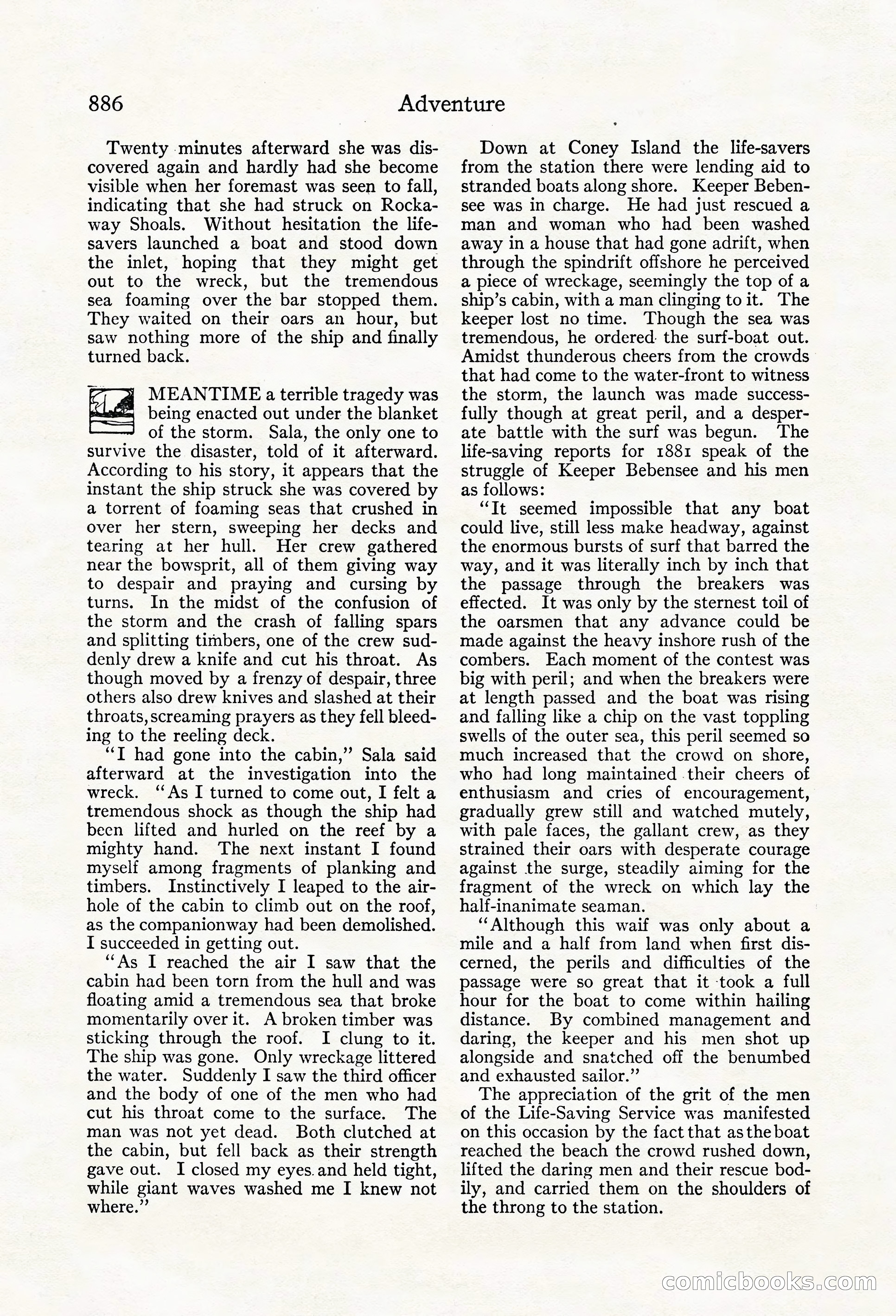
A restored page from Pulp Fiction, 1911. Page through the whole issue in the reader above.
📄 Transcribed text from this page (OCR, searchable)
Machine-transcribed from the original scan — historical spelling and the odd misread are preserved.
886 Twenty minutes afterward she was dis- covered again and hardly had she become visible when her foremast was seen to fall, indicating that she had struck on Rocka- way Shoals. Without hesitation the life- savers launched a boat and stood down the inlet, hoping that they might get out to the wreck, but the tremendous sea foaming over the bar stopped them. They waited on their oars an hour, but saw nothing more of the ship and finally turned back. Cl MEANTIME a terrible tragedy was petktl being enacted out under the blanket — J of the storm. Sala, the only one to survive the disaster, told of it afterward. According to his story, it appears that the instant the ship struck she was covered by a torrent of foaming seas that crushed in over her stern, sweeping her decks and tearing at her hull. Her crew gathered near the bowsprit, all of them giving way to despair and praying and cursing by turns. In the midst of the confusion of the storm and the crash of falling spars and splitting timbers, one of the crew sud- denly drew a knife and cut his throat. As though moved by a frenzy of despair, three others also drew knives and slashed at their throats, screaming prayers as they fell bleed- ing to the reeling deck. “‘T had gone into the cabin,” Sala said afterward at the investigation into the wreck. “As I turned to come out, I felt a tremendous shock as though the ship had been lifted and hurled on the reef by a mighty hand. The next instant I found myself among fragments of planking and timbers. Instinctively I leaped to the air- hole of the cabin to climb out on the roof, as the companionway had been demolished. I succeeded in getting out. ““As I reached the air I saw that the cabin had been torn from the hull and was floating amid a tremendous sea that broke momentarily over it. A broken timber was sticking through the roof. I clung to it. The ship was gone. Only wreckage littered the water. Suddenly I saw the third officer and the body of one of the men who had cut his throat come to the surface. The man was not yet dead. Both clutched at the cabin, but fell back as their strength gave out. I closed my eyes.and held tight, while giant waves washed me I knew not where.” Adventure Down at Coney Island the life-savers from the station there were lending aid to stranded boats along shore. Keeper Beben- see was in charge. He had just rescued a man and woman who had been washed away in a house that had gone adrift, when through the spindrift offshore he perceived a piece of wreckage, seemingly the top of a ship’s cabin, with a man clinging toit. The keeper lost no time. Though the sea was tremendous, he ordered: the surf-boat out. Amidst thunderous cheers from the crowds that had come to the water-front to witness the storm, the launch was made success- fully though at great peril, and a desper- ate battle with the surf was begun. ‘The life-saving reports for 1881 speak of the struggle of Keeper Bebensee and his men as follows: “Tt seemed impossible that any boat could live, still less make headway, against the enormous bursts of surf that barred the way, and it was literally inch by inch that the passage through the breakers was effected. It was only by the sternest toil of the oarsmen that any advance could be made against the heavy inshore rush of the combers. Each moment of the contest was big with peril; and when the breakers were at length passed and the boat was rising and falling like a chip on the vast toppling swells of the outer sea, this peril seemed so much increased that the crowd on shore, who had long maintained their cheers of enthusiasm and cries of encouragement, gradually grew still and watched mutely, with pale faces, the gallant crew, as they strained their oars with desperate courage against the surge, steadily aiming for the fragment of the wreck on which lay the half-inanimate seaman. “Although this waif was only about a mile and a half from land when first dis- cerned, the perils and difficulties of the passage were so great that it took a full hour for the boat to come within hailing distance. By combined management and daring, the keeper and his men shot up alongside and snatched off the benumbed and exhausted sailor.”’ The appreciation of the grit of the men of the Life-Saving Service was manifested on this occasion by the fact that asthe boat reached the beach the crowd rushed down, lifted the daring men and their rescue bod- ily, and carried them on the shoulders of the throng to the station. CO MICLOOOKS ©