
Pulp Fiction, 1911 · page 129 of 196
Adventure Magazine Cover — page 129: what you’re looking at
A restored page from Pulp Fiction, 1911. Page through the whole issue in the reader above.
📄 Transcribed text from this page (OCR, searchable)
Machine-transcribed from the original scan — historical spelling and the odd misread are preserved.
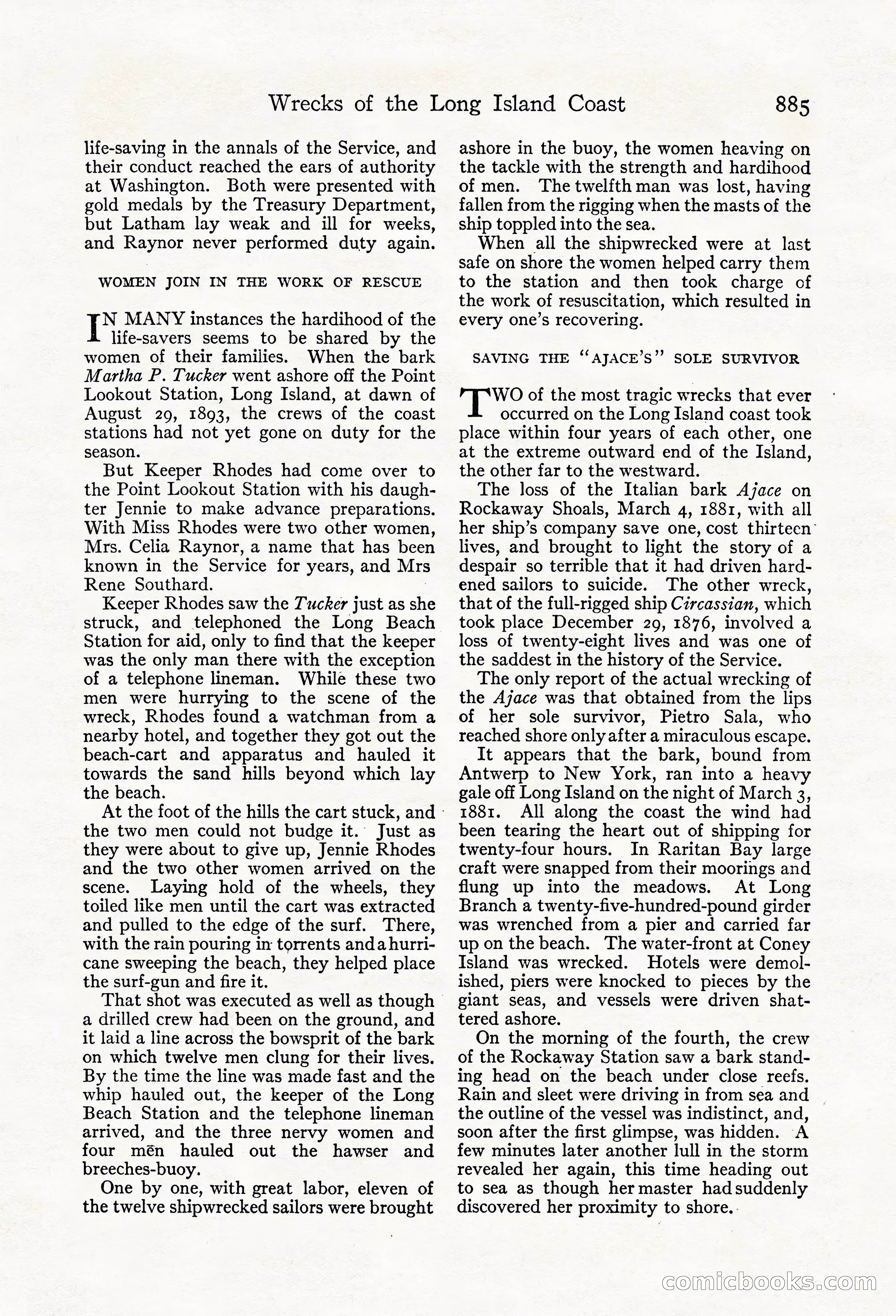
Wrecks of the Long Island Coast life-saving in the annals of the Service, and their conduct reached the ears of authority at Washington. Both were presented with gold medals by the Treasury Department, but Latham lay weak and ill for weeks, and Raynor never performed duty again. WOMEN JOIN IN THE WORK OF RESCUE N MANY instances the hardihood of the life-savers seems to be shared by the women of their families. When the bark Martha P. Tucker went ashore off the Point Lookout Station, Long Island, at dawn of August 29, 1893, the crews of the coast stations had not yet gone on duty for the season. But Keeper Rhodes had come over to the Point Lookout Station with his daugh- ter Jennie to make advance preparations. With Miss Rhodes were two other women, Mrs. Celia Raynor, a name that has been known in the Service for years, and Mrs Rene Southard. 3 Keeper Rhodes saw the Tucker just as she struck, and telephoned the Long Beach Station for aid, only to find that the keeper was the only man there with the exception of a telephone lineman. While these two men were hurrying to the scene of the wreck, Rhodes found a watchman from a nearby hotel, and together they got out the beach-cart and apparatus and hauled it towards the sand hills beyond which lay the beach. At the foot of the hills the cart stuck, and - the two men could not budge it. Just as they were about to give up, Jennie Rhodes and the two other women arrived on the scene. Laying hold of the wheels, they toiled like men until the cart was extracted and pulled to the edge of the surf. There, with the rain pouring in torrents anda hurri- cane sweeping the beach, they helped place the surf-gun and fire it. That shot was executed as well as though > a drilled crew had been on the ground, and it laid a line across the bowsprit of the bark on which twelve men clung for their lives. By the time the line was made fast and the whip hauled out, the keeper of the Long Beach Station and the telephone lineman arrived, and the three nervy women and four mén hauled out the hawser and breeches-buoy. One by one, with great labor, eleven of the twelve shipwrecked sailors were brought 885 ashore in the buoy, the women heaving on the tackle with the strength and hardihood of men. The twelfth man was lost, having fallen from the rigging when the masts of the ship toppled into the sea. When all the shipwrecked were at last safe on shore the women helped carry them to the station and then took charge of the work of resuscitation, which resulted in every one’s recovering. SAVING THE ‘‘AJACE’S’’ SOLE SURVIVOR ae of the most tragic wrecks that ever occurred on the Long Island coast took place within four years of each other, one at the extreme outward end of the Island, the other far to the westward. The loss of the Italian bark Ajace on Rockaway Shoals, March 4, 1881, with all her ship’s company save one, cost thirteen’ lives, and brought to light the story of a despair so terrible that it had driven hard- ened sailors to suicide. The other wreck, that of the full-rigged ship Circassian, which took place December 29, 1876, involved a loss of twenty-eight lives and was one of the saddest in the history of the Service. The only report of the actual wrecking of the Ajace was that obtained from the lips of her sole survivor, Pietro Sala, who reached shore only after a miraculous escape. It appears that the bark, bound from Antwerp to New York, ran into a heavy gale off Long Island on the night of March 3, 1881. All along the coast the wind had been tearing the heart out of shipping for twenty-four hours. In Raritan Bay large craft were snapped from their moorings and flung up into the meadows. At Long Branch a twenty-five-hundred-pound girder was wrenched from a pier and carried far up on the beach. The water-front at Coney Island was wrecked. Hotels were demol- ished, piers were knocked to pieces by the giant seas, and vessels were driven shat- tered ashore. On the morning of the fourth, the crew of the Rockaway Station saw a bark stand- ing head on the beach under close reefs. Rain and sleet were driving in from sea and the outline of the vessel was indistinct, and, soon after the first glimpse, was hidden. A few minutes later another lull in the storm revealed her again, this time heading out to sea as though her master had suddenly discovered her proximity to shore. . COmiclbook ©