
Pulp Fiction, 1911 · page 171 of 196
Adventure, June 1911 — page 171: what you’re looking at
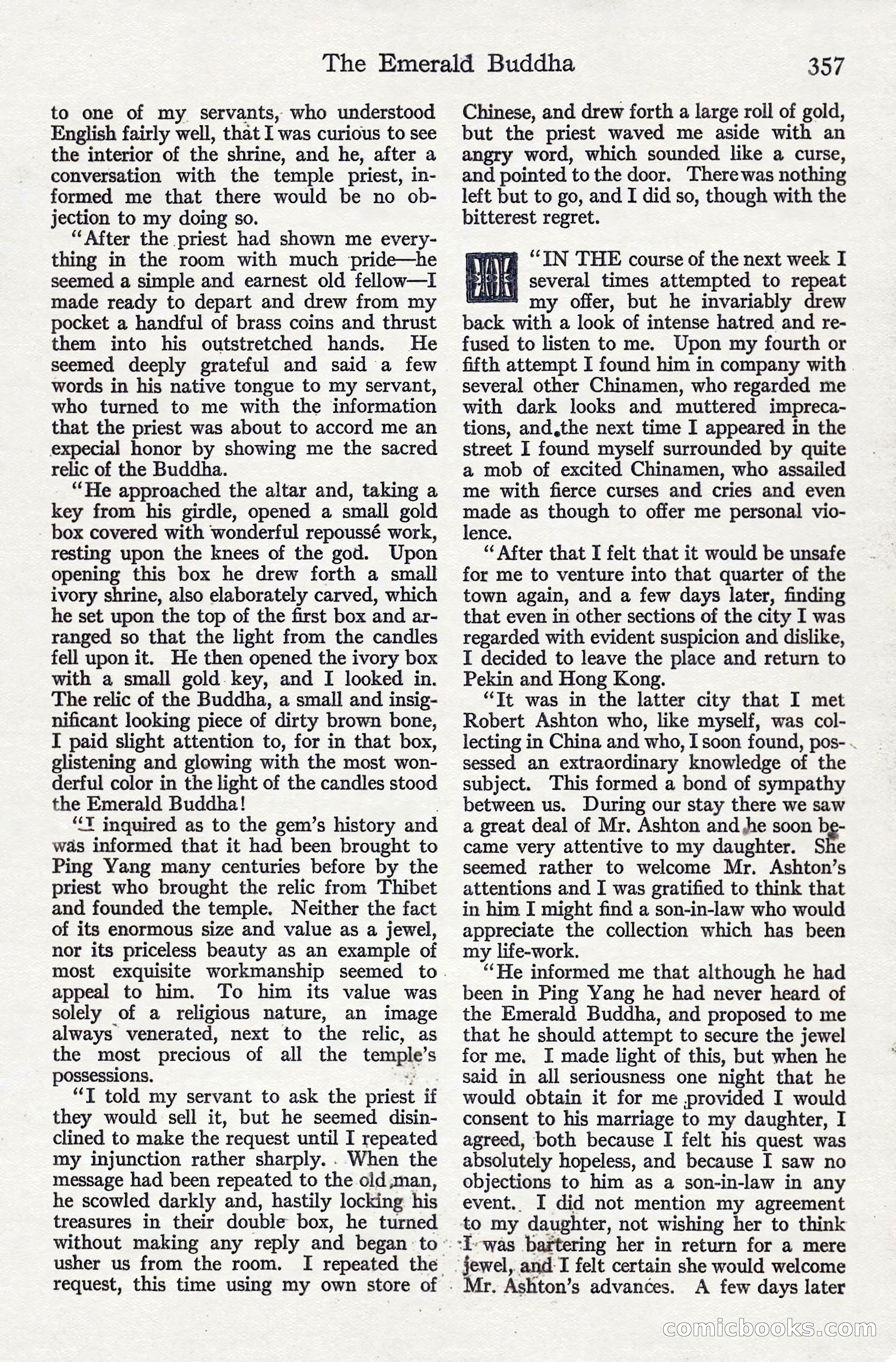
A restored page from Pulp Fiction, 1911. Page through the whole issue in the reader above.
📄 Transcribed text from this page (OCR, searchable)
Machine-transcribed from the original scan — historical spelling and the odd misread are preserved.
The Emerald Buddha to one of my servants, who understood English fairly well, that I was curious to see the interior of the shrine, and he, after a conversation with the temple priest, in- formed me that there would be no ob- jection to my doing so. “After the priest had shown me every- thing in the room with much pride—he seemed a simple and earnest old fellow—I made ready to depart and drew from my pocket a handful of brass coins and thrust them into his outstretched hands. He seemed deeply grateful and said a few words in his native tongue to my servant, who turned to me with the information that the priest was about to accord me an expecial honor by showing me the sacred relic of the Buddha. “He approached the altar and, taking a key from his girdle, opened a small gold box covered with wonderful repoussé work, resting upon the knees of the god. Upon opening this box he drew forth a small ivory shrine, also elaborately carved, which he set upon the top of the first box and ar- ranged so that the light from the candles fell upon it. He then opened the ivory box with a small gold. key, and I looked in. The relic of the Buddha, a small and insig- nificant looking piece of dirty brown bone, I paid slight attention to, for in that box, glistening and glowing with the most won- derful color in the light of the candles stood the Emerald Buddha! ‘Tt inquired as to the gem’s history and was informed that it had been brought to Ping Yang many centuries before by the priest who brought the relic from Thibet and founded the temple. Neither the fact of its enormous size and value as a jewel, nor its priceless beauty as an example of most exquisite workmanship seemed to. appeal to him. To him its value was solely of a religious nature, an image always venerated, next to the relic, as the most precious of all the temple “ possessions. “T told my servant to ask the priest if they would sell it, but he seemed disin- clined to make the ‘request until I repeated my injunction rather sharply. . When the message had been repeated to the oldman, he scowled darkly and, hastily locking his treasures in their double box, he turned without making any reply and began to’ usher us from the room. [I repeated the request, this time using my own store of . 357 Chinese, and drew forth a large roll of gold, but the priest waved me aside with an angry word, which sounded like a curse, and pointed : tothe door. There was nothing left but to go, and I did so, though with the bitterest regret. “IN THE course of the next week I several times attempted to repeat * my offer, but he invariably drew ae with a look of intense hatred and re- fused to listen to me. Upon my fourth or fifth attempt I found him in company with several other Chinamen, who regarded me with dark looks and muttered impreca- tions, and,the next time I appeared in the street I found myself surrounded by quite a mob of excited Chinamen, who assailed me with fierce curses and cries and even made as though to offer me personal vio- lence. “‘ After that I felt that it would be unsafe for me to venture into that quarter of the town again, and a few days later, finding that even in other sections of the city I was regarded with evident suspicion and dislike, I decided to leave the place and return to Pekin and Hong Kong. “Tt was in the latter city that I met Robert Ashton who, like myself, was col- lecting in China and who, I soon found, pos- . sessed an extraordinary knowledge of the subject. This formed a bond of sympathy between us. During our stay there we saw a great deal of Mr. Ashton and he soon be- came very attentive to my daughter. She seemed rather to welcome Mr. Ashton’s attentions and I was gratified to think that in him I might find a son-in-law who would appreciate the collection which has been my life-work. “He informed me that although he had been in Ping Yang he had never heard of the Emerald Buddha, and proposed to me that he should attempt to secure the jewel for me. I made light of this, but when he said in all seriousness one night that he would obtain it for me provided I would consent to his marriage to my daughter, I agreed, both because I felt his quest was absolutely hopeless, and because I saw no objections to him as a son-in-law in any event. I did not mention my agreement to my daughter, not wishing her to think ‘-I- was bartering her in return for a mere jewel, and I felt certain she would welcome Mr, Ashton’s advances. A few days later Go NOOKS ANUC (C@