
Pulp Fiction, 1911 · page 170 of 196
Adventure, June 1911 — page 170: what you’re looking at
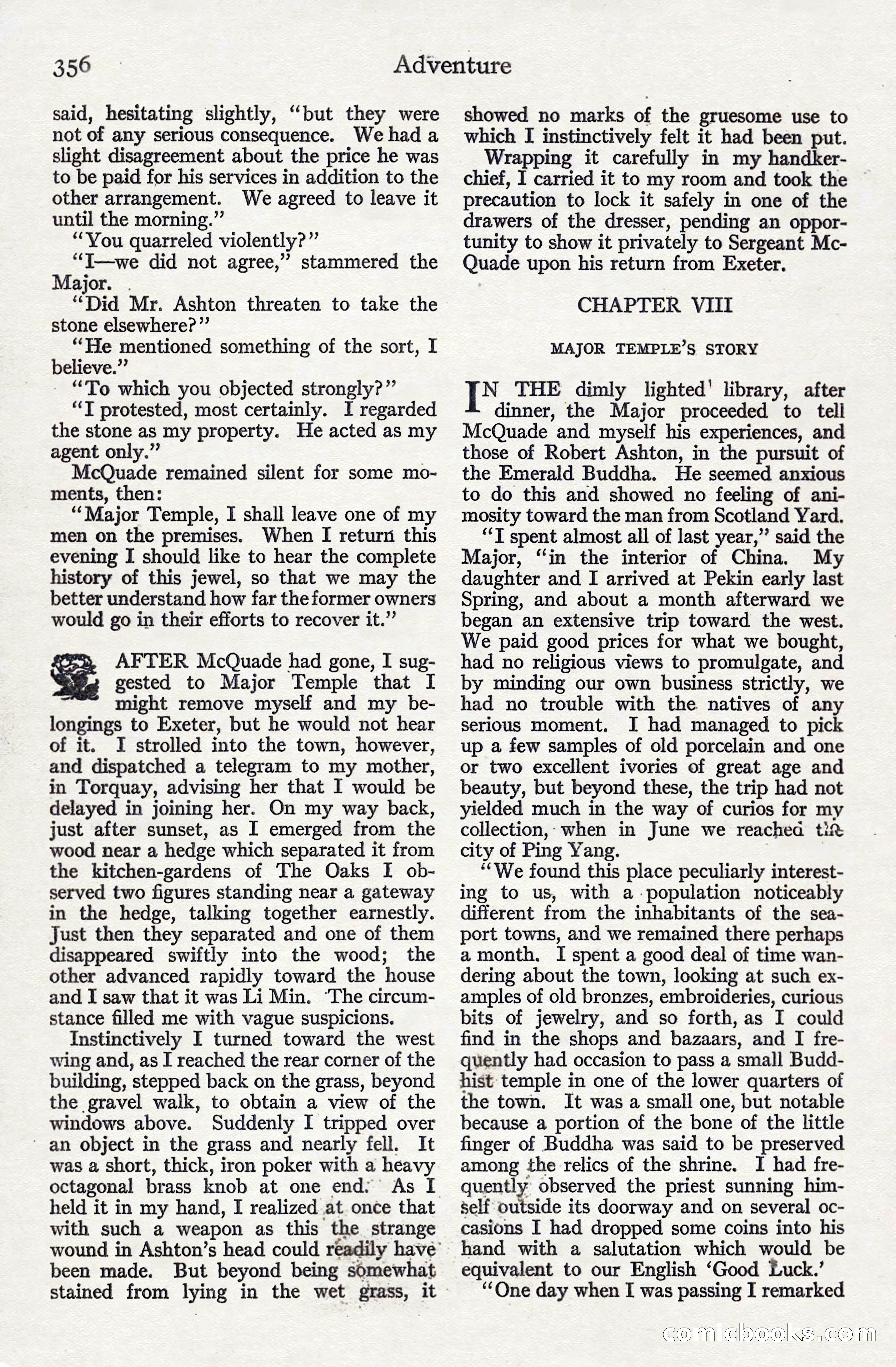
A restored page from Pulp Fiction, 1911. Page through the whole issue in the reader above.
📄 Transcribed text from this page (OCR, searchable)
Machine-transcribed from the original scan — historical spelling and the odd misread are preserved.
356 said, hesitating slightly, ‘but they were not of any serious consequence. Wehad a slight disagreement about the price he was to be paid for his services in addition to the other arrangement. We agreed to leave it until the morning.” ‘You quarreled violently?”’ “‘I—we did not agree,’ stammered the Major. . “Did Mr. Ashton threaten to take the stone elsewhere?”’ “He mentioned something of the sort, I believe.”’ “To which you objected strongly?” “T protested, most certainly. I regarded the stone as my property. He acted as my agent only.” McQuade remained silent for some mo- ments, then: ‘Major Temple, I shall leave one of my men on the premises. When I return this evening I should like to hear the complete history of this jewel, so that we may the better understand how far the former owners would go in their efforts to recover it.” 5 AFTER McQuade had gone, I sug- gested to Major Temple that I might remove myself and my be- longings to Exeter, but he would not hear of it. I strolled into the town, however, and dispatched a telegram to my mother, in Torquay, advising her that I would be delayed in joining her. On my way back, just after sunset, as I emerged from the wood near a hedge which separated it from the kitchen-gardens of The Oaks I ob- served two figures standing near a gateway in the hedge, talking together earnestly. Just then they separated and one of them disappeared swiftly into the wood; the other advanced rapidly toward the house and I saw that it was Li Min. ‘The circum- stance filled me with vague suspicions. Instinctively I turned toward the west wing and, as I reached the rear corner of the building, stepped back on the grass, beyond the gravel walk, to obtain a view of the windows above. Suddenly I tripped over ' an object in the grass and nearly fell. It was a short, thick, iron poker with a heavy octagonal brass knob at one end: As I held it in my hand, I realized at once that with such a weapon as this the strange wound in Ashton’s head could readily have’ been made. But beyond being somewhat stained from lying in the wet ass, ee Adventure showed no marks of the gruesome use to which I instinctively felt it had been put. Wrapping it carefully in my handker- chief, I carried it to my room and took the precaution to lock it safely in one of the drawers of the dresser, pending an oppor- tunity to show it privately to Sergeant Mc- Quade upon his return from Exeter. CHAPTER VIII MAJOR TEMPLE’S STORY 1X THE dimly lighted’ library, after dinner, the Major proceeded to tell McQuade and myself his experiences, and those of Robert Ashton, in the pursuit of the Emerald Buddha. He seemed anxious to do this and showed no feeling of ani- mosity toward the man from Scotland Yard. “I spent almost all of last year,’’ said the Major, “in the interior of China. My daughter and I arrived at Pekin early last Spring, and about a month afterward we began an extensive trip toward the west. We paid good prices for what we bought, had no religious views to promulgate, and by minding our own business strictly, we had no trouble with the natives of any serious moment. I had managed to pick up a few samples of old porcelain and one or two excellent ivories of great age and beauty, but beyond these, the trip had not yielded much in the way of curios for my collection,- when in June we reached t& city of Ping Yang. ‘We found this place peculiarly interest- ing to us, with a population noticeably different from the inhabitants of the sea- port towns, and we remained there perhaps a month. I spent a good deal of time wan- dering about the town, looking at such ex- amples of old bronzes, embroideries, curious bits of jewelry, and so forth, as I could find in the shops and bazaars, and I fre- quently had occasion to pass a small Budd- hist temple in one of the lower quarters of the town. It was a small one, but notable because a portion of the bone of the little finger of Buddha was said to be preserved among the relics of the shrine. I had fre- quently: observed the priest sunning him- self outside its doorway and on several oc- casions I had dropped some coins into his hand with a salutation which would be equivalent to our English ‘Good Luck.’ ‘“‘One day when I was passing I remarked Gomicbdookseeo