
Pulp Fiction, 1911 · page 144 of 196
Adventure, June 1911 — page 144: what you’re looking at
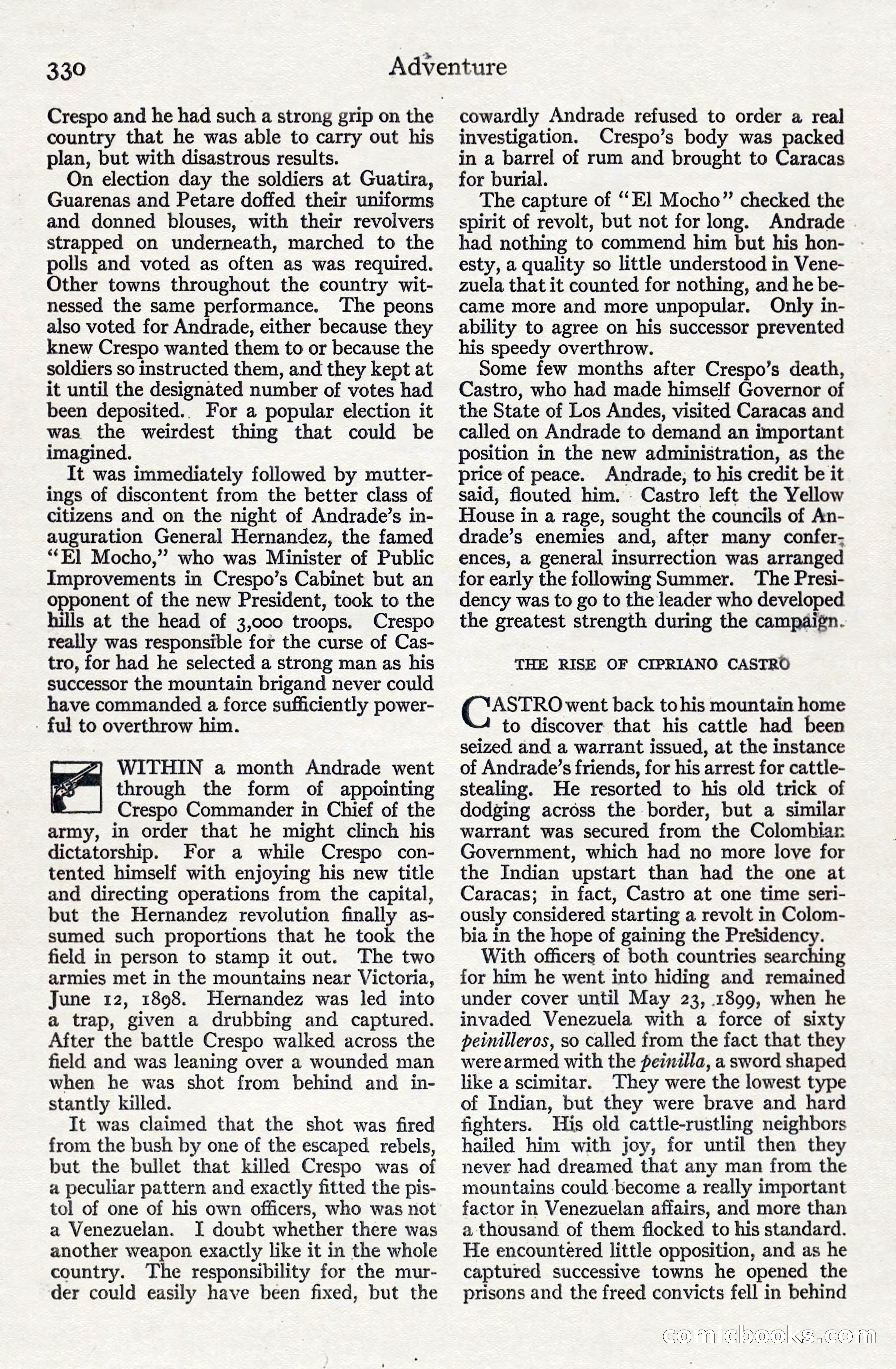
A restored page from Pulp Fiction, 1911. Page through the whole issue in the reader above.
📄 Transcribed text from this page (OCR, searchable)
Machine-transcribed from the original scan — historical spelling and the odd misread are preserved.
330 Crespo and he had such a strong grip on the country that he was able to carry out his plan, but with disastrous results. On election day the soldiers at Guatira, Guarenas and Petare doffed their uniforms and donned blouses, with their revolvers strapped on underneath, marched to the polls and voted as often as was required. Other towns throughout the country wit- nessed the same performance. ‘The peons also voted for Andrade, either because they knew Crespo wanted them to or because the soldiers so instructed them, and they kept at it until the designated number of votes had been deposited.. For a popular election it was. the weirdest thing that could be imagined. It was immediately followed by mutter- ings of discontent from the better class of citizens and on the night of Andrade’s in- auguration General Hernandez, the famed “El Mocho,” who was Minister of Public Improvements in Crespo’s Cabinet but an opponent of the new President, took to the hills at the head of 3,000 troops. Crespo really was responsible for the curse of Cas- tro, for had he selected a strong man as his successor the mountain brigand never could have commanded a force sufficiently power- - ful to overthrow him. eg WITHIN a month Andrade went aa through the form of appointing | Crespo Commander in Chief of the army, in order that he might clinch his dictatorship. For a while Crespo con- tented himself with enjoying his new title and directing operations from the capital, but the Hernandez revolution finally as- sumed such proportions that he took the field in person to stamp it out. The two armies met in the mountains near Victoria, June 12, 1898. Hernandez was led into a trap, given a drubbing and captured. Aiter the battle Crespo walked across the field and was leaning over a wounded man when he was shot from behind and in- stantly killed. Tt was claimed that the shot was fired from the bush by one of the escaped rebels, but the bullet that killed Crespo was of a peculiar pattern and exactly fitted the pis- tol of one of his own officers, who was not a Venezuelan. I doubt whether there was another weapon exactly like it in the whole country. The responsibility for the mur- der could easily have been fixed, but the Adventure cowardly Andrade refused to order a real investigation. Crespo’s body was packed in a barrel of rum and brought to Caracas for burial. The capture of “El Mocho” checked the spirit of revolt, but not for long. Andrade had nothing to commend him but his hon- - esty, a quality so little understood in Vene- zuela that it counted for nothing, and he be- came more and more unpopular. Only in- ability to agree on his successor prevented his speedy overthrow. Some few months after Crespo’s death, Castro, who had made himself Governor of the State of Los Andes, visited Caracas and called on Andrade to demand an important position in the new administration, as the price of peace. Andrade, to his credit be it said, flouted him. - Castro left the Yellow House in a rage, sought the councils of An- drade’s enemies and, after many confer- ences, a general insurrection was arranged for early the following Summer. The Presi- dency was to go to the leader who developed the greatest strength during the campdifn. THE RISE OF CIPRIANO CASTRO ASTRO went back tohis mountain home to discover that his cattle had been seized and a warrant issued, at the instance of Andrade’s friends, for his arrest for cattle- stealing. He resorted to his old trick of dodging across the border, but a similar warrant was secured from the Colombiar Government, which had no more love for the Indian upstart than had the one at Caracas; in fact, Castro at one time seri- ously considered starting a revolt in Colom- bia in the hope of gaining the Presidency. With officers of both countries searching for him he went into hiding and remained under cover until May 23, 1899, when he invaded Venezuela with a force of sixty peintlleros, so called from the fact that they werearmed with the peznilla, a sword shaped like a scimitar. They were the lowest type of Indian, but they were brave and hard fighters. His old cattle-rustling neighbors hailed him with joy, for until then they never had dreamed that any man from the mountains could become a really important factor in Venezuelan affairs, and more than a thousand of them flocked to his standard. He encountered little opposition, and as he captured successive towns he opened the prisons and the freed convicts fell in behind GO OOO) AMUG SoCO