
Pulp Fiction, 1911 · page 143 of 196
Adventure, June 1911 — page 143: what you’re looking at
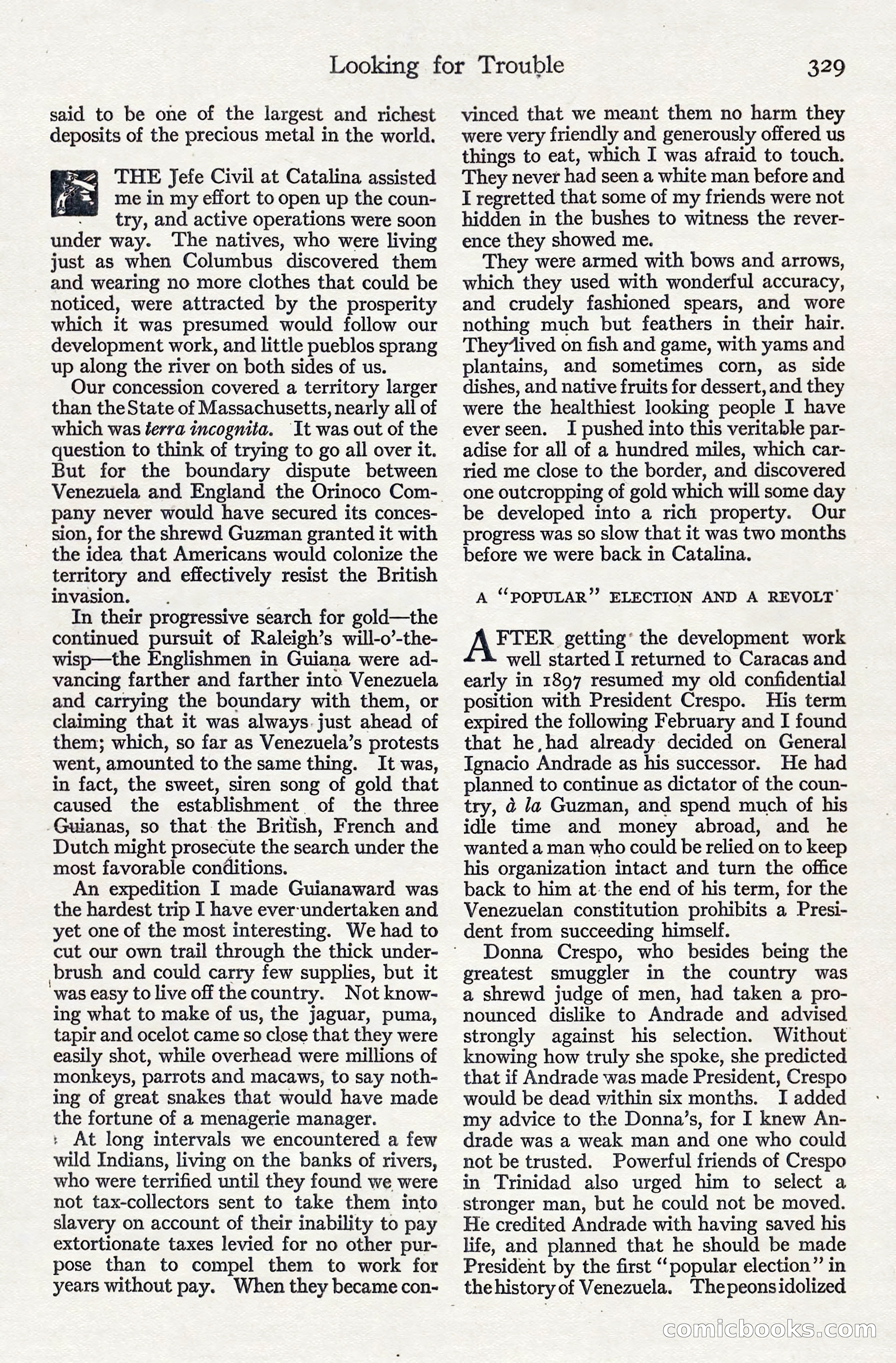
A restored page from Pulp Fiction, 1911. Page through the whole issue in the reader above.
📄 Transcribed text from this page (OCR, searchable)
Machine-transcribed from the original scan — historical spelling and the odd misread are preserved.
Looking for Trouble said to be one of the largest and richest deposits of the precious metal in the world. 1 THE Jefe Civil at Catalina assisted me in my effort to open up the coun- - try, and active operations were soon under way. ‘The natives, who were living just as when Columbus discovered them and wearing no more clothes that could be noticed, were attracted by the prosperity which it was presumed would follow our development work, and little pueblos sprang up along the river on both sides of us. Our concession covered a territory larger than theState of Massachusetts, nearly all of which was derra incognita. It was out of the question to think of trying to go all over it. But for the boundary dispute between Venezuela and England the Orinoco Com- pany never would have secured its conces- sion, for the shrewd Guzman granted it with the idea that Americans would colonize the territory and effectively resist the British invasion. In their progressive search for gold—the continued pursuit of Raleigh’s will-o’-the- wisp—the Englishmen in Guiana were ad- vancing farther and farther into Venezuela and carrying the boundary with them, or claiming that it was always.just ahead of them; which, so far as Venezuela’s protests went, amounted to the same thing. It was, in fact, the sweet, siren song of gold that caused the establishment of the three Guianas, so that the British, French and Dutch might prosecute the search under the most favorable conditions. An expedition I made Guianaward was the hardest trip I have ever-undertaken and yet one of the most interesting. We had to cut our own trail through the thick under- © brush and could carry few supplies, but it was easy to live off the country. Not know- ing what to make of us, the jaguar, puma, tapir and ocelot came so close that they were easily shot, while overhead were millions of monkeys, parrots and macaws, to say noth- ing of great snakes that would have made the fortune of a menagerie manager. : At long intervals we encountered a few wild Indians, living on the banks of rivers, who were terrified until they found we were not tax-collectors sent to take them into slavery on account of their inability to pay extortionate taxes levied for no other pur- pose than to compel them to work for years without pay. When they became con- 329 vinced that we meant them no harm they were very friendly and generously offered us things to eat, which I was afraid to touch. They never had seen a white man before and I regretted that some of my friends were not hidden in the bushes to witness the rever- ence they showed me. They were armed with bows and arrows, which they used with wonderful accuracy, and crudely fashioned spears, and wore nothing much but feathers in their hair. They‘lived on fish and game, with yams and plantains, and sometimes corn, as side dishes, and native fruits for dessert, and they were the healthiest looking people I have ever seen. I pushed into this veritable par- adise for all of a hundred miles, which car- ried me close to the border, and discovered one outcropping of gold which will some day be developed into a rich property. Our progress was so slow that it was two months before we were back in Catalina. A ‘‘POPULAR”’ ELECTION AND A REVOLT’ gees getting’ the development work well started I returned to Caracas and early in 1897 resumed my old confidential position with President Crespo. His term expired the following February and I found that he, had already decided on General Ignacio Andrade as his successor. He had planned to continue as dictator of the coun- try, @ la Guzman, and spend much of his idle time and money abroad, and he wanted a man who could be relied on to keep his organization intact and turn the office back to him at the end of his term, for the Venezuelan constitution prohibits a Presi- dent from succeeding himself. Donna Crespo, who besides being the greatest smuggler in the country was a shrewd judge of men, had taken a pro- nounced dislike to Andrade and advised strongly against his selection. Without knowing how truly she spoke, she predicted that if Andrade was made President, Crespo would be dead within six months. I added my advice to the Donna’s, for I knew An- drade was a weak man and one who could not be trusted. Powerful friends of Crespo in Trinidad also urged him to select a stronger man, but he could not be moved. He credited Andrade with having saved his life, and planned that he should be made President by the first ‘popular election” in thehistory of Venezuela. Thepeonsidolized CORnNICLO© SoCO