
Pulp Fiction, 1922 · page 75 of 196
Adventure, February 20, 1922 — page 75: what you’re looking at
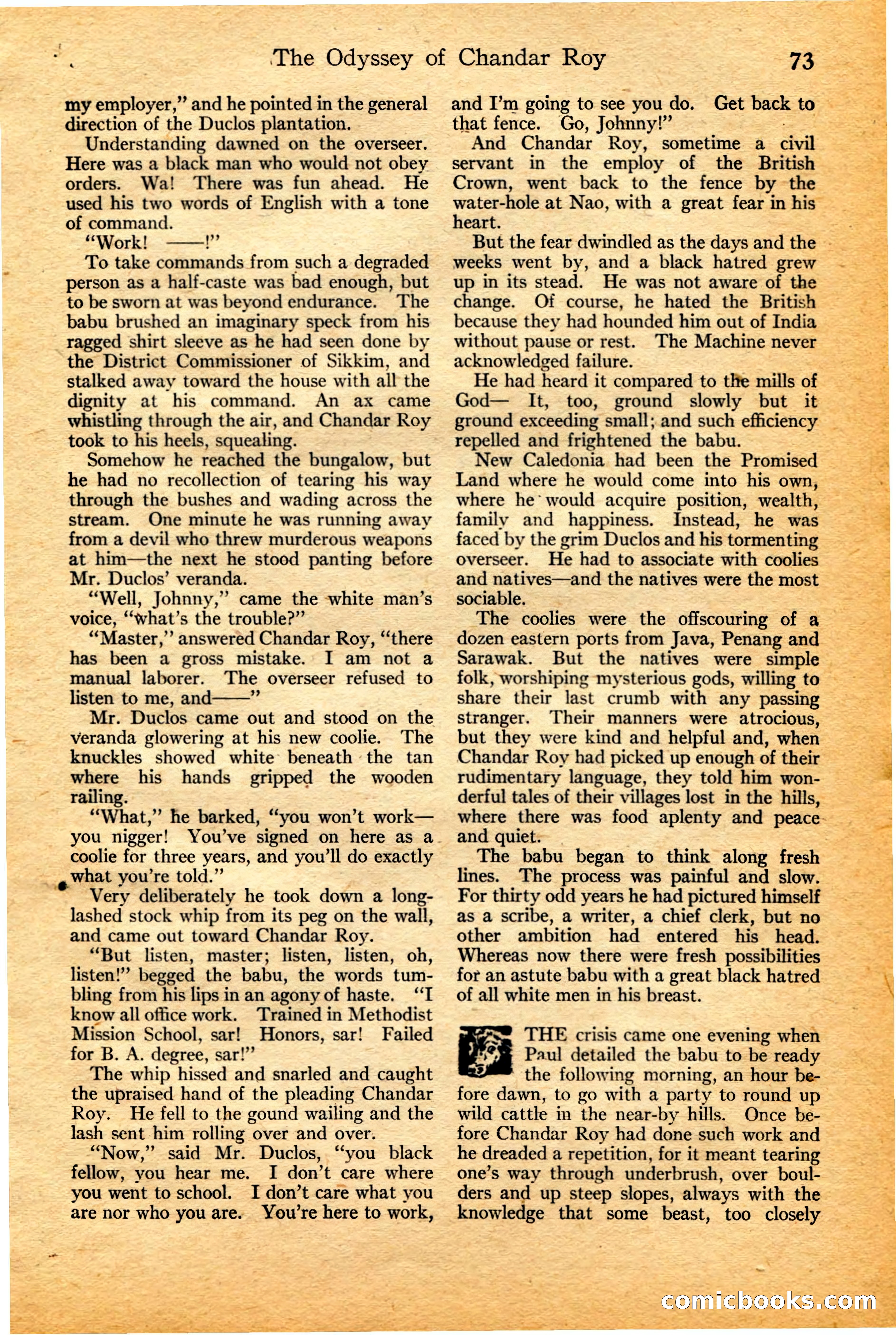
A restored page from Pulp Fiction, 1922. Page through the whole issue in the reader above.
📄 Transcribed text from this page (OCR, searchable)
Machine-transcribed from the original scan — historical spelling and the odd misread are preserved.
aS | The Odyssey of Chandar Roy my employer,” and he pointed in the general direction of the Duclos plantation. _ Understanding dawned on the overseer. Here was a black man who would not obey orders. Wa! ‘There was fun ahead. He used his two words of English with a tone of command. “Work! To take commands from such a degraded person as a half-caste was bad enough, but to be sworn at was beyond endurance. The babu brushed an imaginary speck from his ragged shirt sleeve as he had seen done by the District Commissioner of Sikkim, and stalked away toward the house with all the dignity at his command. An ax came whistling through the air, and Chandar Roy took to his heels, squealing. Somehow he reached the bungalow, but he had no recollection of tearing his way through the bushes and wading across the stream. One minute he was running away from a devil who threw murderous weapons at him—the next he stood panting before Mr. Duclos’ veranda. “Well, Johnny,” came the white man’s voice, ““what’s the trouble?” “‘Master,’’ answered Chandar Roy, “there has been a gross mistake. I am not a manual laborer. The overseer refused to listen to me, and——” Mr. Duclos came out and stood on the veranda glowering at his new coolie. The knuckles showed white beneath the tan where his hands gripped the wooden railing. “What, ” he barked, “you won’t work— you nigger! coolie for three years, and you'll do exactly what you’re told.” Very deliberately he took down a long- lashed stock whip from its peg on the wall, and came out toward Chandar Roy. “But listen, master; listen, listen, oh, listen!” begged the babu, the words tum- bling from his lips in an agony of haste. ‘“‘T know all office work. Trained in Methodist Mission School, sar! Honors, sar! Failed for B. A. degree, sar!” The whip hissed and snarled and caught the upraised hand of the pleading Chandar Roy. He fell to the gound wailing and the lash sent him rolling over and over. “Now,” said Mr. Duclos, “you black fellow, you hear me. I don’t care where you went to school. I don’t care what you are nor who you are. You're here to work, ee ts gd. c me Sie >> - ~~ > Pa You’ve signed on here as a. and I’m going to see you do. that fence. Go, Johnny!” And Chandar Roy, sometime a éfvil servant in the employ of the British Crown, went back to the fence by the water-hole at Nao, with a great fear in his heart. But the fear dwindled as the days and the = | weeks went by, and a black hatred grew up in its stead. He was not aware of the change. Of course, he hated the British because they had hounded him out of India without pause or rest. The Machine never acknowledged failure. He had heard it compared to tle mills of God— It, too, ground slowly but it ground exceeding small; and such efficiency repelled and frightened the babu. New Caledonia had been the Promised — Land where he would come into his own, where he would acquire position, wealth, family and happiness. Instead, he was faced by the grim Duclos and his tormenting overseer. He had to associate with coolies and natives—and the natives were the most sociable. The coolies were the offscouring of a __ dozen eastern ports from Java, Penangand Sarawak. But the natives were simple folk, worshiping mysterious gods, willing to share their last crumb with any passing stranger. Their manners were atrocious, but they were kind and helpful and, when Chandar Roy had picked up enough of their = rudimentary language, they told him won- derful tales of their villages lost in the hills, where there was food aplenty and pees and quiet: The babu began to think along fresh lines. The process was painful and slow. For thirty odd years he had pictured himself as a scribe, a writer, a chief clerk, but no other ambition had entered his head. Whereas now there were fresh possibilities for an astute babu with a great black hatred of all white men in his breast. THE crisis came one evening when Paul detailed the babu to be ready wild cattle in the near-by hills. fore Chandar Roy had done such work and he dreaded a repetition, for it meant tearing — one’s way through underbrush, over boul- ders and up steep slopes, always with the knowledge that some beast, too closely — ~- = Get back to the following morning, an hour be- _ fore dawn, to go with a party to round up_ Once be-- Vey : + (aed decd We aA ; hy) r f ie ‘ ih, a “4 of Ne» AT AG (aA pee hea Heth : : ar ' Wid sr £044 out: Ps ¥ ‘ ‘ 4 fi o. + y ‘ A af 4 he Ua wee f Vy ; ; U / t f i ope - FN bay f om df) vir o "> - . M 4, i ¥ a hi a Sey Pee coum ch Sata So See res E32 Om — rr. ~be L. =