
Pulp Fiction, 1922 · page 74 of 196
Adventure, February 20, 1922 — page 74: what you’re looking at
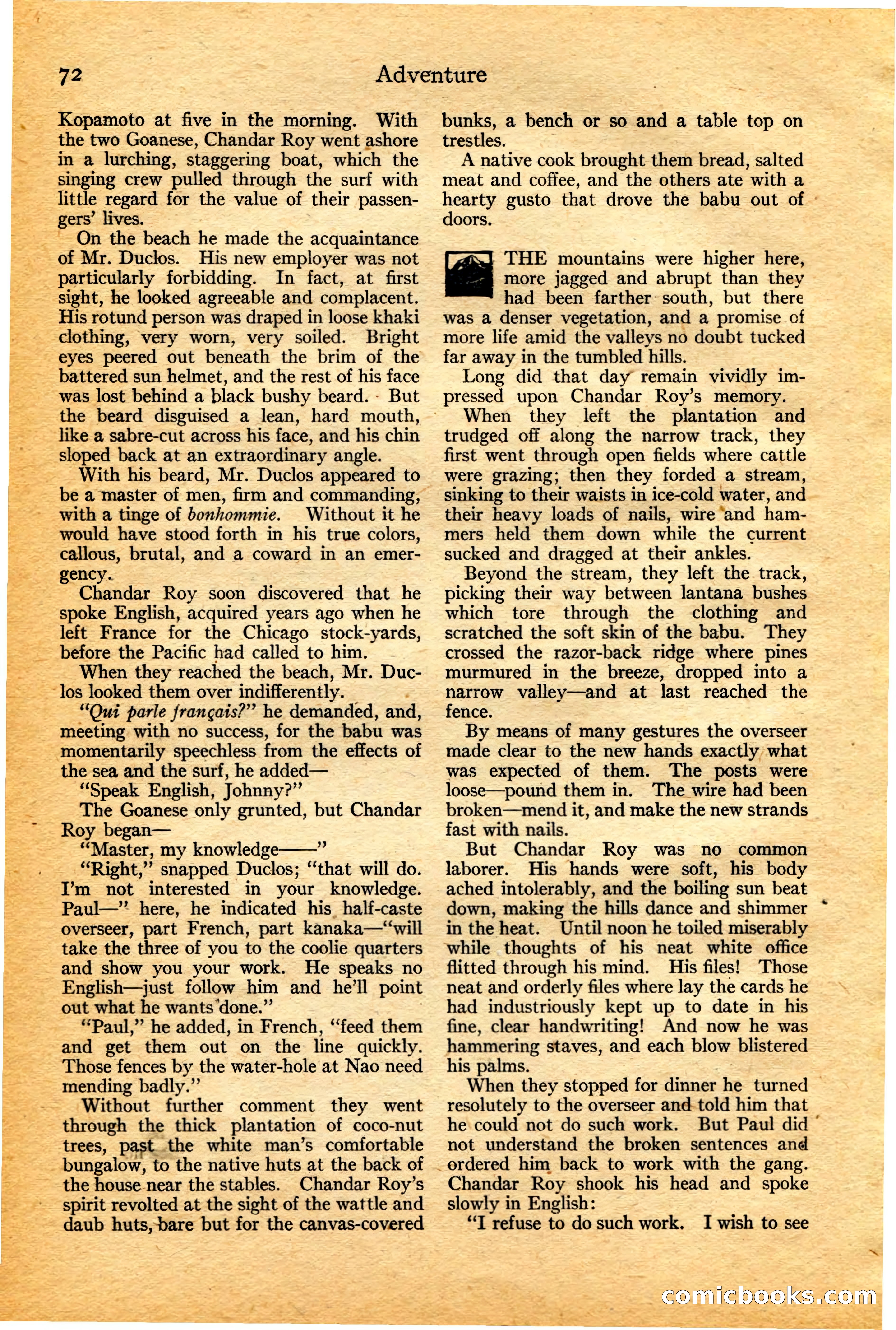
A restored page from Pulp Fiction, 1922. Page through the whole issue in the reader above.
📄 Transcribed text from this page (OCR, searchable)
Machine-transcribed from the original scan — historical spelling and the odd misread are preserved.
72 - Kopamoto at five in the morning. With the two Goanese, Chandar Roy went ashore in a lurching, staggering boat, which the singing crew pulled through the surf with little regard for the value of their passen- gers’ lives. ; _ On the beach he made the acquaintance of Mr. Duclos. His new employer was not particularly forbidding. In fact, at first => ee. Ties FRE ; By - sight, he looked agreeable and complacent. His rotund person was draped in loose khaki clothing, very worn, very soiled. Bright eyes peered out beneath the brim of the battered sun helmet, and the rest of his face was lost behind a black bushy beard. - But the beard disguised a lean, hard mouth, Jike a sabre-cut across his face, and his chin sloped back at an extraordinary angle. _ With his beard, Mr. Duclos appeared to _ be a master of men, firm and commanding, with a tinge of bonhommie. Without it he would have stood forth in his true colors, callous, brutal, and a coward in an emer- gency. Chandar Roy soon discovered that he spoke English, acquired years ago when he left France for the Chicago stock-yards, _ before the Pacific had called to him. When they reached the beach, Mr. Duc- Jos looked them over indifferently. “Qui parle frangais?” he demanded, and, meeting with no success, for the babu was momentarily speechless from the effects of the sea and the surf, he added— “Speak English, Johnny?” The Goanese only grunted, but Chandar Roy began— “Master, my knowledge——” “Right,”’ snapped Duclos; ‘that will do. I’m not interested in your knowledge. Paul—” here, he indicated his_ half-caste overseer, part French, part kanaka—“‘will take the three of you to the coolie quarters - and show you your work. He speaks no English—just follow him and he'll point out what he wants ‘done.”’ “Paul,” he added, in French, ‘‘feed them and get them out on the line quickly. Those fences by the water-hole at Nao need _ mending badly.” Without further comment they went oe through the thick plantation of coco-nut trees, past_.the white man’s comfortable _ bungalow, to the native huts at the back of the house near the stables. Chandar Roy’s spirit revolted at the sight of the wattle and daub huts,bare but for the canvas-covered Adventure aie a bench or so and a table top on trestles. A native cook brought them bread, salted meat and coffee, and the others ate with a hearty gusto that drove the babu out of ° doors. 4a) THE mountains were higher here, more jagged and abrupt than they had been farther: south, but there was a denser vegetation, and a promise of more life amid the valleys no doubt tucked far away in the tumbled hills. Long did that day remain vividly im- pressed upon Chandar Roy’s memory. When they left the plantation and trudged off along the narrow track, they first went through open fields where cattle were grazing; then they forded a stream, sinking to their waists in ice-cold water, and their heavy loads of nails, wire ‘and ham- mers held them down while the current sucked and dragged at their ankles. Beyond the stream, they left the. track, picking their way between lantana bushes which tore through the clothmg and scratched the soft skin of the babu. They crossed the razor-back ridge where pines murmured in the breeze, dropped into a narrow valley—and at last reached the fence. By means of many gestures the overseer made clear to the new hands exactly what was expected of them. The posts were loose—pound them in. The wire had been broken—mend it, and make the new strands fast with nails. But Chandar Roy was no common laborer. His hands were soft, his body ached intolerably, and the boiling sun beat down, making the hills dance and shimmer in the heat. Until noon he toiled miserably while thoughts of his neat white office flitted through his mind. His files! Those neat and orderly files where lay the cards he had industriously kept up to date in his fine, clear handwriting! And now he was hammering staves, and each blow blistered his palms. When they stopped for dinner he turned — resolutely to the overseer and told him that he could not do such work. But Paul did © not understand the broken sentences and _ordered him back to work with the gang. Chandar Roy shook his head and spoke slowly in English: “T refuse to do such work. I wish to see “com ia) book