
Pulp Fiction, 1922 · page 135 of 196
Adventure, February 20, 1922 — page 135: what you’re looking at
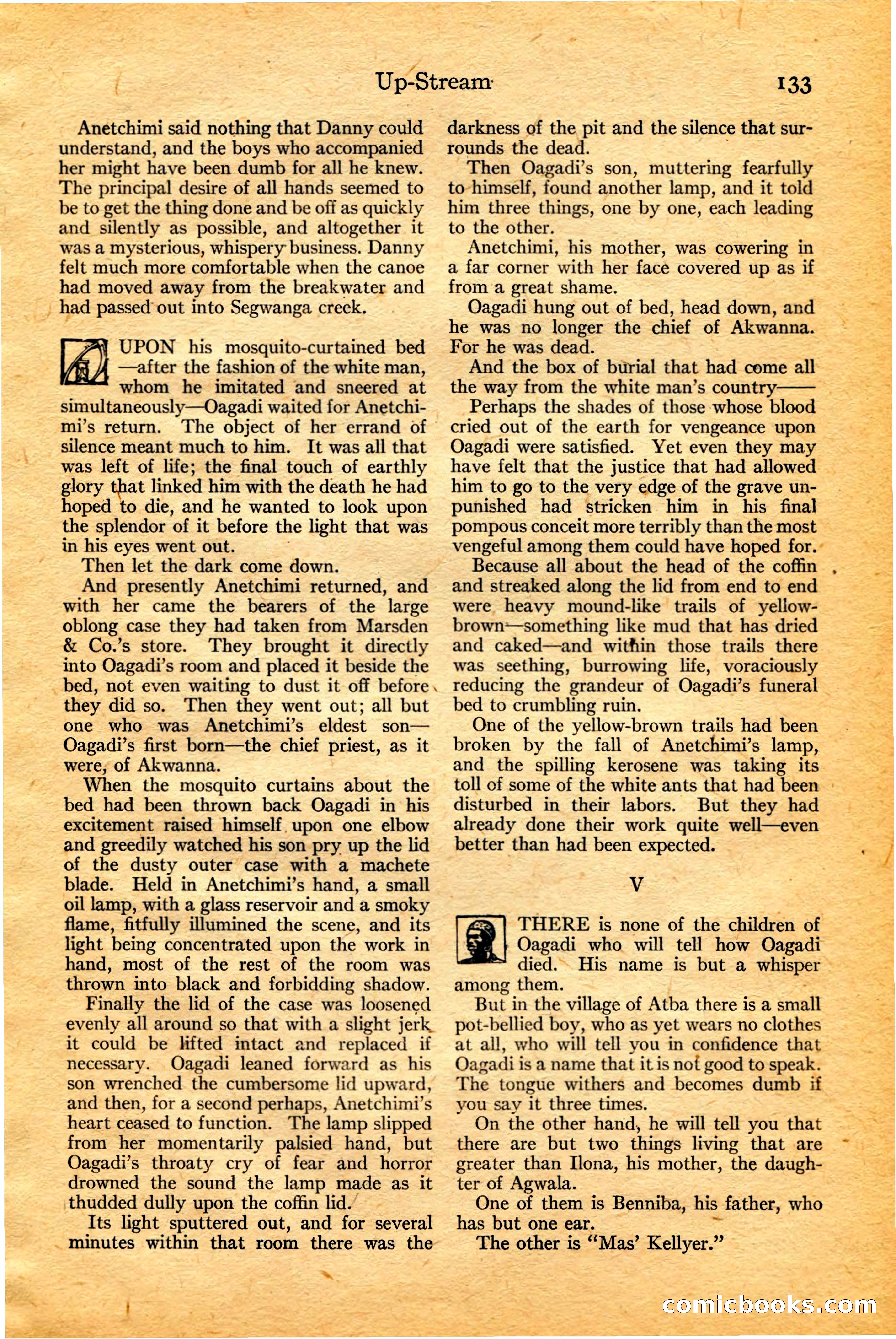
A restored page from Pulp Fiction, 1922. Page through the whole issue in the reader above.
📄 Transcribed text from this page (OCR, searchable)
Machine-transcribed from the original scan — historical spelling and the odd misread are preserved.
| Up-Stream Anetchimi said nothing that Danny could understand, and the boys who accompanied her might have been dumb for all he knew. The principal desire of all hands seemed to be to get the thing done and be off as quickly and silently as possible, and altogether it was a mysterious, whispery business. Danny felt much more comfortable when the canoe had moved away from the breakwater and _ had passed’ out into Segwanga creek, A) UPON his mosquito-curtained bed fy) —after the fashion of the white man, whom he imitated and sneered at simultaneously—Oagadi waited for Anetchi- mi’s return. The object of her errand of silence meant much to him. It was all that was left of life; the final touch of earthly glory that linked him with the death he had hoped to die, and he wanted to look upon the splendor of it before the light that was in his eyes went out. Then let the dark come down. And presently Anetchimi returned, and with her came the bearers of the large oblong case they had taken from Marsden & Co.’s store. They brought it directly into Oagadi’s room and placed it beside the bed, not even waiting to dust it off before , they did so. Then they went out; all but one who was Anetchimi’s eldest son— Oagadi’s first born—the chief priest, as it were, of Akwanna. When the mosquito curtains about the bed had been thrown back Oagadi in his excitement raised himself. upon one elbow and greedily watched his son pry up the lid of the dusty outer case with a machete blade. Held in Anetchimi’s hand, a small oil lamp, with a glass reservoir and a smoky flame, fitfully illumined the scene, and its light being concentrated upon the work in hand, most of the rest of the room was thrown into black and forbidding shadow. Finally the lid of the case was loosened evenly all around so that with a slight jerk. it could be lifted intact and replaced if necessary. Oagadi leaned forward as his son wrenched the cumbersome lid upward, and then, for a second perhaps, Anetchimi’s heart ceased to function. The lamp slipped from her momentarily palsied hand, but Oagadi’s throaty cry of fear and horror drowned the sound the lamp made as it thudded dully upon the coffin lid.’ Its light sputtered out, and for several . minutes within that room there was the ~ 133 darkness of the pit and the silence that sur- rounds the dead. Then Oagadi’s son, muttering fearfully to-himself, found another lamp, and it told him three things, one by one, each leading to the other. Anetchimi, his mother, was cowering in a far corner with her face covered up as if from a great shame. Oagadi hung out of bed, head down, and he was no longer the chief of Akwanna. For he was dead. And the box of burial that had come all the way from the white man’s country—— — Perhaps the shades of those whose blood cried out of the earth for vengeance upon Oagadi were satisfied. Yet even they may have felt that the justice that had allowed him to go to the very edge of the grave un- punished had stricken him in his final pompous conceit more terribly than the most vengeful among them could have hoped for.: Because all about the head of the coffin , and streaked along the lid from end to end were heavy mound-like trails of yellow- brown—something like mud that has dried and caked—and within those trails there was seething, burrowing life, voraciously reducing the grandeur of Oagadi’s funeral bed to crumbling ruin. One of the yellow-brown trails had been broken by the fall of Anetchimi’s lamp, and the spilling kerosene was taking its toll of some of the white ants that had been | disturbed in their labors. But they had already done their work quite well—even better than had been expected. V THERE is none of the children of | Oagadi who will tell how Oagadi died. His name is but a whisper among them. But in the village of Atba there is a small pot-bellied boy, who as yet wears no clothes at all, who will tell you in confidence that Oagadi i is a name that it is not good to speak. The tongue withers and becomes dumb if you say it three times. On the other hand, he will tell you that there are but two things living that are — greater than Ilona, his mother, the daugh- ter of Agwala. One of them is Benniba, his s father, who has but one ear. The other is ‘Mas’ Kellyer.” : Ss i< “o> 4 a = G wi é ' cae ws! be cComicbooks.com > a ~