
Pulp Fiction, 1922 · page 134 of 196
Adventure, February 20, 1922 — page 134: what you’re looking at
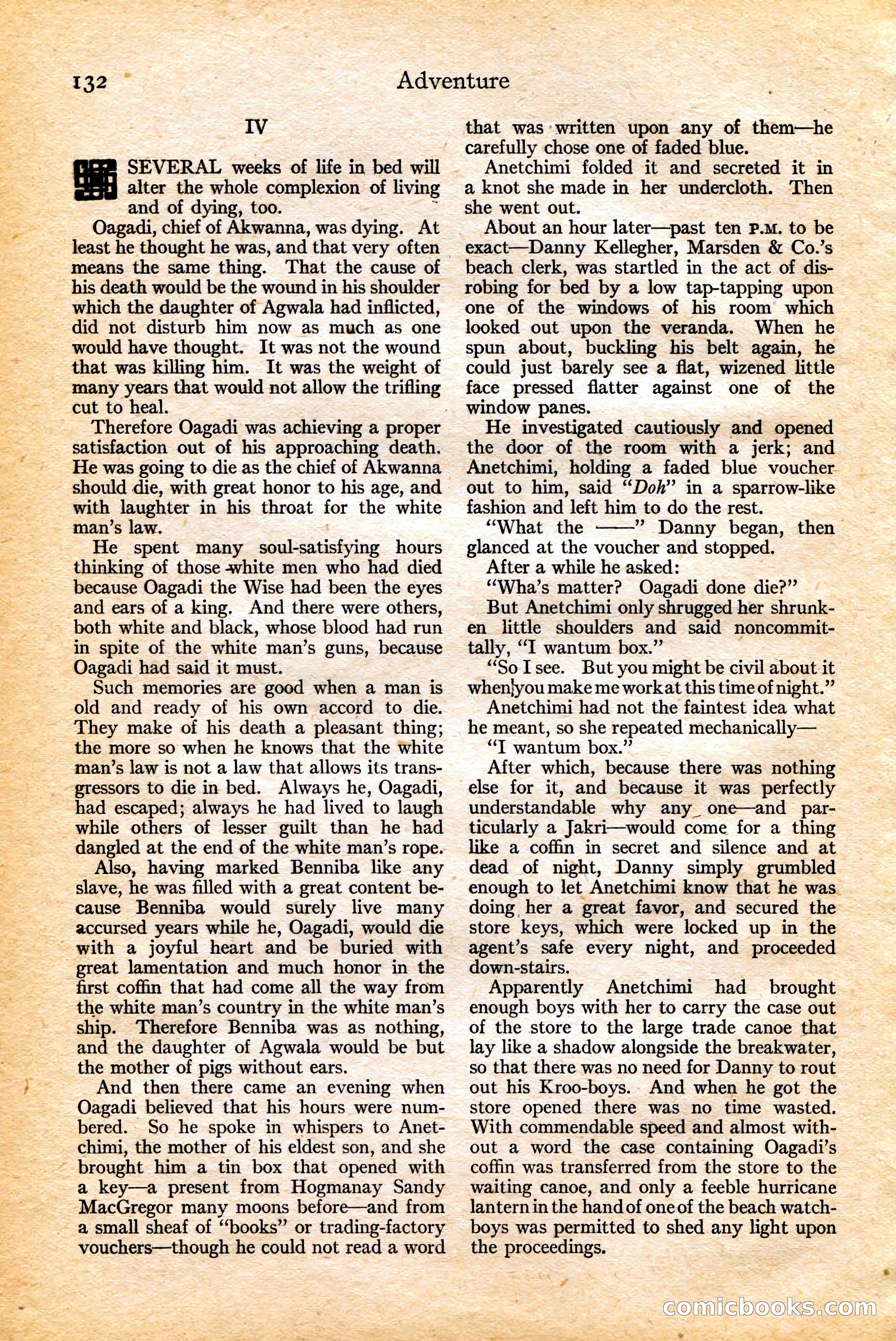
A restored page from Pulp Fiction, 1922. Page through the whole issue in the reader above.
📄 Transcribed text from this page (OCR, searchable)
Machine-transcribed from the original scan — historical spelling and the odd misread are preserved.
132 © IV SEVERAL weeks of life in bed will alter the whole complexion of living and of dying, too. : Oagadi, chief of Akwanna, was dying. At least he thought he was, and that very often — means the same thing. That the cause of his death would be the wound in his shoulder which the daughter of Agwala had inflicted, did not disturb him now as much as one would have thought. It was not the wound that was killing him. It was the weight of many years that would not allow the trifling cut to heal. Therefore Oagadi was achieving a proper satisfaction out of his approaching death. He was going to die as the chief of Akwanna should die, with great honor to his age, and with laughter in his throat for the white man’s law. He spent many soul-satisfying hours thinking of those avhite men who had died because Oagadi the Wise had been the eyes and ears of a king. And there were others, _ both white and black, whose blood had run in spite of the white man’s guns, because Oagadi had said it must. Such memories are good when a man is old and ready of his own accord to die. They make of his death a pleasant thing; the more so when he knows that the white man’s law is not a law that allows its trans- gressors to die in bed. Always he, Oagadi, had escaped; always he had lived to laugh while others of lesser guilt than he had dangled at the end of the white man’s rope. Also, having marked Benniba like any slave, he was filled with a great content be- cause Benniba would surely live many accursed years while he, Oagadi, would die - with a joyful heart and be buried with great lamentation and much honor in the first coffin that had come all the way from the white man’s country in the white man’s ship. ‘Therefore Benniba was as nothing, and the daughter of Agwala would be but the mother of pigs without ears. And then there came an evening when Oagadi believed that his hours were num- bered. So he spoke in whispers to Anet- chimi, the mother of his eldest son, and she - brought him a tin box that opened with a key—a present from Hogmanay Sandy MacGregor many moons before—and from a small sheaf of “books” or trading-factory vouchers—though he could not read a word Adventure that was written upon any of them—he carefully chose one of faded blue. Anetchimi folded it and secreted it in a knot she made in her undercloth. Then she went out. About an hour later—past ten P.m. to be exact—Danny Kellegher, Marsden & Co.’s beach clerk, was startled in the act of dis- robing for bed by a low tap-tapping upon one of the windows of his room which looked out upon the veranda. When he spun about, buckling his belt again, he could just barely see a flat, wizened little face pressed flatter against one of the window panes. He investigated cautiously and opened the door of the room with a jerk; and Anetchimi, holding a faded blue voucher out to him, said “Doh” in a sparrow-like fashion and left him to do the rest. “What the ——” Danny began, then glanced at the voucher and stopped. After a while he asked: ‘“‘Wha’s matter? Oagadi done die?” But Anetchimi only shrugged her shrunk- en little shoulders and said noncommit- tally, “I wantum box.” | “So Isee. But you might be civil about it when}you make me workat this time of night.” Anetchimi had not the faintest idea what he meant, so she repeated mechanically— “T wantum box.” After which, because there was nothing else for it, and because it was perfectly understandable why any_one—and _par- ticularly a Jakri—would come for a thing like a coffin in secret and silence and at dead of night, Danny simply grumbled enough to let Anetchimi know that he was. doing her a great favor, and secured the store keys, which were locked up in the agent’s safe every night, and proceeded down-stairs. Apparently Anetchimi had _ brought enough boys with her to carry the case out of the store to the large trade canoe that lay like a shadow alongside the breakwater, so that there was no need for Danny to rout out his Kroo-boys.. And when he got the store opened there was no time wasted. With commendable speed and almost with- out a word the case containing Oagadi’s coffin was transferred from the store to the waiting canoe, and only a feeble hurricane lantern in the hand of oneof the beach watch- boys was permitted to shed any light upon the proceedings. a: =cOmIchoo (C@)