
Pulp Fiction, 1921 · page 71 of 194
Adventure Magazine Cover — page 71: what you’re looking at
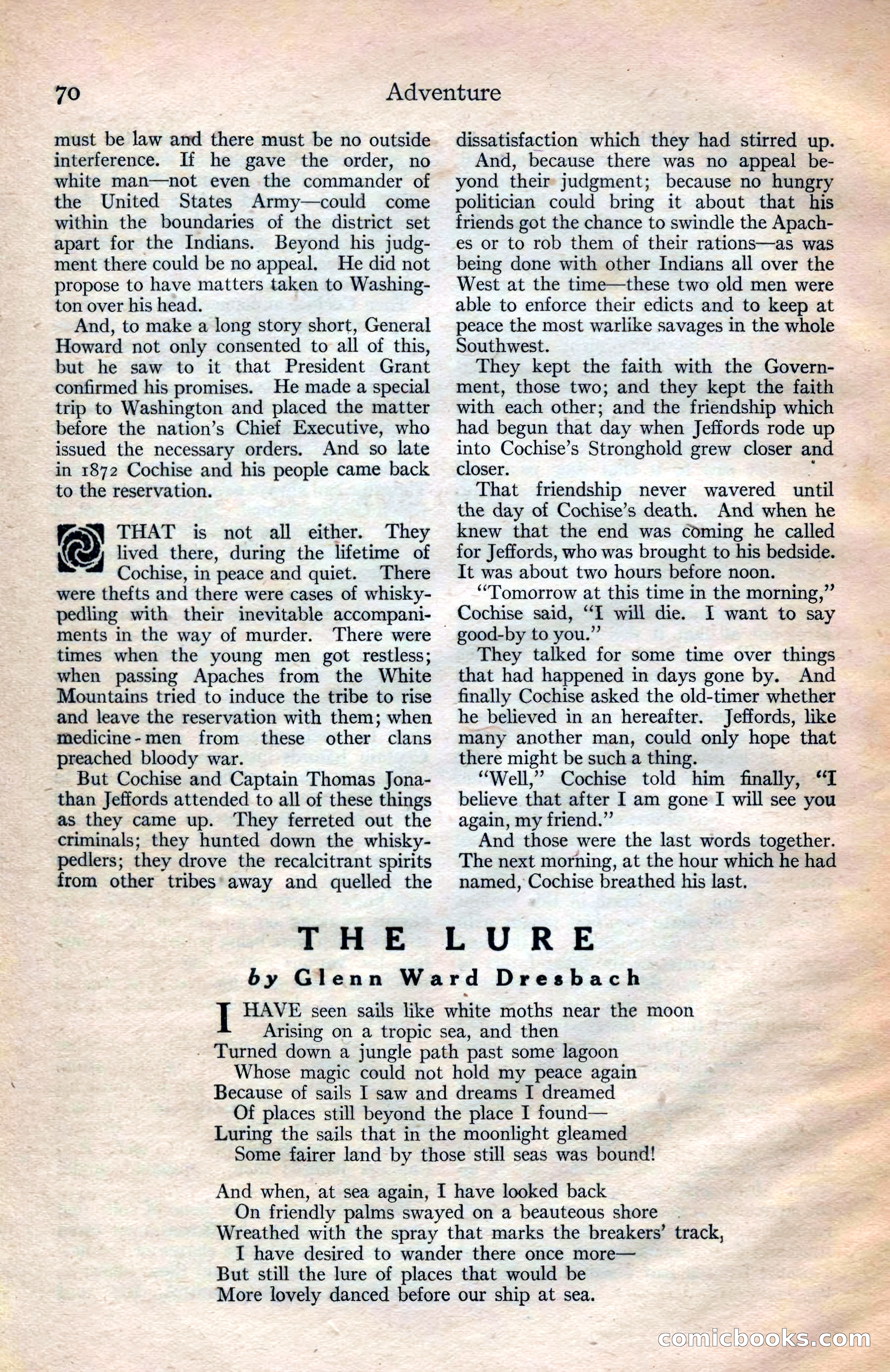
A restored page from Pulp Fiction, 1921. Page through the whole issue in the reader above.
📄 Transcribed text from this page (OCR, searchable)
Machine-transcribed from the original scan — historical spelling and the odd misread are preserved.
70 Adventure must be law and there must be no outside interference. Ii he gave the order, no white man—not even the commander of the United States Army—could come within the boundaries of the district set apart for the Indians. Beyond his judg- ment there could be no appeal. He did not propose to have matters taken to Washing- ton over his head. And, to make a long story short, General Howard not only consented to all of this, but he saw to it that President Grant confirmed his promises. He made a special trip to Washington and placed the matter before the nation’s Chief Executive, who issued the necessary orders. And so late in 1872 Cochise and his people came back to the reservation. Yaa’ THAT is not all either. They @ lived there, during the lifetime of Cochise, in peace and quiet. There were thefts and there were cases of whisky- pediing with their inevitable accompani- ments in the way of murder. There were times when the young men got restless; when passing Apaches from the White Mountains tried to induce the tribe to rise and leave the reservation with them; when medicine-men from these other clans preached bloody war. But Cochise and Captain Thomas Jona- than Jeffords attended to all of these things as they came up. ‘They ferreted out the criminals; they hunted down the whisky- pediers; they drove the recalcitrant spirits from other tribes’away and quelled the dissatisfaction which they had stirred up. And, because there was no appeal be- yond their judgment; because no hungry politician could bring it about that his friends got the chance to swindle the Apach- es or to rob them of their rations—as was being done with other Indians all over the West at the time—these two old men were able to enforce their edicts and to keep at peace the most warlike savages in the whole Southwest. They kept the faith with the Govern- ment, those two; and they kept the faith with each other; and the friendship which had begun that day when Jeffords rode up into Cochise’s Stronghold grew closer and closer. E That friendship never wavered until the day of Cochise’s death. And when he knew that the end was coming he called for Jeffords, who was brought to his bedside. It was about two hours before noon. “Tomorrow at this time in the morning,” Cochise said, “I will die. I want to say _ good-by to you.” They talked for some time over things that had happened in days gone by. And finally Cochise asked the old-timer whether he believed in an hereafter. Jeffords, like many another man, could only hope that there might be such a thing. “Well,” Cochise told him finally, “I believe that after I am gone I will see you again, my friend.” And those were the last words together. The next morning, at the hour which he had named, Cochise breathed his last. THE LURE by Glenn Ward Dresbach HAVE seen sails like white moths near the moon Arising on a tropic sea, and then - Turned down a jungle path past some lagoon Whose magic could not hold my peace again Because of sails I saw and dreams I dreamed Of places still beyond the place I found— Luring the sails that in the moonlight gleamed Some fairer land by those still seas was bound! And when, at sea again, I have looked back On friendly palms swayed on a beauteous shore. Wreathed with the spray that marks the breakers’ track, I have desired to wander there once more— But still the lure of places that would be More lovely danced before our ship at sea. Eomichbooks.co