
Pulp Fiction, 1921 · page 70 of 194
Adventure Magazine Cover — page 70: what you’re looking at
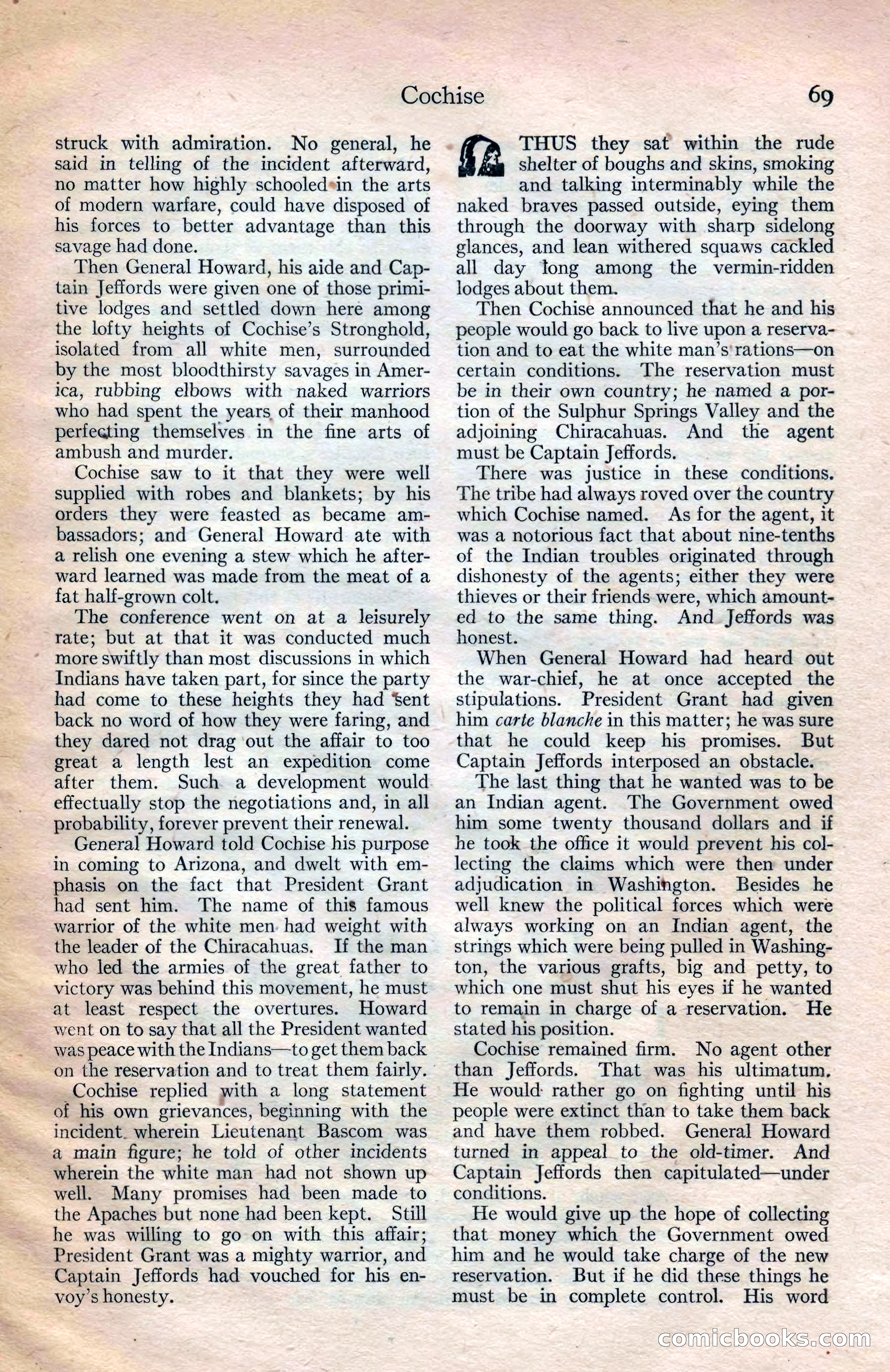
A restored page from Pulp Fiction, 1921. Page through the whole issue in the reader above.
📄 Transcribed text from this page (OCR, searchable)
Machine-transcribed from the original scan — historical spelling and the odd misread are preserved.
Cochise struck with admiration. No general, he said in telling of the incident afterward, no matter how highly schooled*in the arts of modern warfare, could have disposed of his forces to better advantage than this savage had done. Then General Howard, his aide and Cap- tain Jeffords were given one of those primi- tive lodges and settled down here among the lofty heights of Cochise’s Stronghold, isolated from all white men, surrounded by the most bloodthirsty savages in Amer- ica, rubbing elbows with naked warriors who had spent the years of their manhood perfecting themselves in the fine arts of ambush and murder. Cochise saw to it that they were well supplied with robes and blankets; by his orders they were feasted as became am- bassadors; and General Howard ate with a relish one evening a stew which he after- ward learned was made from the meat of a fat half-grown colt. The conference went on at a leisurely rate; but at that it was conducted much * more swiftly than most discussions in which Indians have taken part, for since the party had come to these heights they had Sent back no word of how they were faring, and they dared not drag out the affair to too great a length lest an expedition come after them. Such a development would effectually stop the negotiations and, in all probability, forever prevent their renewal. General Howard told Cochise his purpose in coming to Arizona, and dwelt with em- phasis on the fact that President Grant had sent him. The name of this famous warrior of the white men. had weight with the leader of the Chiracahuas. If the man who led the armies of the great father to victory was behind this movement, he must at least respect the overtures. Howard went on to say that all the President wanted was peace with the Indians—to get them back on the reservation and to treat them fairly. Cochise replied with a long statement of his own grievances, beginning with the incident. wherein Lieutenant Bascom was a main figure; he told of other incidents wherein the white man had not shown up well. Many promises had been made to the Apaches but none had been kept. Still he was willing to go on with this affair; President Grant was a mighty warrior, and Captain Jeffords had vouched for his en- voy’s honesty. 69 THUS they sat within the rude shelter of boughs and skins, smoking and talking interminably while the naked braves passed outside, eying them through the doorway with sharp sidelong glances, and lean withered squaws cackled all day tong among the vermin-ridden lodges about them. Then Cochise announced that he and his people would go back to live upon a reserva- tion and to eat the white man’s'rations—on certain conditions. The reservation must be in their own country; he named a por- tion of the Sulphur Springs Valley and the adjoining Chiracahuas. And the agent must be Captain Jeffords. There was justice in these conditions. The tribe had always roved over the country which Cochise named. As for the agent, it was a notorious fact that about nine-tenths of the Indian troubles originated through dishonesty of the agents; either they were thieves or their friends were, which amount- ed to the same thing. And Jeffords was honest. When General Howard had heard out the war-chief, he at once accepted the stipulations. President Grant had given him carte blanche in this matter; he was sure that he could keep his promises. But Captain Jeffords interposed an obstacle. The last thing that he wanted was to be an Indian agent. The Government owed him some twenty thousand dollars and if he took the office it would prevent his col- lecting the claims which were then under adjudication in Washington. Besides he well knew the political forces which were always working on an Indian agent, the strings which were being pulled in Washing- ton, the various grafts, big and petty, to which one must shut his eyes if he wanted to remain in charge of a reservation. He stated his position. Cochise remained firm. No agent other than Jeffords. That was his ultimatum, He would: rather go on fighting until his people were extinct than to take them back and have them robbed. General Howard turned in appeal to the old-timer. And Captain Jeffords then capitulated—under conditions. He would give up the hope of collecting that money which the Government owed him and he would take charge of the new reservation. But if he did these things he must be in complete control. His word EO CoOpmcooolkkS.