
Pulp Fiction, 1921 · page 68 of 194
Adventure Magazine Cover — page 68: what you’re looking at
A restored page from Pulp Fiction, 1921. Page through the whole issue in the reader above.
📄 Transcribed text from this page (OCR, searchable)
Machine-transcribed from the original scan — historical spelling and the odd misread are preserved.
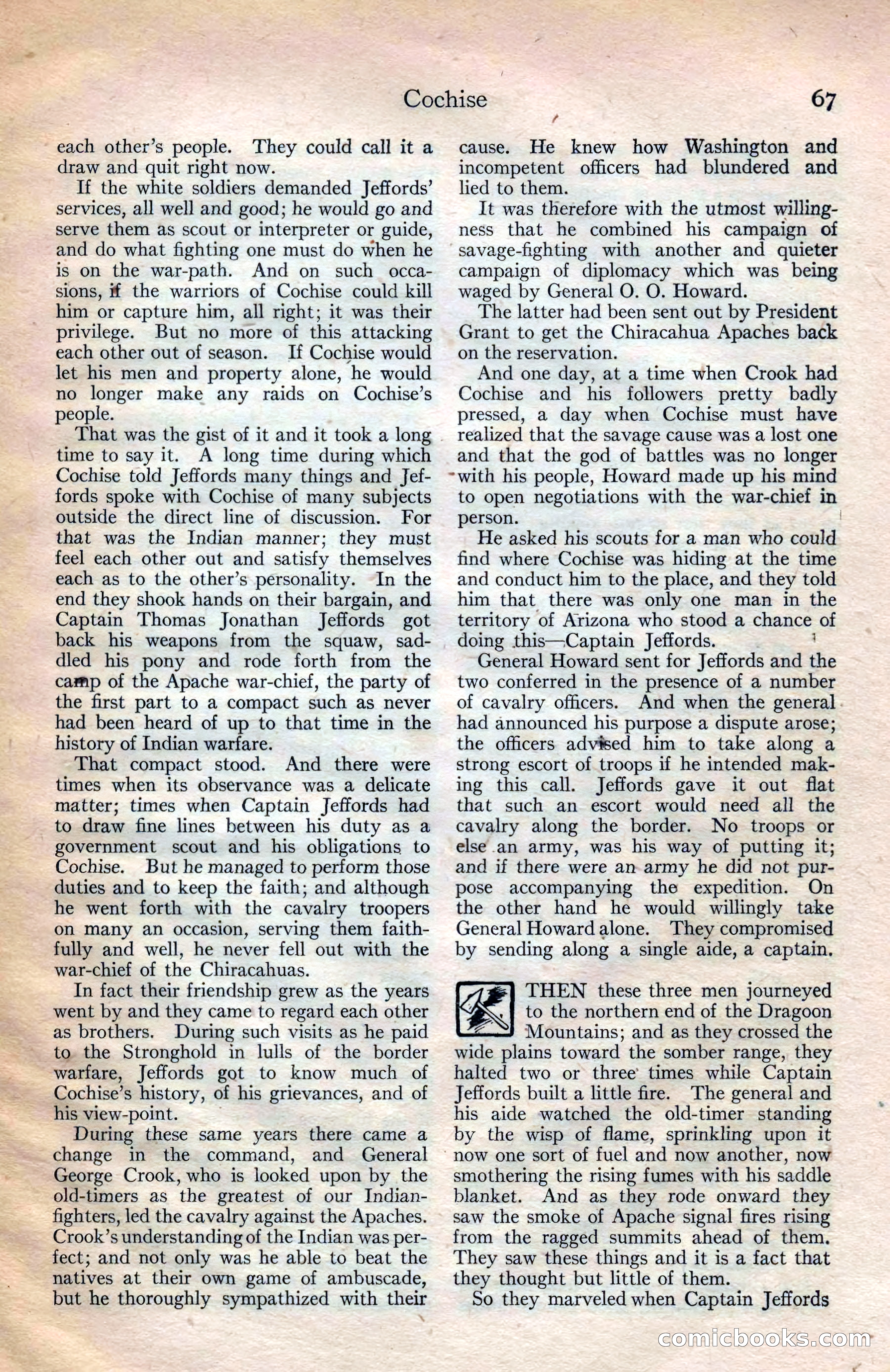
Cochise each other’s people. They could call it a draw and quit right now. If the white soldiers demanded Jeffords’ services, all well and good; he would go and serve them as scout or interpreter or guide, and do what fighting one must do when he is on the war-path. And on such _ occa- sions, # the warriors of Cochise could kill him or capture him, all right; it was their privilege. But no more of this attacking each other out of season. If Cochise would let his men and property alone, he would no longer make any raids on Cochise’s people. That was the gist of it and it took a long time to say it. A long time during which Cochise told Jeffords many things and fef- fords spoke with Cochise of many subjects outside the direct line of discussion. For that was the Indian manner; they must feel each other out and satisfy themselves each as to the other’s personality. In the end they shook hands on their bargain, and Captain Thomas Jonathan Jeffords got back his weapons from the squaw, sad- died his pony and rode forth from the camp of the Apache war-chief, the party of the first part to a compact such as never had been heard of up to that time in the history of Indian warfare. That compact stood. And there were times when its observance was a delicate matter; times when Captain Jeffords had to draw fine lines between his duty as a government scout and his obligations to Cochise. But he managed to perform those duties and to keep the faith; and although he went forth with the cavalry troopers on many an occasion, serving them faith- fully and well, he never fell out with the war-chief of the Chiracahuas. In fact their friendship grew as the years went by and they came to regard each other as brothers. During such visits as he paid to the Stronghold in lulls of the border warfare, Jeffords got to know much of Cochise’ s history, of his grievances, and of his view-point. During these same years there came a change in the command, and General George Crook, who is looked upon by the old-timers as the greatest of our Indian- fighters, led the cavalry against the Apaches. Crook’s understanding of the Indian was per- fect; and not only was he able to beat the natives at their own game of ambuscade, but he thoroughly sympathized with their 67 / cause. He knew how Washington and incompetent officers had blundered and lied to them. It was therefore with the utmost willing- ness that he combined his campaign of savage-fighting with another and quieter campaign of diplomacy which was being waged by General O. O. Howard. The latter had been sent out by President Grant to get the Chiracahua Apaches back on the reservation. And one day, at a time when Crook had Cochise and his followers pretty badly pressed, a day when Cochise must have realized that the savage cause was a lost one and that the god of battles was no longer “with his people, Howard made up his mind to open negotiations with the war-chief in person. He asked his scouts for a man who sank find where Cochise was hiding at the time and conduct him to the place, and they told him that there was only one man in the territory of Arizona who stood a chance of doing this—Captain Jeffords. General Howard sent for Jeffords and the two conferred in the presence of a number of cavalry officers. had announced his purpose a dispute arose; the officers advised him to take along a strong escort of troops if he intended mak- ing this call. Jeffords gave it out flat that such an escort would need all the cavalry along the border. No troops or else an army, was his way of putting it; and if there were an army he did not pur- pose accompanying the expedition. On the other hand he would willingly take General Howard alone. They compromised by sending along a single aide, a captain. ed to the northern end of the Dragoon Mountains; and as they crossed the wide plains toward the somber range, they halted two or three times while Captain Jeffords built a little fire. The general and his aide watched the old-timer standing by the wisp of flame, sprinkling upon it THEN these three men journeyed ‘now one sort of fuel and now another, now smothering the rising fumes with his saddle blanket. And as they rode onward they saw the smoke of Apache signal fires rising from the ragged summits ahead of them. They saw these things and it is a fact that they thought but little of them. So they marveled when Captain Jeffords CopmicoookSse© And when the general.