
Pulp Fiction, 1922 · page 83 of 200
Adventure Magazine Cover, December 10, 1922 — page 83: what you’re looking at
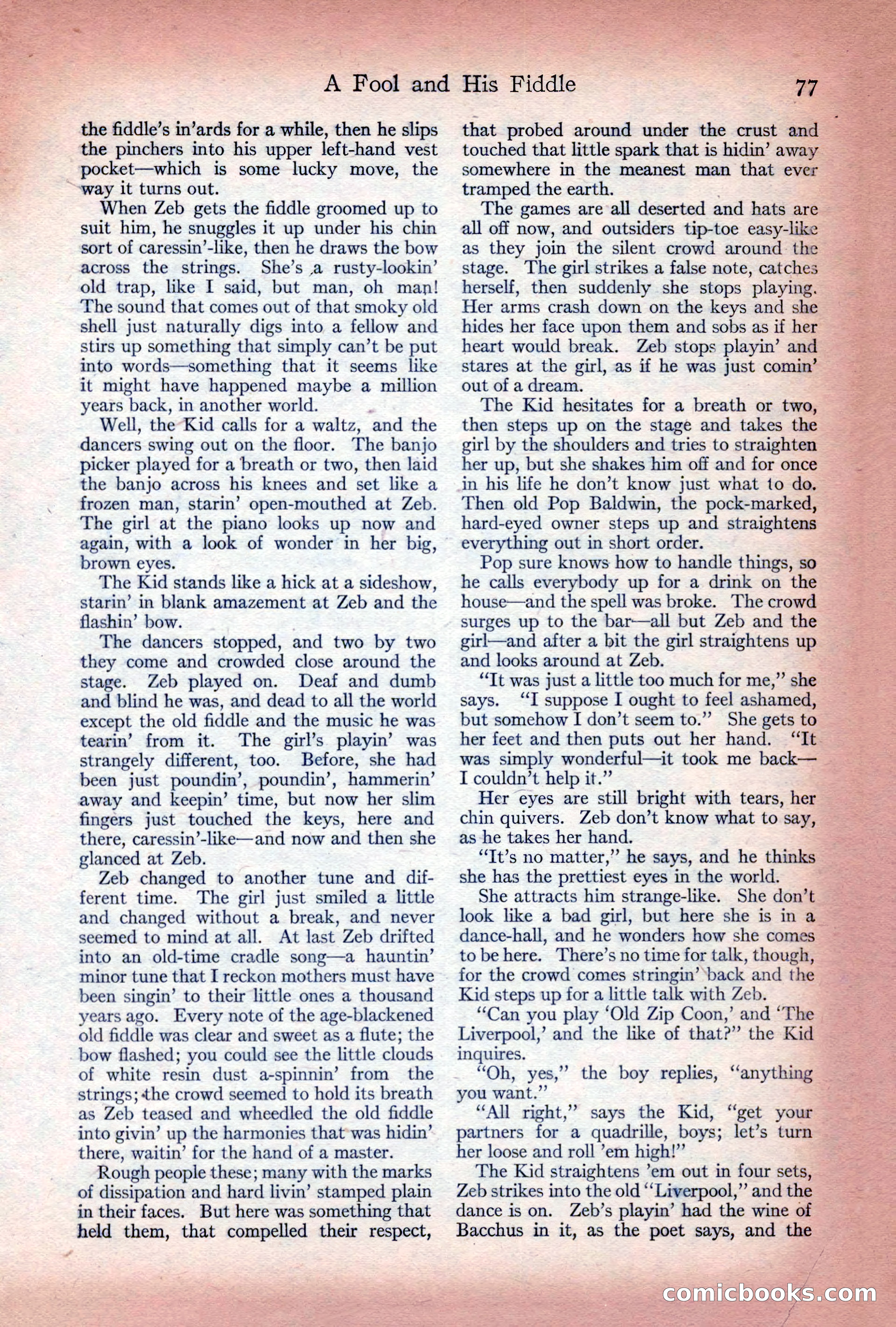
A restored page from Pulp Fiction, 1922. Page through the whole issue in the reader above.
📄 Transcribed text from this page (OCR, searchable)
Machine-transcribed from the original scan — historical spelling and the odd misread are preserved.
A Fool and His Fiddle the fiddle’s in’ards for a while, then he slips the pinchers into his upper left-hand vest pocket—which is some lucky move, the ‘way it turns out. When Zeb gets the fiddle groomed up to suit him, he snuggles it up under his chin sort of caressin’-like, then he draws the bow across the strings. She’s a rusty-lookin’ old trap, like I said, but man, oh man! The sound that comes out of that smoky old shell just naturally digs into a fellow and stirs up something that simply can’t be put into words—something that it seems like it might have happened maybe a million years back, in another world. Well, the Kid calls for a waltz, and the dancers swing out on the floor. The banjo picker played for a breath or two, then laid the banjo across his knees and set like a frozen man, starin’ open-mouthed at Zeb. The girl at the piano looks up now and again, with a look of wonder in her big, brown eyes. The Kid stands like a hick at a sideshow, starin’ in blank amazement at Zeb and the flashin’ bow. The dancers stopped, and two by two they come and crowded close around the stage. Zeb played on. Deaf and dumb and blind he was, and dead to all the world except the old fiddle and the music he was tearin’ from it. The girl’s playin’ was strangely different, too. Before, she had been just poundin’, poundin’, hammerin’ away and keepin’ time, but now her slim fingers just touched the keys, here and there, caressin’-like—and now and then she glanced at Zeb. Zeb changed to another tune and dif- ferent time. The girl just smiled a little and changed without a break, and never seemed to mind at all. At last Zeb drifted into an old-time cradle song—a hauntin’ minor tune that I reckon mothers must have been singin’ to their little ones a thousand years ago. Every note of the age-blackened old fiddle was clear and sweet as a flute; the bow flashed; you could see the little clouds of white resin dust a-spinnin’ from the strings; the crowd seemed to hold its breath as Zeb teased and wheedled the old fiddle into givin’ up the harmonies that’ was hidin’ there, waitin’ for the hand of a master. Rough people these; many with the marks of dissipation and hard livin’ stamped plain in their faces. But here was something that held them, that compelled their respect, 77/ that probed around under the crust and . touched that little spark that is hidin’ away somewhere in the meanest man that ever tramped the earth. The games are all deserted and hats are all off now, and outsiders tip-toe easy-like as they join the silent crowd around the stage. The girl strikes a false note, catches herself, then suddenly she stops playing. Her arms crash down on the keys and she hides her face upon them and sobs as if her heart would break. Zeb stops playin’ and stares at the girl, as if he was just comin’ out of a dream. The Kid hesitates for a breath or two, then steps up on the stage and takes the girl by the shoulders and tries to straighten her up, but she shakes him off and for once in his life he don’t know just what to do. Then old Pop Baldwin, the pock-marked, hard-eyed owner steps up and straightens everything out in short order. Pop sure knows how to handle things, so he calls everybody up for a drink on the house—and the spell was broke. The crowd surges up to the bar—all but Zeb and the girl—and after a bit the girl straightens up and looks around at Zeb. “Tt was just a little too much for me,” she says. “I suppose I ought to feel ashamed, but somehow I don’t seem to.” She gets to her feet and then puts out her hand. “It was simply wonderful—it took me back— I couldn’t help it.” Her eyes are still bright with tears, her chin quivers. Zeb don’t know what to say, as he takes her hand. “Tt’s no matter,” he says, and he thinks she has the prettiest eyes in the world. She attracts him strange-like. She don’t look like a bad girl, but here she is in a dance-hall, and he wonders how she comes to be here. There’s no time for talk, though, for the crowd comes stringin’ back and the Kid steps up for a little talk with Zeb. “Can you play “Old Zip Coon,’ and “The Liverpool,’ and the like of that?” the Kid inquires. “Oh, yes,” the boy replies, “‘anything you want.” “All right,” says the Kid, “get your partners for a quadrille, boys; let’s turn her loose and roll ’em high!’ The Kid straightens ’em out in four sets, Zeb strikes into the old “‘Liverpool,” and the dance is on. Zeb’s playin’ had the wine of Bacchus in it, as the poet says, and the cComicboo cS (E{0)