
Pulp Fiction, 1922 · page 82 of 200
Adventure Magazine Cover, December 10, 1922 — page 82: what you’re looking at
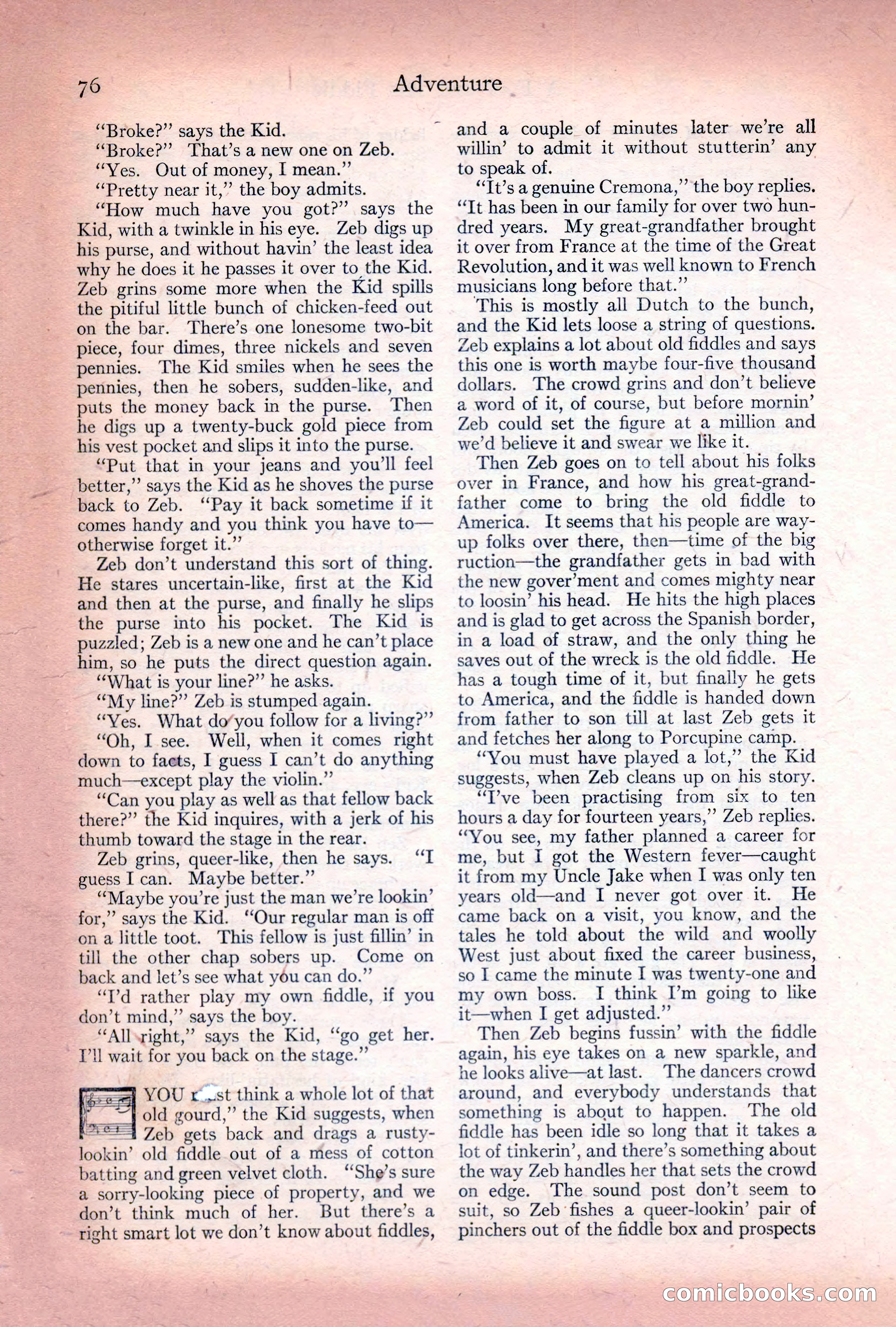
A restored page from Pulp Fiction, 1922. Page through the whole issue in the reader above.
📄 Transcribed text from this page (OCR, searchable)
Machine-transcribed from the original scan — historical spelling and the odd misread are preserved.
be Za as. at a Ee Oe ~ oo o J " a, ad? re 7. = - © “Broker” says the Kid. “Broke?” That’s a new one on Zeb. “Ves. Out of money, I mean.” “Pretty near it,” the boy admits. “How much have you got?” says the Kid, with a twinkle in his eye. Zeb digs up his purse, and without havin’ the least idea why he does it he passes it over to the Kid. Zeb grins some more when the Kid spills the pitiful little bunch of chicken-feed out on the bar. There’s one lonesome two-bit piece, four dimes, three nickels and seven pennies. The Kid smiles when he sees the pennies, then he sobers, sudden-like, and puts the money back in the purse. Then he digs up a twenty-buck gold piece from his vest pocket and slips it into the purse. “Put that in your jeans and you'll feel better,’”’ says the Kid as he shoves the purse back to Zeb. ‘‘Pay it back sometime if it comes handy and you think you have to— otherwise forget it.”’ Zeb don’t understand this sort of thing. He stares uncertain-like, first at the Kid and then at the purse, and finally he slips the purse into his pocket. The Kid is puzzled; Zeb is a new one and he can’t place him, so he puts the direct question again. _ “What is your line?” he asks. “My line?” Zeb is stumped again. “Ves, What do’you follow for a living?” “Oh, I see. Well, when it comes right down to faets, I guess I can’t do anything much—except play the violin.”’ “Can you play as well as that fellow back there?” the Kid inquires, with a jerk of his thumb toward the stage in the rear. Zeb grins, queer-like, then he says. guess I can. Maybe better.”’ “Maybe you’re just the man we’re lookin’ for,” says the Kid. “Our regular man is off on a little toot. This fellow is just fillin’ in till the other chap sobers up. Come on back and let’s see what you can do.” “T’d rather play my own fiddle, if you don’t mind,”’ says the boy. “Allwright,” says the Kid, “go get her. Til wait for you back on the stage.” ane 7 YOU r.,.st think a whole lot of that old gourd,” the Kid suggests, when +4 Zeb gets back and drags a rusty- lookin’ old fiddle out of a mess of cotton batting and green velvet cloth. “She’s sure a sorry-looking piece of property, and we don’t think much of her. But there’s a right smart lot we don’t know about fiddles, — Adventure and a couple of minutes later we’re all willin’ to admit it without stutterin’ any to speak of. “Tt’s a genuine Cremona,” the boy replies. “Tt has been in our family for over two hun- dred years. My great-grandfather brought it over from France at the time of the Great Revolution, and it was well known to French musicians long before that.” This is mostly all Dutch to the bunch, and the Kid lets loose a string of questions. Zeb explains a lot about old fiddles and says this one is worth maybe four-five thousand dollars. The crowd grins and don’t believe a word of it, of course, but before mornin’ Zeb could set the figure at a million and we’d believe it and swear we like it. Then Zeb goes on to tell about his folks over in France, and how his great-grand- father come to bring the old fiddle to America. It seems that his people are way- up folks over there, then—time of the big ruction—the grandfather gets in bad with the new gover’ment and comes mighty near to loosin’ his head. He hits the high places and is glad to get across the Spanish border, in a load of straw, and the only thing he saves out of the wreck is the old fiddle. He has a tough time of it, but finally he gets to America, and the fiddle is handed down from father to son till at last Zeb gets it and fetches her along to Porcupine camp. “You must have played a lot,” the Kid suggests, when Zeb cleans up on his story. “T’ve been practising from six to ten hours a day for fourteen years,”’ Zeb replies. “You see, my father planned a career for me, but I got the Western fever—caught it from my Uncle Jake when I was only ten years old—and I never got over it. He came back on a visit, you know, and the tales he told about the wild and woolly West just about fixed the career business, so I came the minute I was twenty-one and my own boss. I think I’m going to like it—when I get adjusted.” Then Zeb begins fussin’ with the fiddle again, his eye takes on a new sparkle, and he looks alive—at last. The dancers crowd around, and everybody understands that something is about to happen. ‘The old fiddle has been idle so long that it takes a lot of tinkerin’, and there’s something about the way Zeb handles her that sets the crowd on edge. The sound post don’t seem to suit, so Zeb fishes a queer-lookin’ pair of pinchers out of the fiddle box and prospects GEomichoo cS (E@)