
Pulp Fiction, 1922 · page 48 of 200
Adventure Magazine Cover, December 10, 1922 — page 48: what you’re looking at
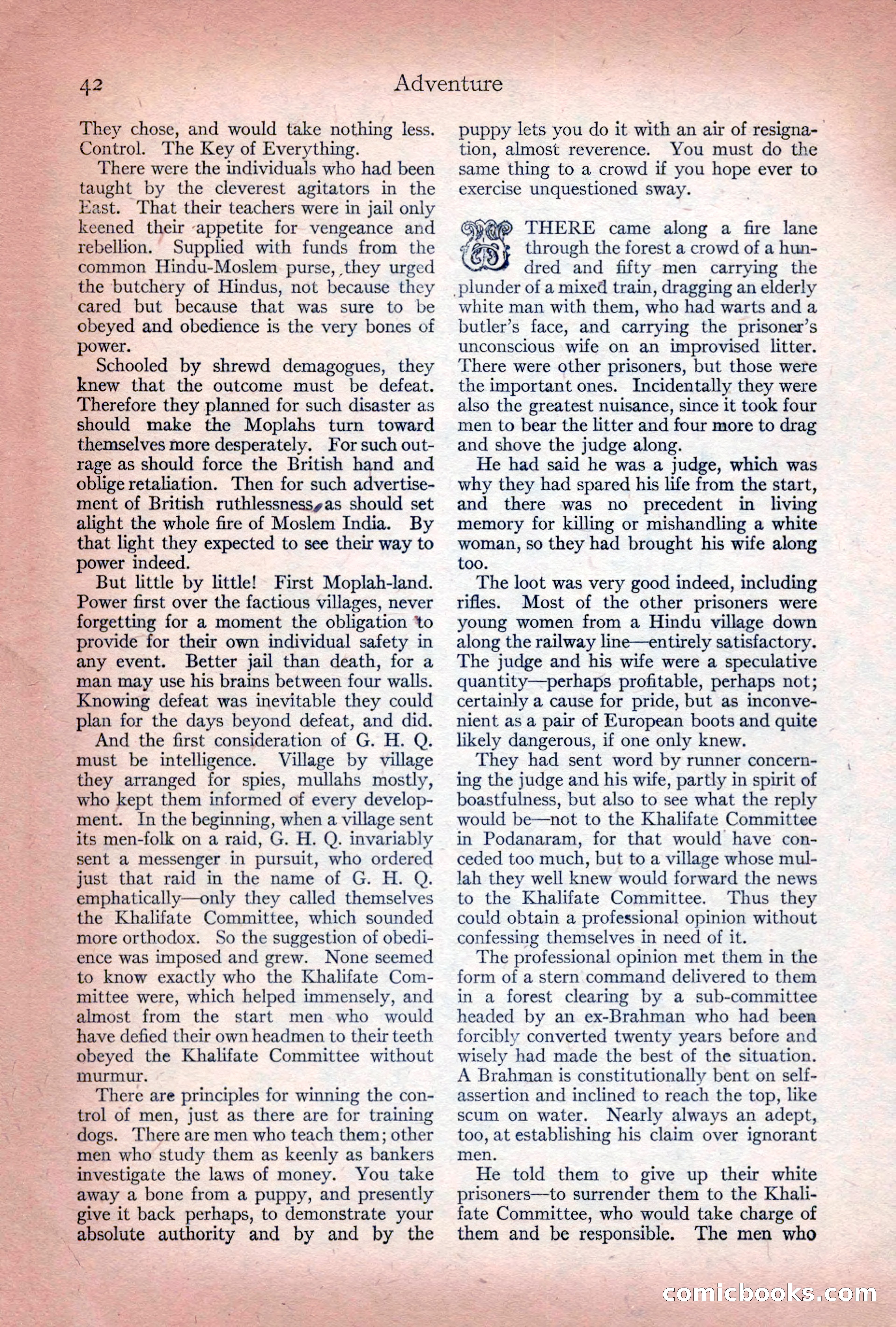
A restored page from Pulp Fiction, 1922. Page through the whole issue in the reader above.
📄 Transcribed text from this page (OCR, searchable)
Machine-transcribed from the original scan — historical spelling and the odd misread are preserved.
42 They chose, and would take nothing less. Control. The Key of Everything. There were the individuals who had been taught by the cleverest agitators in the East. That their teachers were in jail only keened their appetite for vengeance and rebellion. Supplied with funds from the common Hindu-Moslem purse, they urged the butchery of Hindus, not because they cared but because that was sure to be obeyed and obedience is the very bones of power. Schooled by shrewd demagogues, they knew that the outcome must be defeat. Therefore they planned for such disaster as should make the Moplahs turn toward themselves more desperately. For such out- rage as should force the British hand and oblige retaliation. Then for such advertise- ment of British ruthlessnessgas should set alight the whole fire of Moslem India. By that light they expected to see their way to power indeed. But little by little! First Moplah-land. Power first over the factious villages, never forgetting for a moment the obligation ‘to provide for their own individual safety in any event. Better jail than death, for a man may use his brains between four walls. Knowing defeat was inevitable they could plan for the days beyond defeat, and did. And the first consideration of G. H. Q. must be intelligence. Village by village they arranged for spies, mullahs mostly, who kept them informed of every develop- ment. In the beginning, when a village sent its men-folk on a raid, G. H. Q. invariably sent a messenger in pursuit, who ordered just that raid in the name of G. H. Q. emphatically—only they called themselves the Khalifate Committee, which sounded more orthodox. So the suggestion of obedi- ence was imposed and grew. None seemed to know exactly who the Khalifate Com- mittee were, which helped immensely, and almost from the start men who would have defied their own headmen to their teeth obeyed the Khalifate Committee without murmur. There are principles for winning the con- trol of men, just as there are for training -dogs. There are men who teach them; other men who study them as keenly as bankers investigate the laws of money. You take away a bone from a puppy, and presently give it back perhaps, to demonstrate your _ absolute authority and by and by the Adventure puppy lets you do it with an air of resigna- tion, almost reverence. You must do the same thing to a crowd if you hope ever to exercise unquestioned sway. THERE came along a fire lane through the forest a crowd of a hun- dred and fifty men carrying the GS plunder of a mixed train, dragging an elderly white man with them, who had warts and a butler’s face, and carrying the prisoner’s unconscious wife on an improvised litter. ‘There were other prisoners, but those were the important ones. Incidentally they were also the greatest nuisance, since it took four men to bear the litter and four more to drag and shove the judge along. He had said he was a judge, which was why they had spared his life from the start, and there was no precedent in living memory for killing or mishandling a white woman, so they had brought his wife along too. The loot was very good indeed, including rifles. Most of the other prisoners were young women from a Hindu village down along the railway line—entirely satisfactory. The judge and his wife were a speculative quantity—perhaps profitable, perhaps not; certainly a cause for pride, but as inconve- nient as a pair of European boots and quite likely dangerous, if one only knew. They had sent word by runner concern- ing the judge and his wife, partly in spirit of boastfulness, but also to see what the reply would be—not to the Khalifate Committee in Podanaram, for that would have con- ceded too much, but to a village whose mul- lah they well knew would forward the news to the Khalifate Committee. Thus they could obtain a professional opinion without confessing themselves in need of it. The professional opinion met them in the form of a stern command delivered to them in a forest clearing by a sub-committee headed by an ex-Brahman who had been forcibly converted twenty years before and wisely had made the best of the situation. A Brahman is constitutionally bent on self- assertion and inclined to reach the top, like scum on water. Nearly always an adept, too, at establishing his claim over ignorant men. He told them to give up their white prisoners—to surrender them to the Khali- fate Committee, who would take charge of them and be responsible. The men who Gomichbooks (E@)