
Pulp Fiction, 1922 · page 47 of 200
Adventure Magazine Cover, December 10, 1922 — page 47: what you’re looking at
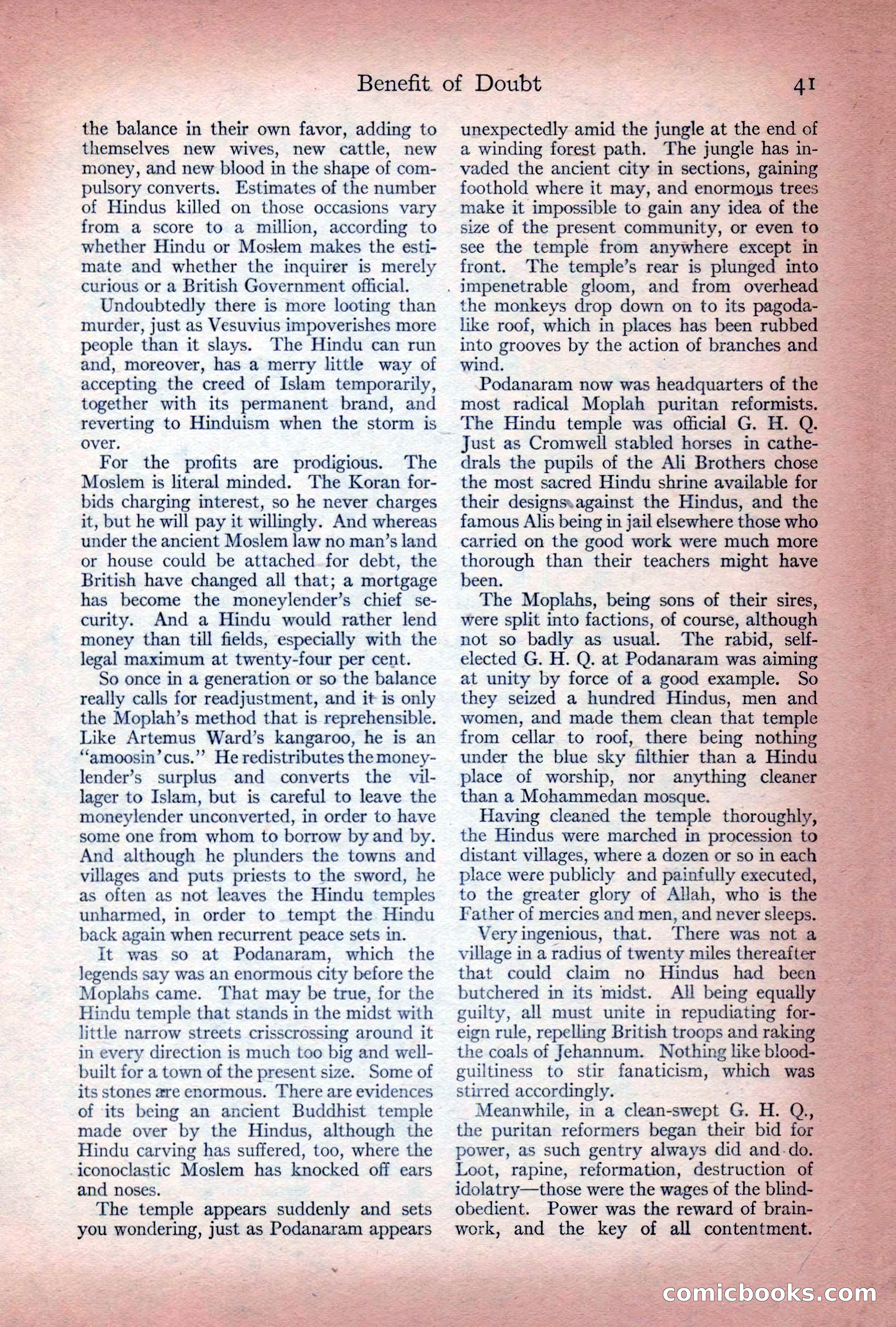
A restored page from Pulp Fiction, 1922. Page through the whole issue in the reader above.
📄 Transcribed text from this page (OCR, searchable)
Machine-transcribed from the original scan — historical spelling and the odd misread are preserved.
Benefit. of Doubt the balance in their own favor, adding to themselves new wives, new cattle, new money, and new blood in the shape of com- pulsory converts. Estimates of the number of Hindus killed on those occasions vary from a score to a million, according to whether Hindu or Moslem makes the esti- mate and whether the inquirer is merely curious or a British Government official. Undoubtedly there is more looting than murder, just as Vesuvius impoverishes more people than it slays. The Hindu can run and, moreover, has a merry little way of accepting the creed of Islam temporarily, together with its permanent brand, and reverting to Hinduism when the storm is over. For the profits are prodigious. The Moslem is literal minded. The Koran for- bids charging interest, so he never charges it, but he will pay it willingly. And whereas under the ancient Moslem law no man’s land or house could be attached for debt, the British have changed all that; a mortgage has become the moneylender’s chief se- curity. And a Hindu would rather lend money than till fields, especially with the legal maximum at twenty-four per cent. So once in a generation or so the balance really calls for readjustment, and it is only the Moplah’s method that is reprehensible. Like Artemus Ward’s kangaroo, he is an ‘“‘amoosin’cus.’’ He redistributes the money- lender’s surplus and converts the vil- lager to Islam, but is careful to leave the moneylender unconverted, in order to have some one from whom to borrow by and by. And although he plunders the towns and villages and puts priests to the sword, he as often as not leaves the Hindu temples unharmed, in order to tempt the Hindu back again when recurrent peace sets in. It was so at Podanaram, which the legends say was an enormous city before the Moplahs came. That may be true, for the Hindu temple that stands in the midst with little narrow streets crisscrossing around it in every direction is much too big and well- built for a town of the present size. Some of its stones are enormous. There are evidences of its being an ancient Buddhist temple made over by the Hindus, although the Hindu carving has suffered, too, where the iconoclastic Moslem has knocked off ears and noses. The temple appears suddenly and sets you wondering, just as Podanaram appears Al unexpectedly amid the jungle at the end of a winding forest path. The jungle has in- vaded the ancient city in sections, gaining foothold where it may, and enormous trees make it impossible to gain any idea of the size of the present community, or even to see the temple from anywhere except in front. The temple’s rear is plunged into . Jmpenetrable gloom, and from overhead the monkeys drop down on to its pagoda- like roof, which in places has been rubbed into grooves by the action of branches and wind. Podanaram now was headquarters of the most radical Moplah puritan reformists. The Hindu temple was official G. H. Q. Just as Cromwell stabled horses in cathe- drals the pupils of the Ali Brothers chose the most sacred Hindu shrine available for their designsxagainst the Hindus, and the famous Alis being in jail elsewhere those who carried on the good work were much more thorough than their teachers might have been. The Moplahs, being sons of their sires, were split into factions, of course, although not so badly as usual. The rabid, self- elected G. H. Q. at Podanaram was aiming at unity by force of a good example. So they seized a hundred Hindus, men and women, and made them clean that temple from cellar to roof, there being nothing under the blue sky filthier than a Hindu place of worship, nor anything cleaner than a Mohammedan mosque. Having cleaned the temple thoroughly, the Hindus were marched in procession to distant villages, where a dozen or so in each place were publicly and painfully executed, to the greater glory of Allah, who is the Father of mercies and men, and never sleeps. Very ingenious, that. There was not a village in a radius of twenty miles thereafter that could claim no Hindus had been butchered in its midst. All being equally guilty, all must unite in repudiating for- eign rule, repelling British troops and raking the coals of fehannum. Nothing like blood- guiltiness to stir fanaticism, which was stirred accordingly. Meanwhile, in a clean-swept G. H. Gs the puritan reformers began their bid for power, as such gentry always did and-do. Loot, rapine, reformation, destruction of idolatry—those were the wages of the blind- obedient. Power was the reward of brain- work, and the key of all contentment. Gcomicbooks (Eo)