
Pulp Fiction, 1922 · page 43 of 200
Adventure Magazine Cover, December 10, 1922 — page 43: what you’re looking at
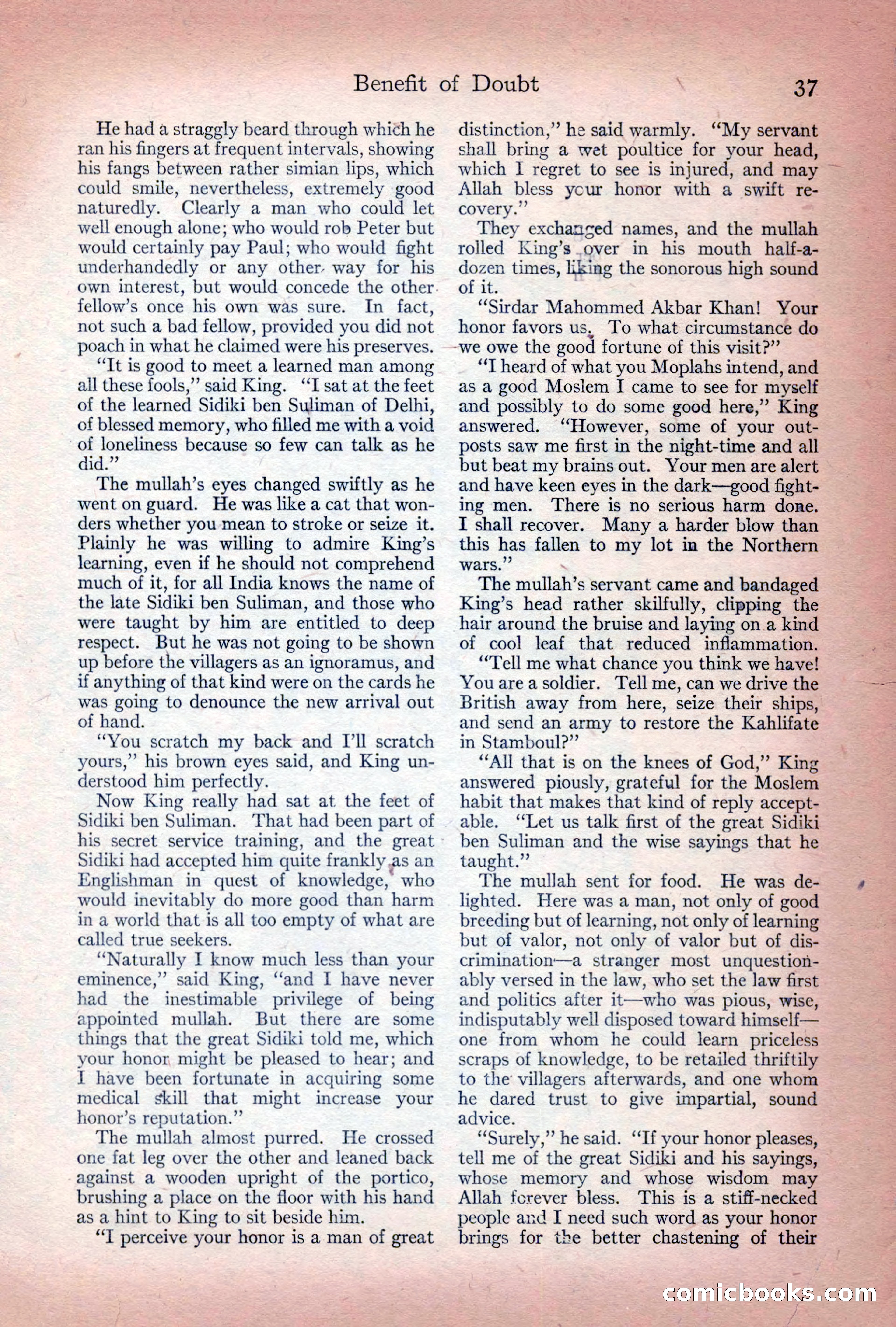
A restored page from Pulp Fiction, 1922. Page through the whole issue in the reader above.
📄 Transcribed text from this page (OCR, searchable)
Machine-transcribed from the original scan — historical spelling and the odd misread are preserved.
Benefit of Doubt : He had a straggly beard through whith he ran his fingers at frequent intervals, showing his fangs between rather simian lips, which could smile, nevertheless, extremely good naturedly. Clearly a man who could let well enough alone; who would rob Peter but would certainly pay Paul; who would fight underhandedly or any other. way for his own interest, but would concede the other. fellow’s once his own was sure. In fact, not such a bad fellow, provided you did not poach in what he claimed were his preserves. “It is good to meet a learned man among all these fools,” said King. “I sat at the feet of the learned Sidiki ben Suliman of Delhi, of blessed memory, who filled me with a void of loneliness because so few can talk as he did.” The mullah’s eyes changed swiftly as he went on guard. He was like a cat that won- ders whether you mean to stroke or seize it. Plainly he was willing to admire King’s learning, even if he should not comprehend much of it, for all India knows the name of the late Sidiki ben Suliman, and those who were taught by him are entitled to deep respect. But he was not going to be shown up before the villagers as an ignoramus, and if anything of that kind were on the cards he was going to denounce the new arrival out of hand. “You scratch my back and I'll scratch yours,” his brown eyes said, and King un- derstood him perfectly. Now King really had sat at the feet of Sidiki ben Suliman. That had been part of his secret service training, and the great Sidiki had accepted him quite frankly as an Englishman in quest of knowledge, who would inevitably do more good than harm in a world that is all too empty of what are called true seekers. “Naturally I know much less than your eminence,” said King, ‘‘and I have never had the inestimable privilege of being appointed mullah. But there are some things that the great Sidiki told me, which your honor might be pleased to hear; and I have been fortunate in acquiring some medical skill that might increase your honor’s reputation.”’ The mullah almost purred. He crossed one fat leg over the other and leaned back against a wooden upright of the portico, brushing a place on the floor with his hand as a hint to King to sit beside him. “TY perceive your honor is a man of great distinction,” he said warmly. ‘My servant shall bring a wet poultice for your head, which I regret to see is injured, and may Allah bless your honor with a swift re- covery.” They exchanged names, and the mullah rolled King’s over in his mouth half-a- dozen times, liking the sonorous high sound of it. “Sirdar Mahommed Akbar Khan! honor favors us, Your To what circumstance do -we owe the good fortune of this visit?” “T heard of what you Moplahs intend, and as a good Moslem I came to see for myself and possibly to do some good here,” King answered. ‘However, some of your out- posts saw me first in the night-time and all but beat my brains out. Your men are alert and have keen eyes in the dark—good fight- ing men. There is no serious harm done. I shall recover. Many a harder blow than this has fallen to my lot in the Northern wars.’ The mullah's servant came and bandaged King’s head rather skilfully, clipping the hair around the bruise and laying on a kind of cool leaf that reduced inflammation. ‘Tell me what chance you think we have! You area soldier. Tell me, can we drive the British away from here, seize their ships, and send an army to restore the Kahlifate in Stamboul?”’ “All that is on the knees of God,” King answered piously, grateful for the Moslem habit that makes that kind of reply accept- able. ‘Let us talk first of the great Sidiki ben Suliman and the wise sayings that he taught.” The mullah sent for food. He was de- lighted. Here was a man, not only of good breeding but of learning, not only of learning but of valor, not only of valor but of dis- crimination—a stranger most unquestion- ably versed in the law, who set the law first and politics after it—who was pious, wise, indisputably well disposed toward himself— one from whom he could learn priceless scraps of knowledge, to be retailed thriftily to the villagers afterwards, and one whom he dared trust to give impartial, sound advice. “Surely,” he said. “If your honor pleases, tell me of the great Sidiki and his sayings, © whose memory and whose wisdom may Allah forever bless. This is a stiff-necked people and I need such word as your honor brings for the better chastening of their -_ Eomichoo im (E(0) - ' ; 4,07) ( ‘ ¢ BR ae RN Sa, { i" 1 ‘ vig vs “4 PAR | tie eh SAY i vi, t ha Wi) f ¥ . Pa, 4 es fdgres +f P WaAbis Pate & ’ ‘ie. “IN . ; ‘ 4 \ ¥ ete iL SAMA iy TR eae erry) ae | ¥ fall aid ty phe Ay) (Pa vi 9) ea i ee ST Ory Any a AE ee “S Hs $ -