
Pulp Fiction, 1922 · page 42 of 200
Adventure Magazine Cover, December 10, 1922 — page 42: what you’re looking at
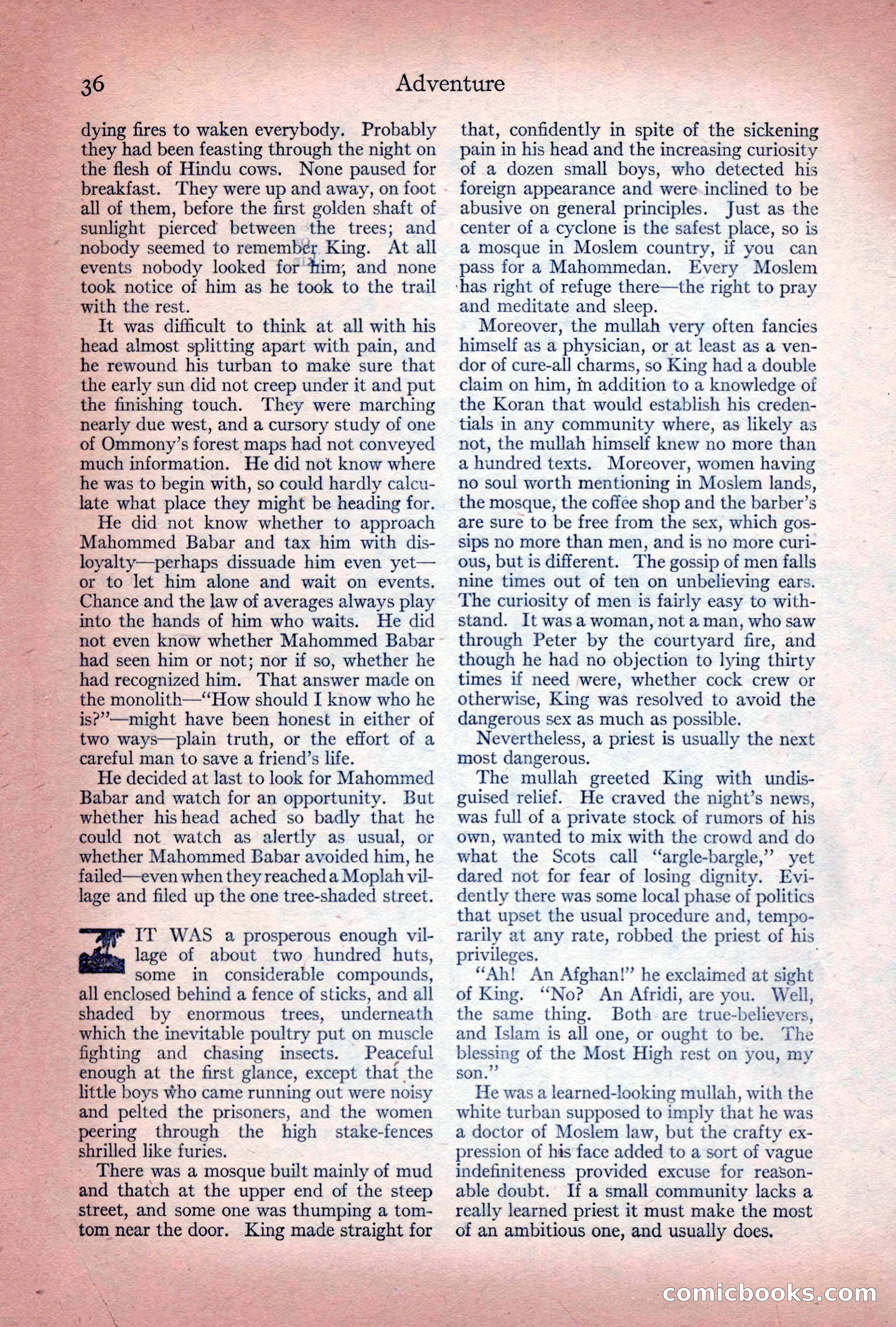
A restored page from Pulp Fiction, 1922. Page through the whole issue in the reader above.
📄 Transcribed text from this page (OCR, searchable)
Machine-transcribed from the original scan — historical spelling and the odd misread are preserved.
26 dying fires to waken everybody. Probably they had been feasting through the night on the flesh of Hindu cows. None paused for breakfast. They were up and away, on foot all of them, before the first golden shaft of sunlight pierced between the trees; and nobody seemed to remember King. At all events nobody looked for’trim;, and none took notice of him as he took to the trail with the rest. It was difficult to think at all with his head almost splitting apart with pain, and he rewound his turban to make sure that the early sun did not creep under it and put the finishing touch. They were marching nearly due west, and a cursory study of one of Ommony’s forest maps had not conveyed much information. He did not know where he was to begin with, so could hardly calcu- late what place they might be heading for. He did not know whether to approach Mahommed Babar and tax him with dis- loyalty—perhaps dissuade him even yet— or to let him alone and wait on events. Chance and the law of averages always play into the hands of him who waits. He did not even know whether Mahommed Babar had seen him or not; nor if so, whether he had recognized him. That answer made on the monolith—*‘How should I know who he is?’—might have been honest in either of two ways—plain truth, or the effort of a careful man to save a friend’s life. He decided at last to look for Mahommed Babar and watch for an opportunity. But whether his head ached so badly that he could not watch as alertly as usual, or whether Mahommed Babar avoided him, he failed—even when they reached a Moplah vil- lage and filed up the one tree-shaded street. IT WAS a prosperous enough vil- lage of about two hundred huts, some in considerable compounds, all enclosed behind a fence of sticks, and all shaded by enormous trees, underneath which the inevitable poultry put on muscle fighting and chasing insects. Peaceful enough at the first glance, except that the little boys who came running out were noisy and pelted the prisoners, and the women peering through the high stake-fences shrilled like furies. There was a mosque built mainly of mud and thatch at the upper end of the steep street, and some one was thumping a tom- tom near the door. King made straight for Adventure that, confidently in spite of the sickening pain in his head and the increasing curiosity of a dozen small boys, who detected his foreign appearance and were inclined to be abusive on general principles. Just as the center of a cyclone is the safest place, so is a mosque in Moslem country, if you can pass for a Mahommedan. Every Moslem ‘has right of refuge there—the right to pray and meditate and sleep. Moreover, the mullah very often fancies himself as a physician, or at least as a ven- dor of cure-all charms, so King had a double claim on him, im addition to a knowledge of the Koran that would establish his creden- tials in any community where, as likely as not, the mullah himself knew no more than a hundred texts. Moreover, women having no soul worth mentioning in Moslem lands, the mosque, the coffee shop and the barber’s are sure to be free from the sex, which gos- sips no more than men, and is no more curi- ous, but is different. The gossip of men falls nine times out of ten on unbelieving ears. The curiosity of men is fairly easy to with- stand. It wasa woman, not a man, who saw through Peter by the courtyard fire, and though he had no objection to lying thirty times if need were, whether cock crew or otherwise, King was resolved to avoid the dangerous sex as much as possible. Nevertheless, a priest is usually the next most dangerous. The mullah greeted King with undis- guised relief. He craved the night’s news, was full of a private stock of rumors of his own, wanted to mix with the crowd and do what the Scots call “argle-bargle,” yet dared not for fear of losing dignity. Evi- dently there was some local phase of politics that upset the usual procedure and, tempo- rarily at any rate, robbed the priest of his privileges. “Ah! An Afghan!” he exclaimed at sight of King. “No? An Afridi, are you. Well, the same thing. Both are true-believers, and Islam is all one, or ought to be. The blessing of the Most High rest on you, my son.”’ He was a learned-looking mullah, with the white turban supposed to imply that he was a doctor of Moslem law, but the crafty ex- pression of his face added to a sort of vague indefiniteness provided excuse for reason- able doubt. If a small community lacks a really learned priest it must make the most of an ambitious one, and usually does. comicbooks. (E(0)