
Pulp Fiction, 1922 · page 150 of 200
Adventure Magazine Cover, December 10, 1922 — page 150: what you’re looking at
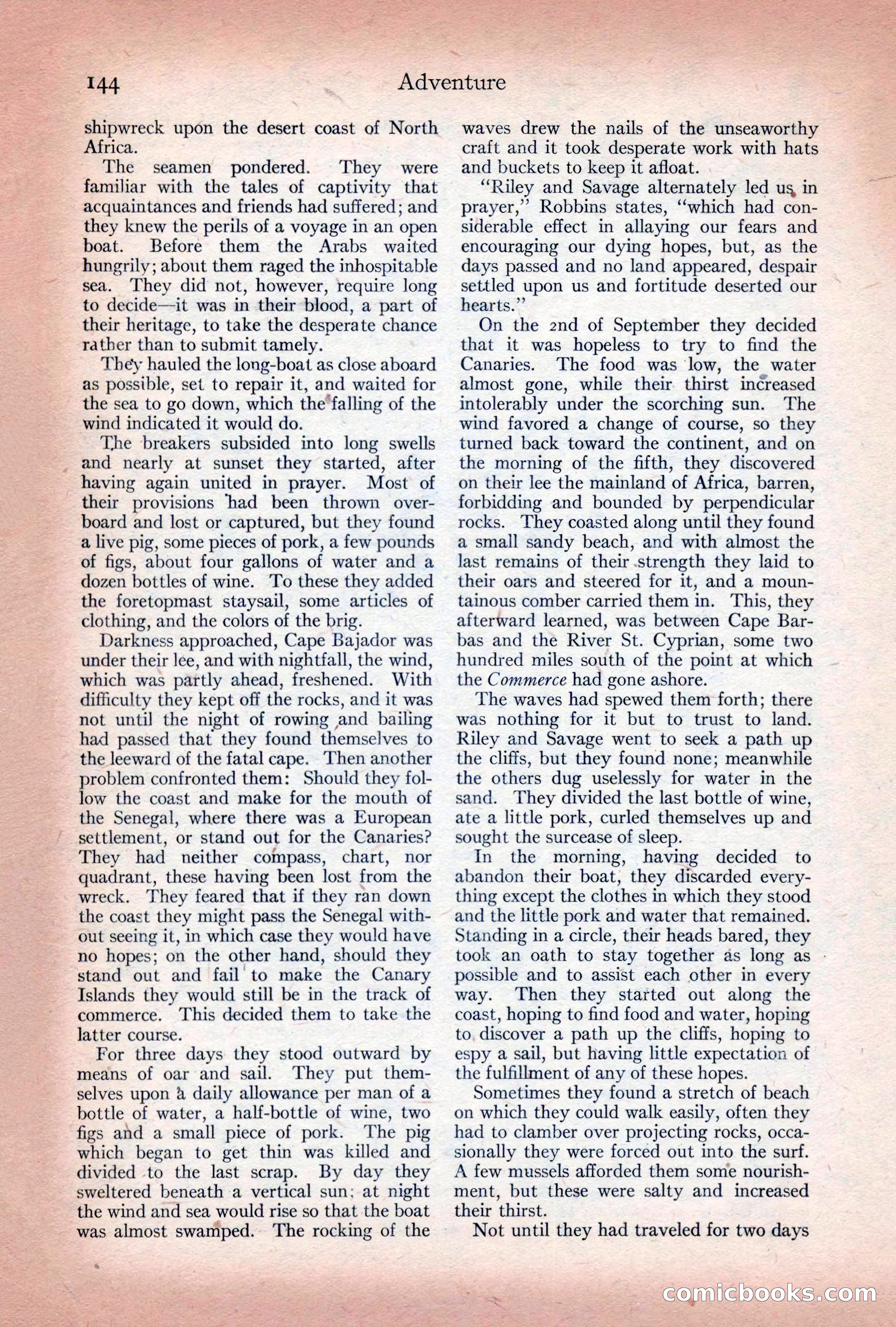
A restored page from Pulp Fiction, 1922. Page through the whole issue in the reader above.
📄 Transcribed text from this page (OCR, searchable)
Machine-transcribed from the original scan — historical spelling and the odd misread are preserved.
144 shipwreck upon the desert coast of North Africa. The seamen pondered. They were familiar with the tales of captivity that acquaintances and friends had suffered; and they knew the perils of a voyage in an open boat. Before them the Arabs waited hungrily; about them raged the inhospitable sea. ‘They did not, however, require long to decide—it was in their blood, a part of their heritage, to take the desperate chance rather than to submit tamely. They hauled the long-boat as close aboard as possible, set to repair it, and waited for the sea to go down, which the falling of the wind indicated it would do. The breakers subsided into long swells _ and nearly at sunset they started, after having again united in prayer. Most of their provisions had been thrown over- board and lost or captured, but they found a live pig, some pieces of pork, a few pounds of figs, about four gallons of water and a dozen bottles of wine. To these they added the foretopmast staysail, some articles of clothing, and the colors of the brig. Darkness approached, Cape Bajador was under their lee, and with nightfall, the wind, which was partly ahead, freshened. With difficulty they kept off the rocks, and it was not until the night of rowing and bailing had passed that they found themselves to the leeward of the fatal cape. Then another problem confronted them: Should they fol- low the coast and make for the mouth of the Senegal, where there was a European settlement, or stand out for the Canaries? They had neither compass, chart, nor quadrant, these having been lost from the wreck. They feared that if they ran down the coast they might pass the Senegal with- out seeing it, in which case they would have no hopes; on the other hand, should they stand out and fail to make the Canary Islands they would still be in the track of commerce. ‘This decided them to take the latter course. For three days they stood outward by means of oar and sail. They put them- selves upon & daily allowance per man of a bottle of water, a half-bottle of wine, two figs and a small piece of pork. The pig which began to get thin was killed and divided to the last scrap. By day they sweltered beneath a vertical sun; at night the wind and sea would rise so that the boat was almost swamped. The rocking of the Adventure waves drew the nails of the unseaworthy craft and it took desperate work with hats and buckets to keep it afloat. “Riley and Savage alternately led us in prayer,’ Robbins states, “which had con- siderable effect in allaying our fears and encouraging our dying hopes, but, as the days passed and no land appeared, despair settled upon us and fortitude deserted our hearts.” On the 2nd of September they decided that it was hopeless to try to find the Canaries. The food was low, the water almost gone, while their thirst increased intolerably under the scorching sun. The wind favored a change of course, so they turned back toward the continent, and on the morning of the fifth, they discovered on their lee the mainland of Africa, barren, forbidding and bounded by perpendicular rocks. They coasted along until they found a small sandy beach, and with almost the last remains of their .strength they laid to their oars and steered for it, and a moun- tainous comber carried them in. ‘This, they afterward learned, was between Cape Bar- bas and the River St. Cyprian, some two hundred miles south of the point at which the Commerce had gone ashore. The waves had spewed them forth; there was nothing for it but to trust to land. Riley and Savage went to seek a path up the cliffs, but they found none; meanwhile the others dug uselessly for water in the sand. They divided the last bottle of wine, ate a little pork, curled themselves up and sought the surcease of sleep. In the morning, having decided to abandon their boat, they discarded every- thing except the clothes in which they stood and the little pork and water that remained. Standing in a circle, their heads bared, they took an oath to stay together as long as - possible and to assist each other in every way. Then they started out along the coast, hoping to find food and water, hoping to. discover a path up the cliffs, hoping to espy a sail, but having little expectation of the fulfillment of any of these hopes. Sometimes they found a stretch of beach on which they could walk easily, often they had to clamber over projecting rocks, occa- sionally they were forced out into the surf. A few mussels afforded them some nourish- ment, but these were salty and increased their thirst. Not until they had traveled for two days Eomicbooks 4 (E)