
Pulp Fiction, 1922 · page 148 of 200
Adventure Magazine Cover, December 10, 1922 — page 148: what you’re looking at
A restored page from Pulp Fiction, 1922. Page through the whole issue in the reader above.
📄 Transcribed text from this page (OCR, searchable)
Machine-transcribed from the original scan — historical spelling and the odd misread are preserved.
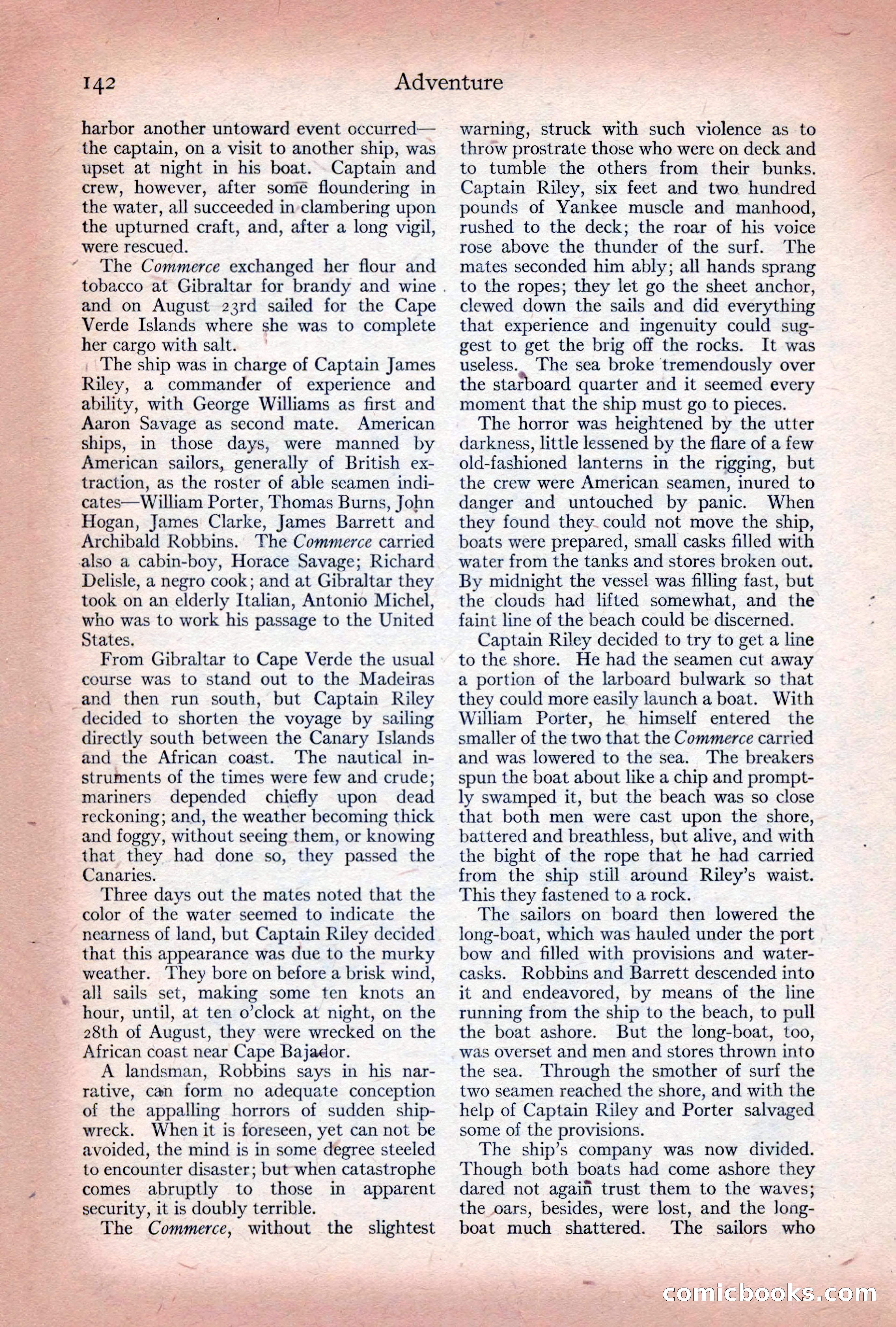
142 harbor another untoward event occurred— the captain, on a visit to another ship, was upset at night in his boat. Captain and crew, however, after somé floundering in the water, all succeeded in clambering upon the upturned craft, and, after a long vigil, were rescued. The Commerce exchanged her flour and tobacco at Gibraltar for brandy and wine . and on August 23rd sailed for the Cape Verde Islands where she was to complete her cargo with salt. _ The ship was in charge of Captain James Riley, a commander of experience and ability, with George Williams as first and Aaron Savage as second mate. American ships, in those days, were manned by American sailors, generally of British ex- traction, as the roster of able seamen indi- cates—William Porter, Thomas Burns, John Hogan, James Clarke, James Barrett and Archibald Robbins. The Commerce carried also a cabin-boy, Horace Savage; Richard Delisle, a negro cook; and at Gibraltar they took on an elderly Italian, Antonio Michel, who was to work his passage to the United States. From Gibraltar to Cape Verde the usual course was to stand out to the Madeiras and then run south, but Captain Riley decided to shorten the voyage by sailing directly south between the Canary Islands and the African coast. The nautical in- struments of the times were few and crude; mariners depended chiefly upon dead reckoning; and, the weather becoming thick and foggy, without seeing them, or knowing that they had done so, they passed the Canaries. Three days out the mates noted that the color of the water seemed to indicate the nearness of land, but Captain Riley decided that this appearance was due to the murky weather. They bore on before a brisk wind, all sails set, making some ten knots an hour, until, at ten o’clock at night, on the 28th of August, they were wrecked on the African coast near Cape Bajador. A landsman, Robbins says in his nar- rative, can form no adequate conception of the appalling horrors of sudden ship- wreck. When it is foreseen, yet can not be avoided, the mind is in some degree steeled to encounter disaster; but when catastrophe comes abruptly to those in apparent security, it is doubly terrible. The Commerce, without the slightest Adventure warning, struck with such violence as to throw prostrate those who were on deck and to tumble the others from their bunks, Captain Riley, six feet and two hundred pounds of Yankee muscle and manhood, rushed to the deck; the roar of his voice rose above the thunder of the surf. The mates seconded him ably; all hands sprang to the ropes; they let go the sheet anchor, clewed down the sails and did everything that experience and ingenuity could sug- gest to get the brig off the rocks. It was useless. The sea broke tremendously over the starboard quarter and it seemed every moment that the ship must go to pieces. The horror was heightened by the utter darkness, little lessened by the flare of a few old-fashioned lanterns in the rigging, but the crew were American seamen, inured to danger and untouched by panic. When they found they. could not move the ship, boats were prepared, small casks filled with water from the tanks and stores broken out. By midnight the vessel was filling fast, but the clouds had lifted somewhat, and the faint line of the beach could be discerned. Captain Riley decided to try to get a line to the shore. He had the seamen cut away a portion of the larboard bulwark so that they could more easily launch a boat. With William Porter, he himself entered the smaller of the two that the Commerce carried and was lowered to the sea. The breakers spun the boat about like a chip and prompt- ly swamped it, but the beach was so close that both men were cast upon the shore, battered and breathless, but alive, and with the bight of the rope that he had carried from the ship still around Riley’s waist. This they fastened to a rock. The sailors on board then lowered the long-boat, which was hauled under the port bow and filled with provisions and water- casks. Robbins and Barrett descended into it and endeavored, by means of the line running from the ship to the beach, to pull the boat ashore. But the long-boat, too, was overset and men and stores thrown into the sea. Through the smother of surf the two seamen reached the shore, and with the help of Captain Riley and Porter salvaged some of the provisions. The ship’s company was now divided. Though both boats had come ashore they dared not again trust them to the waves; the oars, besides, were lost, and the Jong- boat much shattered. The sailors who ecomicbooks co