
Pulp Fiction, 1922 · page 11 of 200
Adventure Magazine Cover, December 10, 1922 — page 11: what you’re looking at
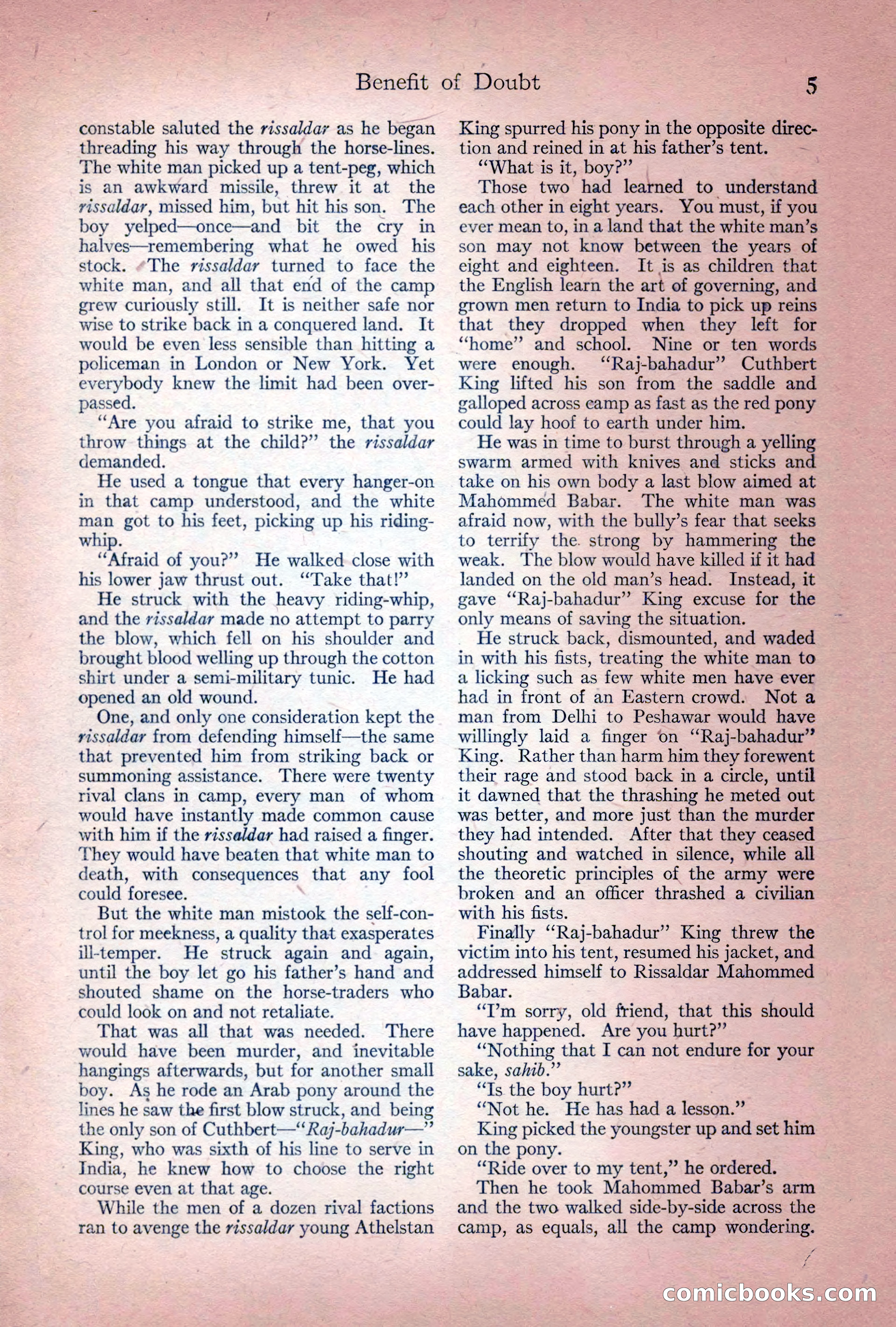
A restored page from Pulp Fiction, 1922. Page through the whole issue in the reader above.
📄 Transcribed text from this page (OCR, searchable)
Machine-transcribed from the original scan — historical spelling and the odd misread are preserved.
Benefit of Doubt constable saluted the rissalday as he began threading his way through the horse-lines. The white man picked up a tent-peg, which is an awkward missile, threw it at the vissaldar, missed him, but hit his son. The boy yelped—once—and bit the cry in halves—remembering what he owed his stock. «The rissaldar turned to face the white man, and all that end of the camp grew curiously still. It is neither safe nor wise to strike back in a conquered land. It would be even less sensible than hitting a policeman in London or New York. Yet everybody knew the limit had been over- passed. “Are you afraid to strike me, that you throw things at the child?” the rissaldar demanded. He used a tongue that every hanger-on in that camp understood, and the white man got to his feet, picking up his riding- whip. “Afraid of you?” He walked close with his lower jaw thrust out. ‘Take that!” He struck with the heavy riding-whip, and the rissaldar made no attempt to parry the blow, which fell on his shoulder and brought blood welling up through the cotton shirt under a semi-military tunic. He had opened an old wound. One, and only one consideration kept the vissaldar from defending himself—the same that prevented him from striking back or summoning assistance. There were twenty rival clans in camp, every man of whom would have instantly made common cause with him if the rissaldar had raised a finger. They would have beaten that white man to death, with consequences that any fool could foresee. But the white man mistook the self-con- trol for meekness, a quality that exasperates ill-temper. He struck again and again, until the boy let go his father’s hand and shouted shame on the horse-traders who could look on and not retaliate. That was all that was needed. There would have been murder, and inevitable hangings afterwards, but for another small boy. As he rode an Arab pony around the lines he saw the first blow struck, and being the only son of Cuthbert—‘“‘Raj-bahadur—” King, who was sixth of his line to serve in India, he knew how to choose the right course even at that age. While the men of a dozen rival factions ran to avenge the rissaldar young Athelstan King spurred his pony in the opposite direc- _— tion and reined in at his father’s tent. “What is it, boy?” | Those two had learned to understand — each other in eight years. You must, if you ever mean to, in a land that the white man’s son may not know between the years of eight and eighteen. It is as children that the English learn the art of governing, and grown men return to India to pick up reins that they dropped when they left for “home” and school. Nine or ten words were enough. ‘‘Raj-bahadur” Cuthbert King lifted his son from the saddle and galloped across eamp as fast as the red pony could lay hoof to earth under him. He was in time to burst through a yelling swarm armed with knives and sticks and take on his own body a last blow aimed at Mahommed Babar. The white man was afraid now, with the bully’s fear that seeks to terrify the. strong by hammering the weak. The blow would have killed if it had landed on the old man’s head. Instead, it gave ‘‘Raj-bahadur” King excuse for the only means of saving the situation. He struck back, dismounted, and waded in with his fists, treating the white man to a licking such as few white men have ever had in front of an Eastern crowd. Not a man from Delhi to Peshawar would have willingly laid a finger on “Raj-bahadur” King. Rather than harm him they forewent their rage and stood back in a circle, until it dawned that the thrashing he meted out was better, and more just than the murder they had intended. After that they ceased shouting and watched in silence, while all the theoretic principles of the army were broken and an officer thrashed a civilian with his fists. Finally ‘“Raj-bahadur”’ King threw the victim into his tent, resumed his jacket, and addressed himself to Rissaldar Mahommed — Babar. “T’m sorry, old friend, that this should have happened. Are you burt?” “Nothing that I can not endure for your sake, sahib.”’ “Ts the boy hurt?” “Not he. He has had a lesson.” King picked the youngster up and set him on the pony. “Ride over to my tent,” he ordered. Then he took Mahommed Babar’s arm and the two walked side-by-side across the camp, as equals, all the camp wondering. a i f micboo (eo) Ss (e(0)