
Pulp Fiction, 1922 · page 10 of 200
Adventure Magazine Cover, December 10, 1922 — page 10: what you’re looking at
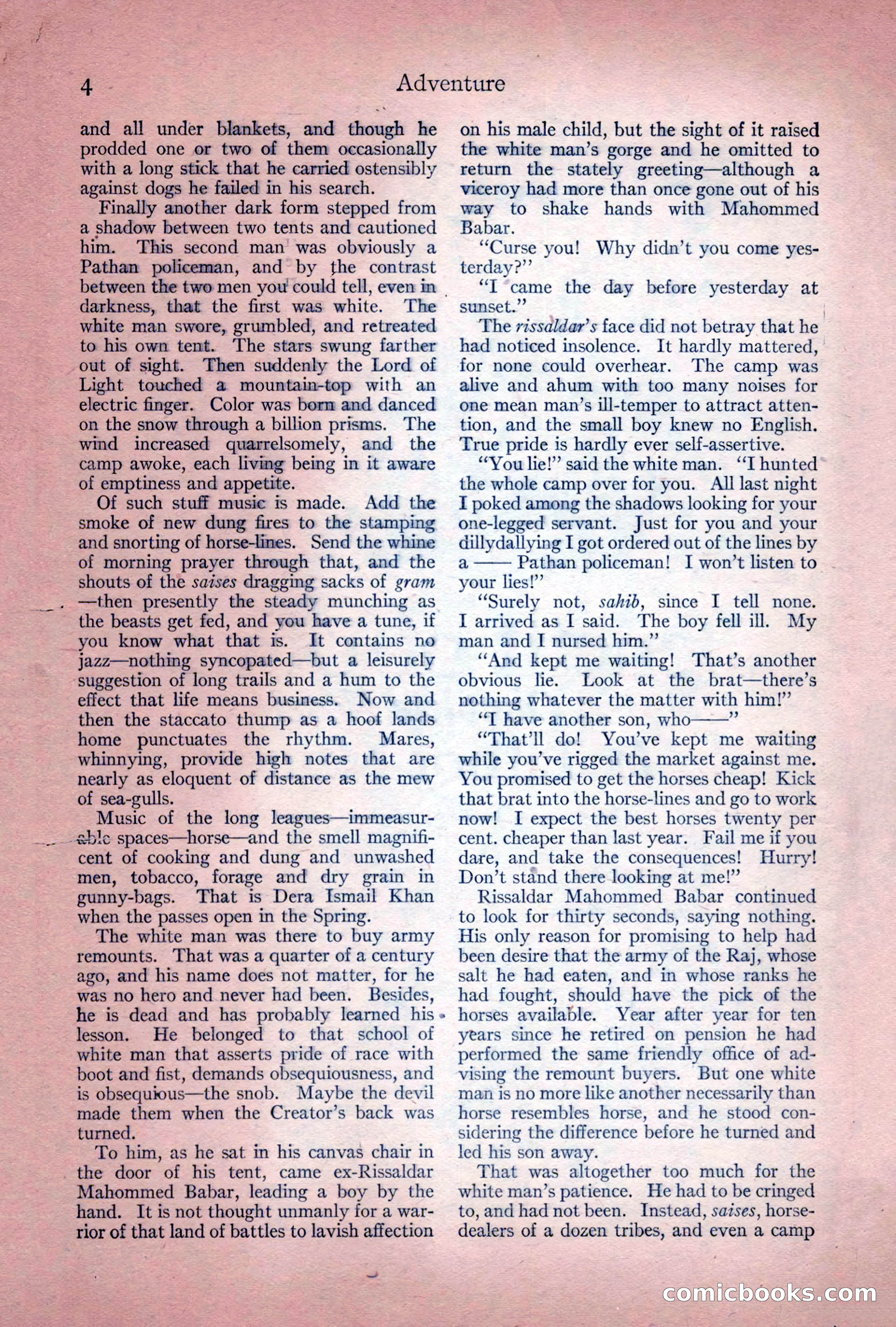
A restored page from Pulp Fiction, 1922. Page through the whole issue in the reader above.
📄 Transcribed text from this page (OCR, searchable)
Machine-transcribed from the original scan — historical spelling and the odd misread are preserved.
and all under blankets, and though he prodded one or two of them occasionally with a long stick that he carried ostensibly against dogs he failed in his search. ae —~ Finally another dark form stepped from _ a shadow between two tents and cautioned him. This second man was obviously a Pathan policeman, and by the contrast between the two men you could tell, even mn — darkness, that the first was white. The white man swore, grumbled, and retreated to his own tent. The stars swung farther out of sight. Then suddenly the Lord of Light touched a mountain-top with an electric finger. Color was borm and danced on the snow through a billion prisms. The wind increased quarrelsomely, and the camp awoke, each living being in it aware of emptiness and appetite. Of such stuff music is made. Add the smoke of new dung fires to the stamping and snorting of horse-lines. Send the whine of morning prayer through that, and the shouts of the saises dragging sacks of gram . —then presently the steady munching as _ the beasts get fed, and you have a tune, if you know what that is. It contains no jazz—nothing syncopated—but a leisurely ‘suggestion of long trails and a hum to the effect that life means business. Now and then the staccato thump as a hoof lands home punctuates the rhythm. Mares, whinnying, provide high notes that are nearly as eloquent of distance as the mew of sea-gulls. Music of the long leagues—immeasur- -xble spaces—horse—and the smell magnifi- cent of cooking and dung and unwashed men, tobacco, forage and dry grain in gunny-bags. That is Dera Ismail Khan when the passes open in the Spring. The white man was there to buy army remounts. That was a quarter of a century ago, and his name does not matter, for he was no hero and never had been. Besides, he is dead and has probably learned his lesson. He belonged to that school of white man that asserts pride of race with boot and fist, demands obsequiousness, and is obsequious—the snob. Maybe the devil made them when the Creator’s back was turned. To him, as he sat in his canvas chair in _the door of his tent, came ex-Rissaldar Mahommed Babar, leading a boy by the hand. It is not thought unmanly for a war- rior of that land of battles to lavish affection — Adventure on his male child, but the sight of it raised the white man’s gorge and he omitted to return the stately greeting—although a viceroy had more than once gone out of his way to shake hands with Mahommed Babar. “Curse you! Why didn’t you come yes- terday?”’ “I “came the day before yesterday at sunset.” The rissaldar’s face did not betray that he | had noticed insolence. It hardly mattered, for none could overhear. The camp was alive and ahum with too many noises for one mean man’s ill-temper to attract atten- tion, and the small boy knew no English. True pride is hardly ever self-assertive. “You lie!” said the white man. “I hunted the whole camp over for you. All last night I poked among the shadows looking for your one-legged servant. Just for you and your dillydallying I got ordered out of the lines by a Pathan policeman! I won’t listen to your lies!’’ “Surely not, sahib, since I tell none. I arrived as I said. The boy fell ill. My man and I nursed him.” “And kept me waiting! That’s another obvious lie. Look at the brat—there’s nothing whatever the matter with him!” “T have another son, who——” “That'll do! You’ve kept me waiting while you’ve rigged the market against me. You promised to get the horses cheap! Kick that brat into the horse-lines and go to work now! I expect the best horses twenty per cent. cheaper than last year. Fail me if you dare, and take the consequences! Hurry! Don’t stand there looking at me!” Rissaldar Mahommed Babar continued to look for thirty seconds, saying nothing. His only reason for promising to help had been desire that the army of the Raj, whose salt he had eaten, and in whose ranks he had fought, should have the pick of the horses available. Year after year for ten years since he retired on pension he had performed the same friendly office of ad- vising the remount buyers. But one white man is no more like another necessarily than horse resembles horse, and he stood con- sidering the difference before he turned and led his son away. That was altogether too much for the white man’s patience. He had to be cringed to, and had not been. Instead, saises, horse- dealers of a dozen tribes, and even a camp (€(0) _.OOKS AME (E(0)