
Pulp Fiction, 1922 · page 192 of 196
Adventure Magazine Cover — page 192: what you’re looking at
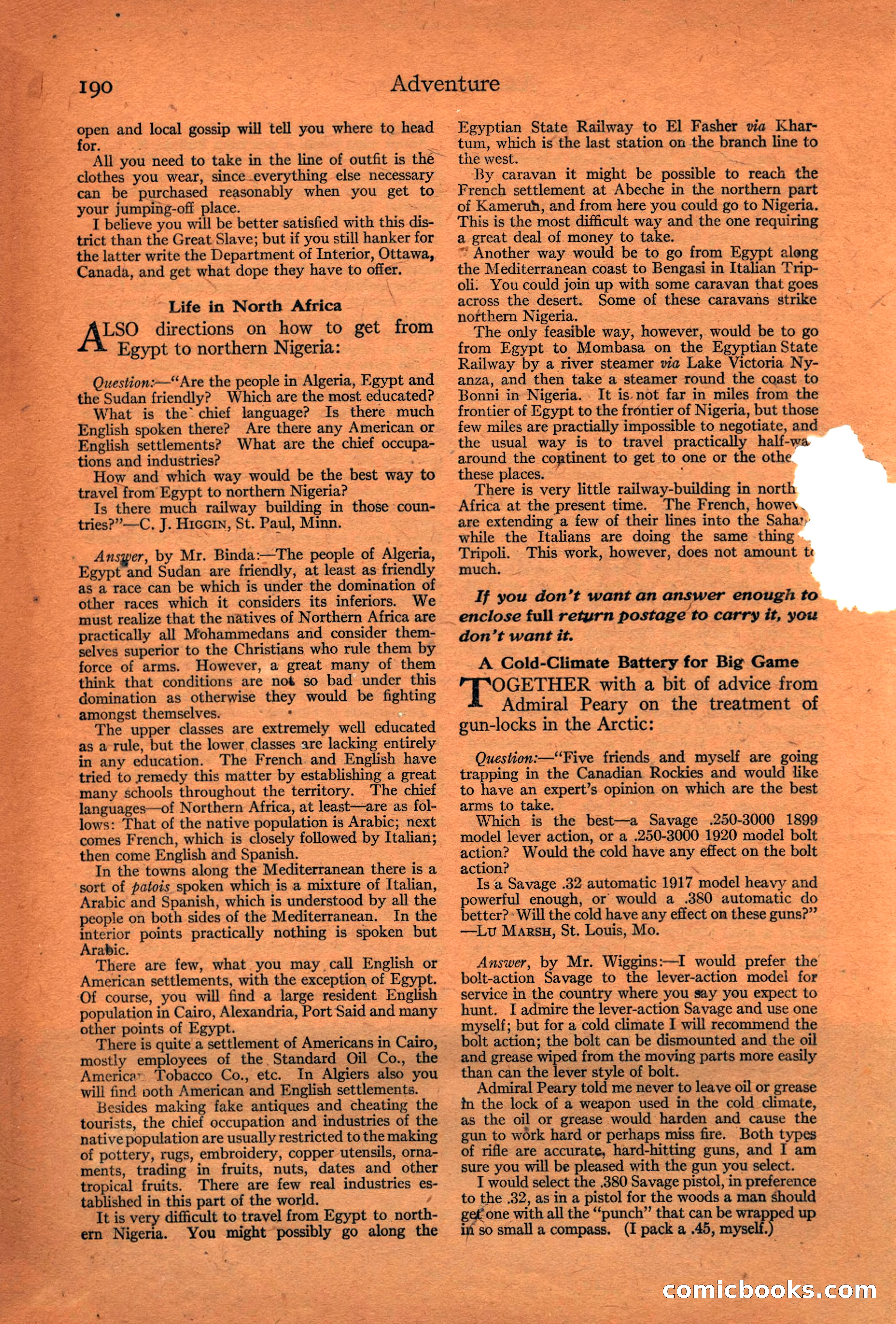
A restored page from Pulp Fiction, 1922. Page through the whole issue in the reader above.
📄 Transcribed text from this page (OCR, searchable)
Machine-transcribed from the original scan — historical spelling and the odd misread are preserved.
ae om ieee bs 4) 190 at \ eae : ee All you need to take in the line of outfit is the open and local gossip will tell you where to head clothes you wear, since.everything else necessary can be purchased reasonably when you get to — your jumping-off place. ~~ | believe you will be better satisfied with this dis- trict than the Great Slave; but if you still hanker for the latter write the Department of Interior, Ottawa, Canada, and get what dope they have to offer. - * Life in North Africa Ais directions on how to get from Egypt to northern Nigeria: - Question>—“Are the people in Algeria, Egypt and the Sudan friendly? Which are the most educated? What is the’ chief language? Is there much English spoken there? Are there any American or English settlements? What are the chief occupa- tions and industries? ' How and which way would be the best way travel from Egypt to northern Nigeria? Is there much railway building in those coun- tries?” —C, J. Hiccery, St. Paul, Minn. Answer, by Mr. Binda :—The people of Algeria, Egypt and Sudan are friendly, at least as friendly as a race can be which is under the domination of other races which it considers its inferiors. We must realize that the natives of Northern Africa are practically all Mohammedans and consider them- selves superior to the Christians who rule them by force of arms. However, a great many of them think that conditions are nots so bad under this domination as otherwise they would be fighting amongst themselves. oe The upper classes are extremely well educated as a rule, but the lower, classes are lacking entirely in any education. The French and English have - tried to remedy this matter by establishing a great many schools throughout the territory. The chief languages—of Northern Africa, at least—are as fol- lows: That of the native population is Arabic; next comes French, which is closely followed by Italian; then come English and Spanish. In the towns along the Mediterranean there is a sort of patois spoken which is a mixture of Italian, Arabic and Spanish, which is understood by all the people on both sides of the Mediterranean. In the interior points practically nothing is spoken but Arabic. There are few, what you may call English or American settlements, with the exception of Egypt. ‘Of course, you will find a large resident English - population in Cairo, Alexandria, Port Said and many other points of Egypt. There is quite a settlement of Americans in Cairo, mostly employees of the Standard Oil Co., the Americar Tobacco Co., etc. In Algiers also you will find noth American and English settlements. Besides making fake antiques and cheating the tourists, the chief occupation and industries of the native population are usually restricted to the making of pottery, rugs, embroidery, copper utensils, orna- ‘ments, trading in fruits, nuts, dates and other _ tropical fruits. There are few real industries es- tablished in this part of the world. ; It is very difficult to travel from Egypt to north- ern Nigeria. You might possibly go along the Adventure Egyptian State Railway to El Fasher via Khar- tum, which is the last station on the branch line to the west. ae By caravan it might be possible to reach the French settlement at Abeche in the northern part of Kameruh, and from here you could go to Nigeria. This is the most difficult way and the one requiring a great deal of money to take. “ Another way would be to go from Egypt along the Mediterranean coast to Bengasi in Italian Trip- oli. You could join up with some caravan that goes across the desert. Some of these caravans strike northern Nigeria. The only feasible way, however, would be to go from Egypt to Mombasa on the Egyptian State Railway by a river steamer via Lake Victoria Ny- anza, and then take a steamer round the coast to Bonni in Nigeria. . It is not far in miles from the frontier of Egypt to the frontier of Nigeria, but those few miles are practially impossible to negotiate, and the usual way is to travel practically half-wa around the coptinent to get to one or the othe. these places. © There is very little railway-building in north Africa at the present time. The French, howevy. are extending a few of their lines into the Saha, while the Italians are doing the same thing epol - This work, however, does not amount t« much, _ If you don’t want an answer enough to _enclose full return postage’: to carry it, you don’t want it. A Cold-Climate Battery for Big Game OGETHER with a bit of advice from Admiral Peary on the treatment of gun-locks in the Arctic: . Question:—‘Five friends and myself are going trapping in the Canadian Rockies and would like _ to have an expert’s opinion on which are the best arms to take. : Which is the best—a Savage .250-3000 1899 model lever action, or a .250-3000 1920 model bolt action? Would the cold have any effect on the bolt action? ‘ Is a Savage .32 automatic 1917 model heavy and powerful enough, or would a .380 automatic do better? > Will the cold have any effect on these guns?” —Lvu Marsa, St. Louis, Mo. Answer, by Mr. Wiggins:—I would prefer the bolt-action Savage to the lever-action modei for service in the country where you say you expect to hunt. I admire the lever-action Savage and use one myself; but for a cold climate I will recommend the bolt action; the bolt can be dismounted and the oil and grease wiped from the moving parts more easily than can the lever style of bolt. Admiral Peary told me never to leave oil or grease in the lock of a weapon used in the cold climate, as the oil or grease would harden and cause the gun to work hard or perhaps miss fire. Both types of rifle are accurate, hard-hitting guns, and I am sure you will be pleased with the gun you select. I would select the .380 Savage pistol, in preference to the .32, as in a pistol for the woods a man should getone with all the “punch” that can be wra: up in so small a compass. CF pada 45 nivale ; ofefe) Eco miic cS