
Pulp Fiction, 1922 · page 189 of 196
Adventure Magazine Cover — page 189: what you’re looking at
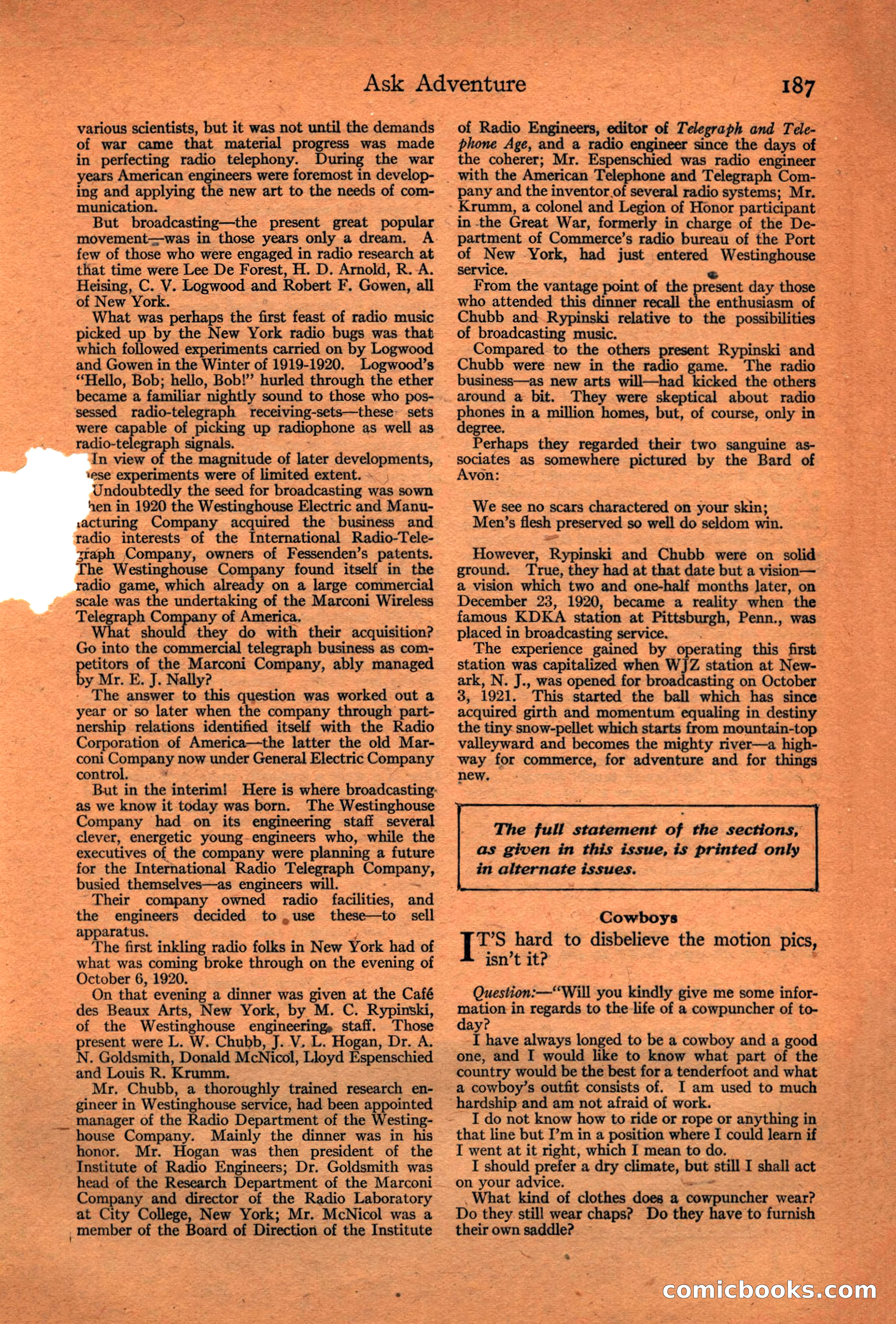
A restored page from Pulp Fiction, 1922. Page through the whole issue in the reader above.
📄 Transcribed text from this page (OCR, searchable)
Machine-transcribed from the original scan — historical spelling and the odd misread are preserved.
various scientists, but it was not until the demands of war came that ial progress was made in perfecting radio telephony. During the war years American engi were foremost in develop- ing and applying the new art to the needs of com- munication. : | But broadcasting—the present great popular movement—was in those years only a dream. A _ few of those who were engaged in radio research at that time were Lee De Forest, H. D. Arnold, R.-A. Heising, C. V. Logwood and Robert F. Gowen, all of New York. What was perhaps the first feast of radio music picked up by the New York radio bugs was that which followed experiments carried on by Logwood and Gowen in the Winter of 1919-1920. Logwood’s _ “Hfello, Bob; hello, Bob!’ hurled through the ether became a familiar nightly sound to those who pos- . sessed radio-telegraph receiving-sets—these: sets were capable of picking up radiophone as well as radio-telegraph signals. . In view "6 the magnitude of later developments, ‘ese experiments were of limited extent... Undoubtedly the seed for broadcasting was sown hen in 1920 the Westinghouse Electric and Manu- ,acturing Company acquired the business and radio interests of the International Radio-Tele- traph Company, owners of Fessenden’s patents. The Westinghouse Soren found itself in the radio game, which already on a large commercial scale was the undertaking of the Marconi Wireless Telegraph Co y of America. t should they do with their acquisition? Go into the commercial telegraph business as com- titors of the Marconi Company, ably managed y Mr. E. J. Nally? - The answer to this question was worked out a year or so later when the company through part- nership relations identified itself with the Radio Corporation of America—the latter the old Mar- coni Company now under General Electric Company control. | | But in the interim! Here is where broadcasting: as we know it today was born. The Westinghouse - Company had on its engineering staff several clever, energetic young-engineers who, while the executives of the company were planning a future for the International Radio Telegraph Company, busied themselves—as engineers will. : Their company owned radio facilities, and the engineers decided to.,use these—to sell apparatus. ; The first inkling radio folks in New York had of what was coming broke through on the evening of October 6, 1920. On that evening a dinner was given at the Café des Beaux Arts, New York, by M. C. Rypinski, of the Westinghouse engineering, staff. Those present were L. W. Chubb, J. V. L. Hogan, Dr. A. N. Goldsmith, Donald McNicol, Lloyd Espenschied and Louis R. Krumm, Mr. Chubb, a thoroughly trained research en- gineer in Westinghouse service, had been appointed manager of the Radio Department of the Westing- house Company. Mainly the dinner was in his honor. Mr. Hogan was then president of the Institute of Radio Engineers; Dr. Goldsmith was head of the Research Department of the Marconi Company and director of the Radio Laboratory at City College, New York; Mr. McNicol was a , member of the Board of Direction of the Institute Ask Adventure of Radio Engineers, editor of Telegraph and Tele- phone Age, and a radi the coherer; Mr. Espenschied was radio engineer _ with the American Telephone and Telegraph Com- pany and the inventor of several radio systems; Mr. - Krumm, a colonel and Legion of Honor participant: in -the Great War, formerly in charge of the De- partment of Commerce’s radio bureau of the Port 187 2 O engineer since the days of — of New York, had just entered Westinghouse — From the vantag of broadcasting music. Compared to the others present Rypinski and Chubb were new in the radio game. The radio business—as new arts will—had kicked the others around a bit. They were skeptical about radio ee in a million homes, but, of course, only in. egree. 7 Perhaps they regarded their two ine as- pomaees as somewhere pictured by the Bard of von: We see no scars charactered on your skin; Men’s flesh preserved so well do seldom win. e point of gh en day those who attended this dinner recall enthusiasm of — Chubb and. Rypinski relative to the possibilities However, Rypinski and Chubb were on solid ground. True, they had at that date but a vision— a vision which two and one-half months later, on December 23, 1920, became a reality when the famous KDKA station at Pittsburgh, Penn., was placed in broadcasting service. _. ; The experience gained by rating this first station was capitalized when WJZ station at New- ark, N. J., was opened for broadcasting on October 3, 1921. This started the ball which has since acquired girth and momentum equaling in destiny the tiny: snow-pellet which starts from mountain-top valleyward and becomes the mighty river—a high- way for commerce, for adventure and for things new. . ‘ The full statement of the sections, as given in this issue, is printed only — in alternate issues. Cowboys Te hard to disbelieve the motion isn’t it? pics, . Question: —“Will you kindly give me some infor- mee in regards to the life of a cowpuncher of to- ye -I have always longed to be a cowboy and a good one, and I would like to know what part of the country would be the best for a tenderfoot and what a cowboy’s outfit consists of. I am used to much ‘hardship and am not afraid of work. - I do not know how to ride or rope or anything in that line but I’m in a position where I could learn if I went at it right, which I mean to do. I should prefer a dry climate, but still I shall act on your advice. “ What kind of clothes does a cowpuncher wear? | Do they still wear chaps? Do they have to furnish their own saddle? — > _ ~__ _ €omicbooks com |