
Pulp Fiction, 1922 · page 177 of 196
Adventure Magazine Cover — page 177: what you’re looking at
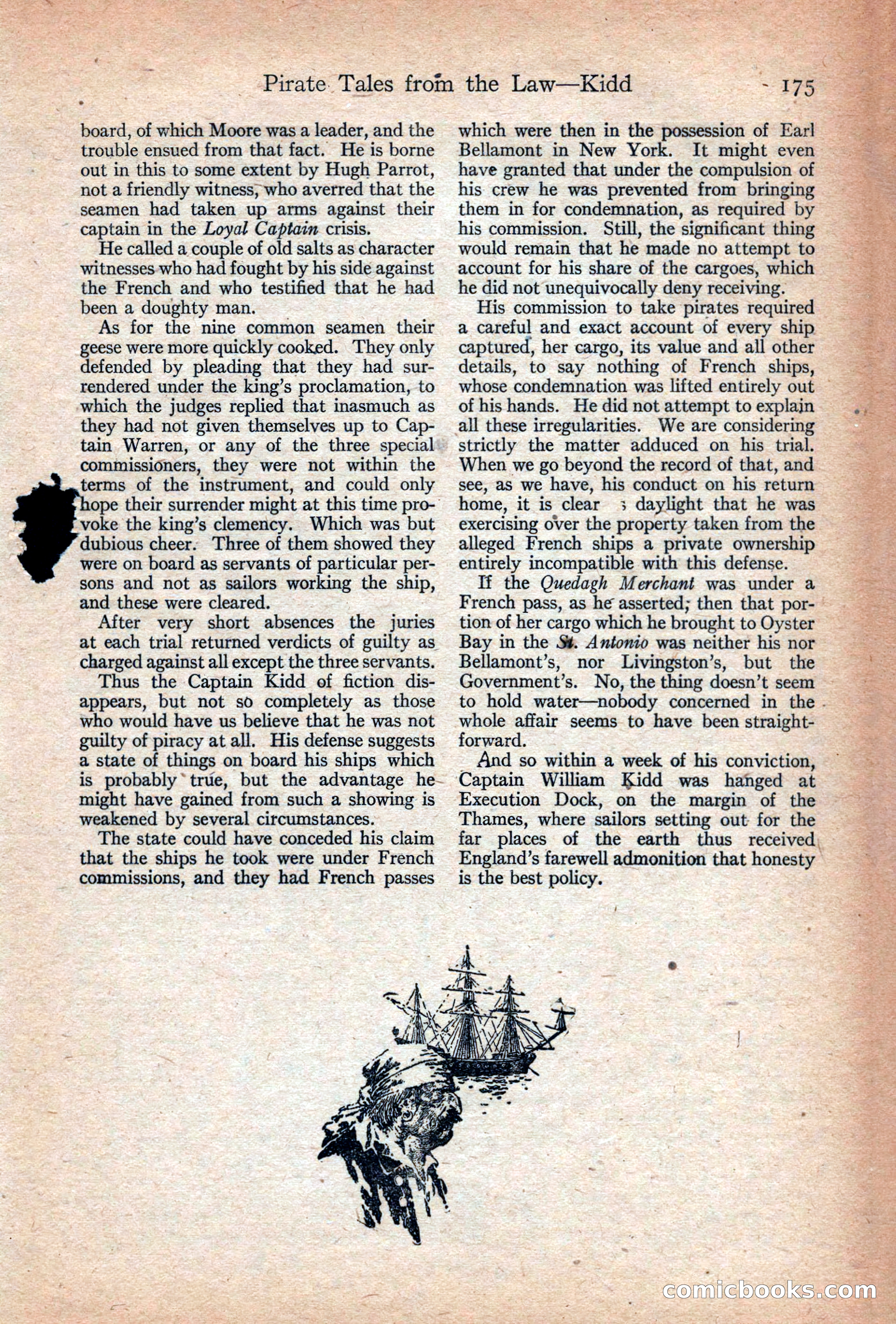
A restored page from Pulp Fiction, 1922. Page through the whole issue in the reader above.
📄 Transcribed text from this page (OCR, searchable)
Machine-transcribed from the original scan — historical spelling and the odd misread are preserved.
board, of which Moore was a leader, and the trouble ensued from that fact. He is borne out in this to some extent by Hugh Parrot, not a friendly witness, who averred that the seamen had taken up arms against their captain in the Loyal Captain crisis. He called a couple of old salts as character witnesses who had fought by his side against the French and who testified that he had been a doughty man. As for the nine common seamen their geese were more quickly cooked. They only defended by pleading that they had sur- rendered under the king’s proclamation, to which the judges replied that inasmuch as they had not given themselves up to Cap- tain Warren, or any of the three special commissioners, they were not within the terms of the instrument, and could only ope their surrender might at this time pro- voke the king’s clemency. Which was but dubious cheer. Three of them showed they were on board as servants of particular per- sons and not as sailors working the ship, and these were cleared. After very short absences the juries at each trial returned verdicts of guilty as charged against all except the three servants. Thus the Captain Kidd of fiction dis- appears, but not so completely as those who would have us believe that he was not guilty of piracy at all. His defense suggests a state of things on board his ships which is probably true, but the advantage he- might have gained from such a showing is weakened by several circumstances. The state could have conceded his claim that the ships he took were under French commissions, and they had French passes Pirate. Tales from the Law—Kidd all these irregularities. Captain William Kidd was hanged at ; ; oe + 2 Sale . aw : <"¥ cin —S which were then in the possession of Earl Bellamont in New York. It might even | have granted that under the compulsion of his crew he was prevented from bringing them in for condemnation, as required by his commission. Still, the significant thing would remain that he made no attempt to account for his share of the cargoes, which he did not unequivocally deny receiving. His commission to take pirates required a careful and exact account of every ship captured, her cargo, its value and all other details, to say nothing of French ships, whose condemnation was lifted entirely out — of hishands. He did not attempt to explain We are considering strictly the matter adduced on his trial. When we go beyond the record of that, and see, as we have, his conduct on his return home, it is clear +3 daylight that he was exercising over the property taken from the alleged French ships a private ownership entirely incompatible with this defense. eae Tf the Quedagh Merchant was under a French pass, as he asserted; then that por- — tion of her cargo which he brought to Oyster 2: Bay in the St. Antonio was neither his nor Bellamont’s, nor Livingston’s, but the Fae Government’s. No, the thing doesn’t seem = to hold water—nobody concerned in the. = whole affair seems to have been straight- eS. forward. aes And so within a week of his conviction, =—S Execution Dock, on the margin of the Thames, where sailors setting out for the far places of the earth thus received, England’s farewell admonition that honesty is the best policy. hy 2 rhe | Web SOI SN (rh SIE 48. ig | a : : a hen CCOLMMUCE JOOKS.comM