
Pulp Fiction, 1922 · page 171 of 196
Adventure Magazine Cover — page 171: what you’re looking at
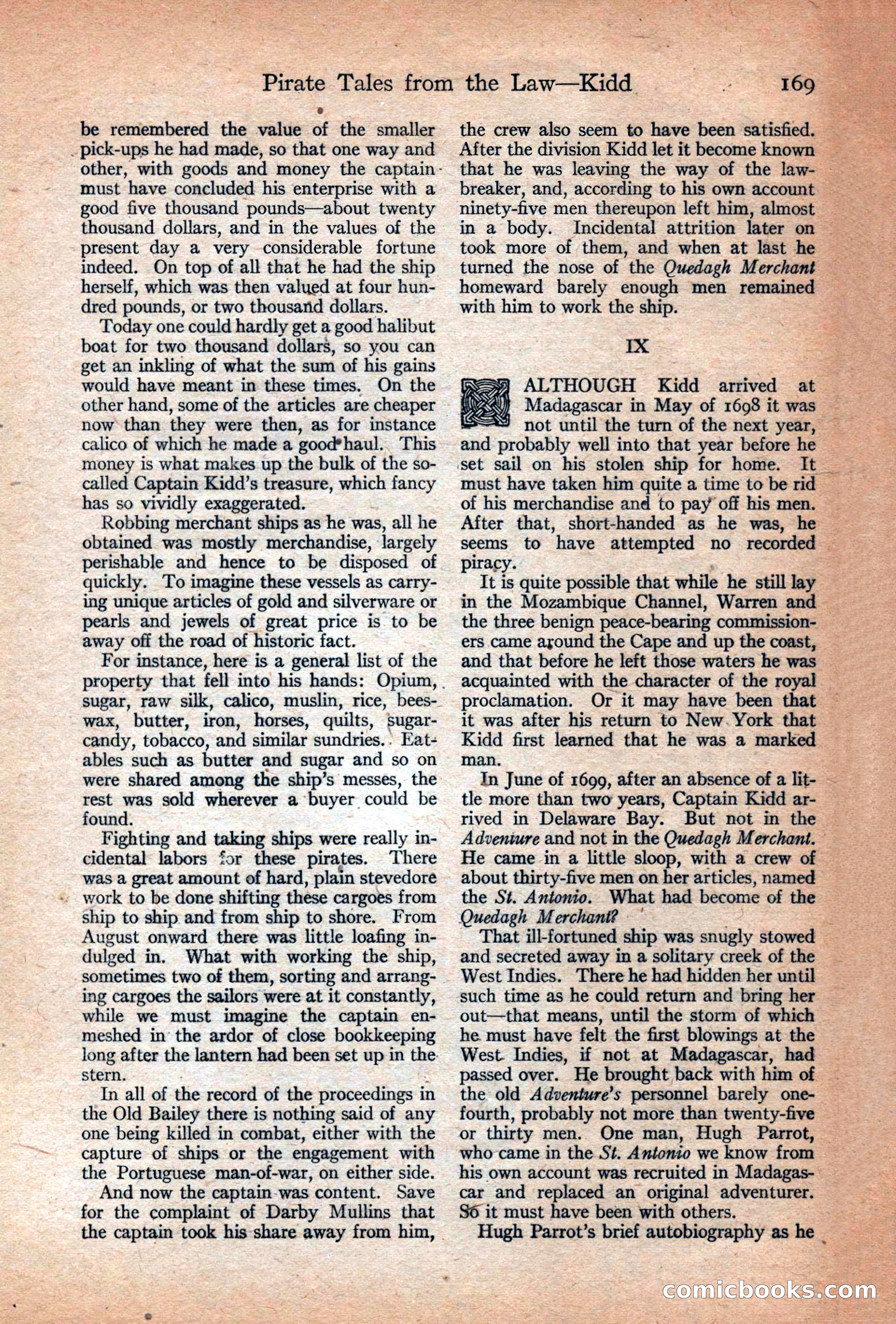
A restored page from Pulp Fiction, 1922. Page through the whole issue in the reader above.
📄 Transcribed text from this page (OCR, searchable)
Machine-transcribed from the original scan — historical spelling and the odd misread are preserved.
Pirate Tales from the Law—Kidd. ¢ be remembered the value of the smaller . pick-ups he had made, so that one way and other, with goods and money the captain- must have concluded his enterprise with a good five thousand pounds—about twenty thousand dollars, and in the values of the present day a very considerable fortune indeed. On top of all that he had the ship herself, which was then valued at four hun- dred pounds, or two thousand dollars. Today one could hardly get a good halibut boat for two thousand dollars, so you can get an inkling of what the sum of his gains would have meant in these times. On the other hand, some of the articles are cheaper MQ) now than they were then, as for instance calico of which he made a good*haul.. This money is what makes up the bulk of the so- called Captain Kidd’s treasure, which fancy has so vividly exaggerated. Robbing merchant ships as he was, all he obtained was mostly merchandise, largely perishable and hence to be disposed of quickly. To imagine these vessels as carry- ing unique articles of gold and silverware or pearls and jewels of great price is to be away off the road of historic fact. For instance, here is a general list of the property that fell into his hands: Opium, . sugar, raw silk, calico, muslin, rice, bees-. wax, butter, iron, horses, quilts, sugar- candy, tobacco, and similar sundries.. Eat- ables such as butter and sugar and so on were shared among the ship’s messes, the rest was sold wherever a buyer could be found. Fighting and taking ships were really in- cidental labors for these pirates. There was a great amount of hard, plain stevedore -- work to be done shifting these cargoes from ship to ship and from ship to shore. From August onward there was little loafing in- dulged in. What with working the ship, sometimes two of them, sorting and arrang- ing cargoes the sailors were at it constantly, while we must imagine the captain en- meshed in’ the ardor of close bookkeeping long after the lantern had been set up in the. stern. In all of the record of the proceedings i in hee Old Bailey there is nothing said of any one being killed in combat, either with the capture of ships or the engagement with the Portuguese man-of-war, on either side. And now the captain-was content. Save for the complaint of Darby Mullins that the captain took his share away from him, ninety-five men thereupon left him, almost — the crew also seem to have been satisfied. — After the division Kidd let it become known — that he was leaving the way of the law- RS breaker, and, according to his own account =—s_— i = in a body. Incidental attrition later on took more of them, and when at last he eee es turned the nose of the Quedagh Merchant =. Be homeward barely enough men remained with him to work the ship. Se S59 ALTHOUGH Kidd arrived at. A =e Do ) Madagascar in May of 1698 it was Es ares * not until the turn of the next year, ate probably well into that year before he : as set sail on his stolen ship for home. It _ must have taken him quite a time to be rid of his merchandise and to pay off his men. = After that, short-handed as he was, io ES eee seems to have attempted no recorded — Soe piracy. It is quite possible that while he still ues x atted in the Mozambique Channel, Warren and the three benign peace-bearing commission- ers came around the Cape and up the coast, and that before he left those waters he was — acquainted with the character of the royal — proclamation. Or it may have been that — it was after his return to New. York that Kidd first learned that he was a marked In June of 1699, after an absence of a lit. < a; tle more than two years, Captain Kidd ar- — oe rived in Delaware Bay. But not n the ~~ Adventure and not in the Quedagh Merchant. = ee He came in a little sloop, with a crew of about thirty-five men on her articles, named oe Hee the St. Antonio. What had become of thes 2 Ae Quedagh Merchant? » Sy That ill-fortuned ship was snugly stowed _ 3 and secreted away in a solitary creek of the = aS ees West Indies. There he had hiddenheruntil such time as he could return and bring her | out—that means, until the storm of which he must have felt the first blowings at ~ West. Indies, if not at Madagascar, had passed over. He brought. back with him of — the old Adventure’s personnel barely one-— ae fourth, probably not more than twenty-five or thirty men. One man, Hugh Parrot, — who came in the St. Antonio we know from his own account was recruited in Madagas- — re car and replaced an original adventurer. ee aes SO it must have been with others. Sa Ss Hugh Parrot’s brief antehiegeiey as he A a ae comicbook