
Pulp Fiction, 1922 · page 167 of 196
Adventure Magazine Cover — page 167: what you’re looking at
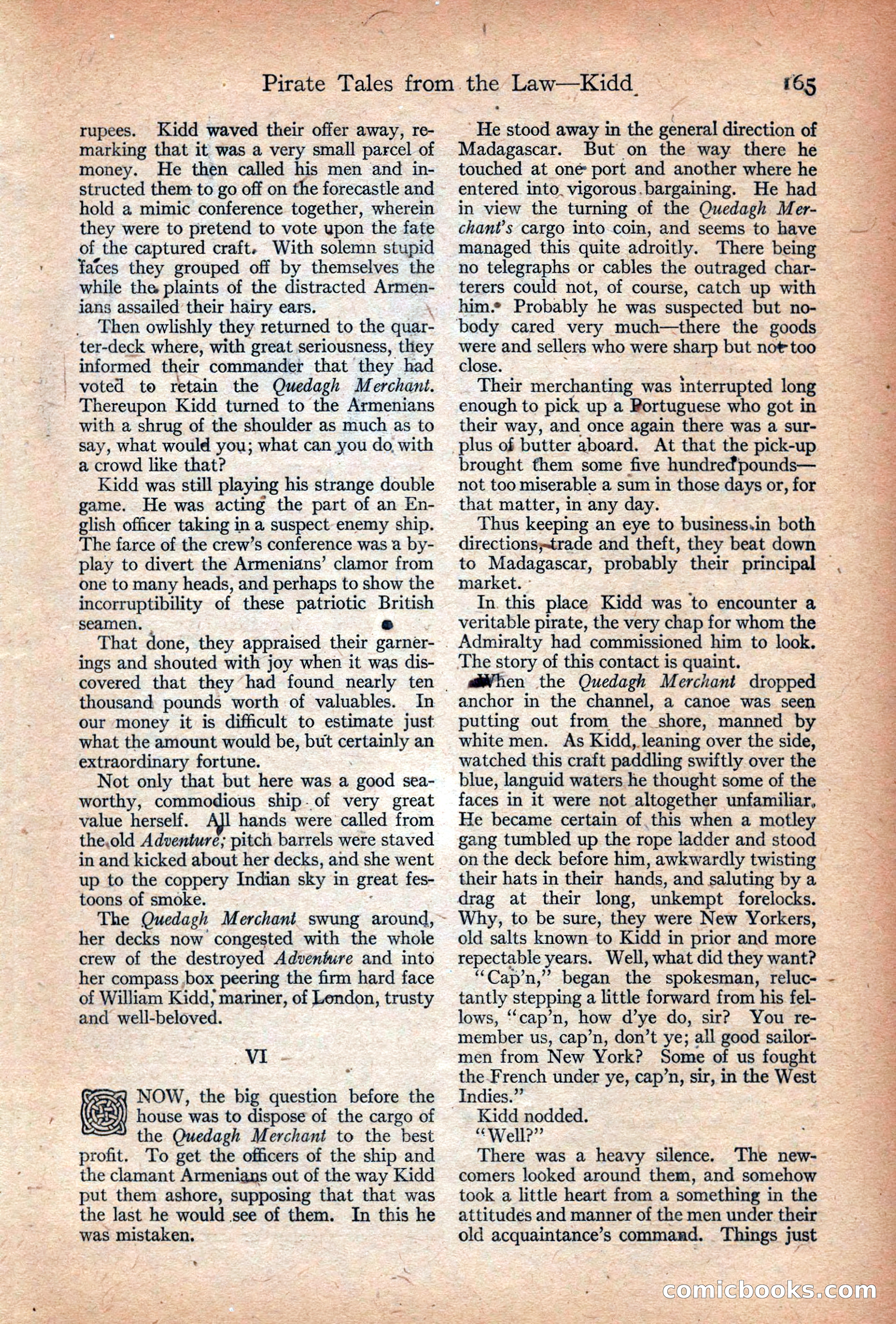
A restored page from Pulp Fiction, 1922. Page through the whole issue in the reader above.
📄 Transcribed text from this page (OCR, searchable)
Machine-transcribed from the original scan — historical spelling and the odd misread are preserved.
Pirate Tales from the Law—Kidd rupees. Kidd waved their offer away, re- marking that it was a very small parcel of money. He then called his men and in- structed them: to go off on the forecastle and hold a mimic conference together, wherein they were to pretend to vote upon the fate of the captured craft. With solemn stupid faces they grouped off by themselves the while the plaints of the distracted Armen- jans assailed their hairy ears. _ Then owlishly they returned to the quar- ter-deck where, with great seriousness, they - informed their commander that they had voted to retain the Quedagh Merchant. Thereupon Kidd turned to the Armenians with a shrug of the shoulder as much as to say, what would you; what can you do with a crowd like that? Kidd was still playing his strange double game. He was acting the part of an En- glish officer taking in a suspect enemy ship. The farce of the crew’s conference was a by- play to divert the Armenidns’ clamor from one to many heads, and perhaps to show the incorruptibility of these patriotic _ seamen. That done, they appraised their bs SF ings and shouted with j joy when it was dis- covered that they had found nearly ten | thousand pounds worth of valuables. In our money it is difficult to estimate just what the amount would be, but sy an extraordinary fortune. Not only that but here was a good sea- worthy, commodious ship.of very great value herself. hands were called from the,old Adventure; pitch barrels were staved in and kicked about her decks, and she went up to the coppery Indian sky i in great fes- toons of smoke. The Quedagh Merchant. swung around, ~ her decks now congested with the whole crew of the destroyed Adventure and into her compass box peering the firm hard face of William Kidd; mariner, of Lendon, trusty and well-beloved. VI - NOW, the big question before the house was to dispose of the cargo of (Gy) © the Quedagh Merchant to the best profit. To get the officers of the ship and the clamant Armenians out of the way Kidd put them ashore, supposing that that was the last he would see of them. In this he was mistaken. e (65 He stood away in the general direction of Madagascar. touched at one port and another where he entered into, vigorous.bargaining. He had in view the turning of the Quedagh Mer- chant’s cargo into coin, and seems to have managed this quite adroitly. There being no telegraphs or cables the outraged char- terers could not, of course, catch up with him. Probably he was suspected but no- body cared very much—there the goods were and sellers who were sharp but not too close. Their merchanting was interrupted long enough to pick up a Portuguese who got in their way, and once again there was a sur- brought them some five hundredpounds— But on the way there he plus of butter aboard. At that the pick-up — not too miserable a sum in those days or, for that matter, in any day. Thus keeping an eye to business.in both directions;~trade and theft, they beat down to Madagascar, probably their principal — market. ° In. this place Kidd was ‘to encounter a veritable pirate, the very chap for whom the ~ . Admiralty had commissioned him to look. The story of this contact is quaint. @W¥hen the Quedagh Merchant dropped anchor in the channel, a canoe was seen putting out from the shore, manned by white men. As Kidd, leaning over the side, watched this craft paddling swiftly over the © blue, languid waters he thought some of the | faces in it were not altogether unfamiliar, He became certain of this when a motley gang tumbled up the rope ladder and stood on the deck before him, awkwardly twisting their hats in their hands, and saluting by a drag at their long, unkempt forelocks. Why, to be sure, they were New Yorkers, old salts known to Kidd in prior and more repectable years. Well, what did they want? “Cap’n,” began the spokesman, reluc- tantly stepping a little forward from his fel- lows, ‘‘cap’n, how d’ye do, sir? You re- member us, cap’n, don’t ye; all good sailor- men from New York? Some of us fought the-French under ye, cap’n, sir, in the West Indies.” Kidd nodded. “Well?” There was a heavy silence. comers looked around them, and somehow took a little heart from a something in the attitudes and manner of the men under their old acquaintance’s command. Things just com (c IOOKS The new- co Mi ut 4, iy = Pe, oe or + cnta V4, uit PP Pt mee +f . ; 3-3 Ga = ,f we wee A = hd byi ATE ¢ / =) } oa Wey Le he © fer Ew Bix) yik ety ne Mi So eee g | 2 vs i ‘ xf wal tiene hae) ; ’ . é tt 71% ae aty ba Sh eee Ol ii thoy MY a Ps , Thcpent Voth Salts f is s har oy eed rola rk aaa th hie e a, i ay At hE ye aA ryt, eal WARY re SEN WOT AAR RS REM LON Mahe st St ORAM trae ae I RATTAN eR ORO Pe OEMTEE EMIT Clery Pi RaMEAU Ee GMI Paerny AU UIte AT) NK oa RT ‘ ® ny Te PAR) IAB es 80 . fe ' We : ” , Wf Sos Lee ¥) Se RUN ba : ; I. j ¥ bpd os a jeu be s s é ee