
Pulp Fiction, 1922 · page 165 of 196
Adventure Magazine Cover — page 165: what you’re looking at
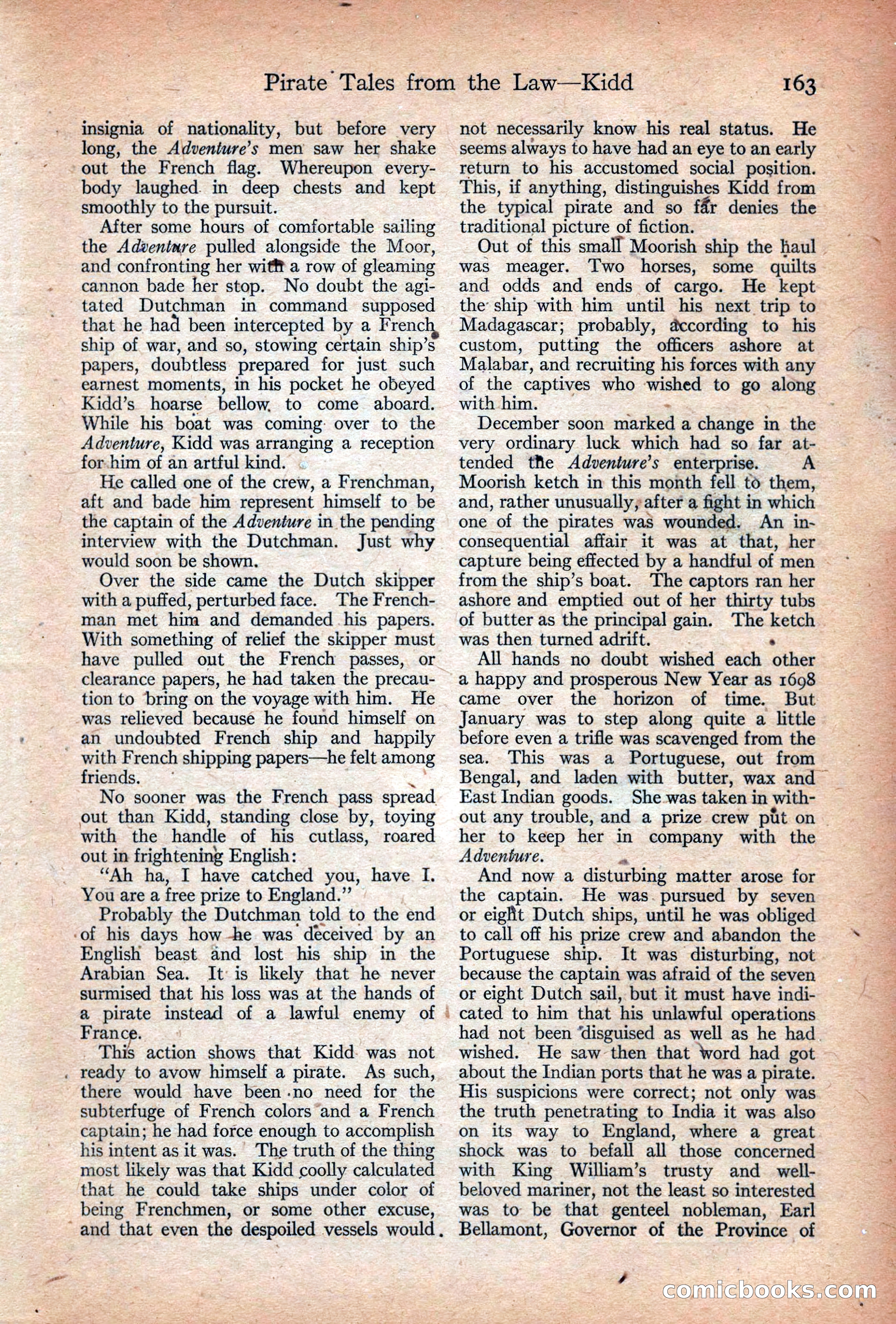
A restored page from Pulp Fiction, 1922. Page through the whole issue in the reader above.
📄 Transcribed text from this page (OCR, searchable)
Machine-transcribed from the original scan — historical spelling and the odd misread are preserved.
~ | Pirate. Tales from the Law—Kidd insignia of nationality, but before very long, the Adveniure’s men saw her shake out the French flag. Whereupon every- body laughed. in deep chests and kept smoothly to the pursuit. After some hours of comfortable sailing the Adventure pulled alongside the Moor, and confronting her wit a row of gleaming cannon bade her stop. No doubt the agi- tated Dutchman in command _ supposed that he had been intercepted by a F rench, ship of war, and so, stowing certain ship’s papers, doubtless prepared for just such earnest moments, in his pocket he obeyed Kidd’s_ hoarse bellow, to come aboard. While his boat was coming: over to the Adventure, Kidd was arranging a reception for him of an artful kind. | He called one of the crew, a Frenchman, aft and bade him represent himself to be the captain of the Adventure in the pending interview with the Dutchman. Just why would soon be shown. | Over the side came the Dutch skipper with a puffed, perturbed face. The French- man met him and demanded his papers. With something of relief the skipper must have pulled out the French passes, or clearance papers, he had taken the precau- tion to bring on the voyage with him. He -was relieved because he found himself on an undoubted French ship and happily - with French shipping papers—he felt among friends. , = No sooner was the French pass spread. out than Kidd, standing close by, toying with the handle of his cutlass, roared out in frightening English: “Ah ha, I have catched you, have I. You are a free prize to England.” Probably the Dutchman told to the end -of his days how-he was deceived by an English beast and lost his ship in the Arabian Sea. It is likely that he never surmised that his loss was at the hands of a pirate instead of a lawful enemy of France. _ This action shows that Kidd- was not . ready to avow himself a pirate. As such, there would have been -no need for the subterfuge of French colors and a French captain; he had force enough to accomplish his intent as it was. The truth of the thing most likely was that Kidd coolly calculated that he could take ships under color of being Frenchmen, or some other excuse, - and that even the despoiled vessels would. i not necessarily know his real status. He seems always to have had an eye to an early return to his accustomed social position. This, if anything, distinguishes Kidd from the typical pirate and so far denies the traditional picture of fiction. | 163. Out of this small Moorish ship the haul — was meager. Two horses, some quilts and odds and ends of cargo. He kept the ship with him until his next trip to Madagascar; probably, according to his custom, putting the officers ashore at Malabar, and recruiting his forces with any of the captives who wished to go along with him. : | December soon marked a change in the very ordinary luck which had so far at- tended the Adventure’s enterprise. A Moorish ketch in this month fell to them, and, rather unusually; after a fight in which one of the pirates was wounded. An in- consequential affair it was at that, her capture being effected by a handful of men - from the ship’s boat. The captors ran her ashore and emptied out of her thirty tubs of butter as the principal gain. The ketch was then turned adrift. | . All hands no doubt wished each other a happy and prosperous New Year as 1608 came over the horizon of time. But January was to step along quite a little before even a trifle was scavenged from the sea. This was a Portuguese, out from Bengal, and laden with butter, wax and — East Indian goods. She was taken in with- out any trouble, and a prize crew put on ~ her to keep her in company with the Adventure. ‘ And now a disturbing matter arose for the captain. He was. pursued by seven or eiglt Dutch ships, until he was obliged to call off his prize crew and abandon the Portuguese ship. It was disturbing, not because the captain was afraid of the seven or eight Dutch sail, but it must have indi- cated to him that his unlawful operations had not been “disguised as well as he had. wished. He saw then that Word had got about the Indian ports that he was a pirate. His suspicions were correct; not only was the truth penetrating to India it was also on its way to England, where a great shock was to befall all those concerned with King William’s trusty and well- beloved mariner, not the least so interested was to be that genteel nobleman, Earl Bellamont, Governor of the Province of 4 Gomicbooks s ayedaa ash ade Ae AE ane et ce ban PTO et Ppt iy SS Ste ea Wr oh . ae \2 bhit renga LS Oe Tee eR are Oo ge eee bn te Red Ae a aey va ee ae Meir fe oe yc" cor >< I. Mae at oer ij Pa wari rae will ‘ . + pe