
Pulp Fiction, 1922 · page 153 of 196
Adventure Magazine Cover — page 153: what you’re looking at
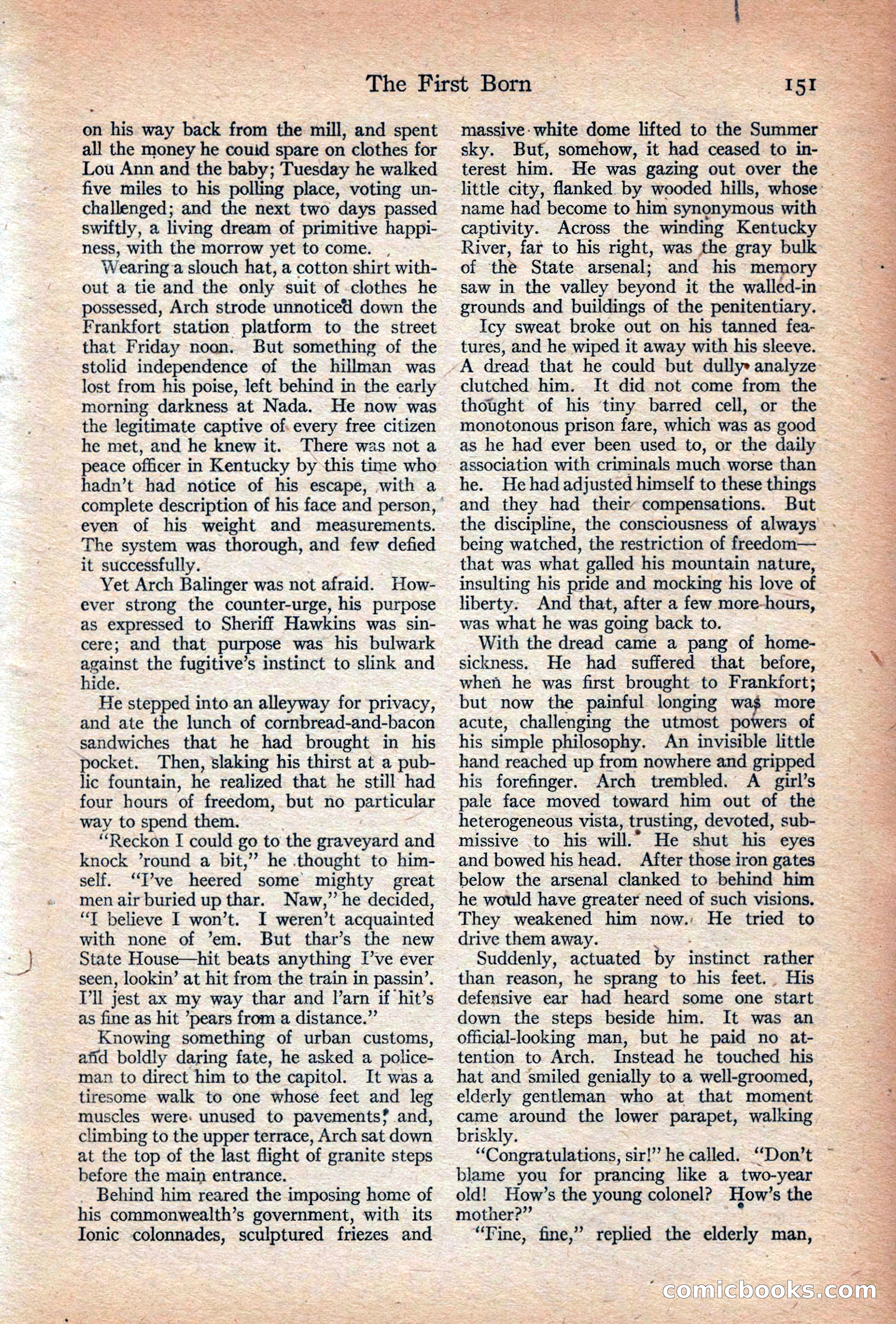
A restored page from Pulp Fiction, 1922. Page through the whole issue in the reader above.
📄 Transcribed text from this page (OCR, searchable)
Machine-transcribed from the original scan — historical spelling and the odd misread are preserved.
The First Born on his way back from the mill, and spent all the money he couid spare on clothes for Lou Ann and the baby; Tuesday he walked five miles to his polling place, voting un- challenged; and the next two days passed swiftly, a living dream of primitive happi- ness, with the morrow yet to come. , Wearing a slouch hat, a cotton shirt with- out a tie and the only suit of clothes he possessed, Arch strode unnoticed down the Frankfort station platform to the street that Friday noon. But something of the stolid independence of the hillman was lost from his poise, left behind in the early morning darkness at Nada. He now was the legitimate captive of. every free citizen he met, and he knew it. There was not a peace officer in Kentucky by this time who hadn’t had notice of his escape, with a complete description of his face and person, even of his weight and measurements. The system was thorough, and few defied it successfully. Yet Arch Balinger was not afraid. How- ever strong the counter-urge, his purpose as expressed to Sheriff Hawkins was sin- cere; and that purpose was his bulwark against the fugitive’s instinct to slink and hide. He stepped into an alleyway for privacy, and ate the lunch of cornbread-and-bacon sandwiches that he had brought in his pocket. Then, slaking his thirst at a pub- lic fountain, he realized that he still had four hours of freedom, but no particular - way to spend them. ‘Reckon I could go to the graveyard and knock ’round a bit,” he thought to him- self. ‘I’ve heered some mighty great men air buried up thar. Naw,” he decided, “T believe I won’t. I weren’t acquainted with none of ’em. But thar’s the new State House—hit beats anything I’ve ever seen, lookin’ at hit from the train in passin’. Vll jest ax my way thar and l’arn if hit’s as fine as hit ’pears from a distance.” Knowing something of urban customs, afid boldly daring fate, he asked a police- man to direct him to the capitol. It was a tiresome walk to one whose feet and leg muscles were: unused to pavements? and, climbing to the upper terrace, Arch sat down at the top of the last flight of granite steps before the main entrance. _ Behind him reared the imposing home of his commonwealth’s government, with its Ionic colonnades, sculptured friezes and jigs massive: white dome lifted to the Summer sky. But, somehow, it had ceased to in- terest him. He was gazing out over the | little city, flanked by wooded hills, whose name had become to him synonymous with captivity. Across the winding Kentucky River, far to his right, was the gray bulk of the State arsenal; and his memory saw in the valley beyond it the walled-in grounds and buildings of the penitentiary. Icy sweat broke out on his tanned fea- tures, and he wiped it away with his sleeve. A dread that he could but dully: analyze clutched him. It did not come from the thought of his tiny barred cell, or the monotonous prison fare, which was as good as he had ever been used to, or the daily — - association with criminals much worse than he. He had adjusted himself to these things and they had their compensations. But the discipline, the consciousness of always being watched, the restriction of freedom— that was what galled his mountain nature, insulting his pride and mocking his love of liberty. And that, after a few more-hours, was what he was going back to. With the dread came a pang of home- sickness. He had suffered that before, when he was first brought to Frankfort; but now the painful longing more acute, challenging the utmost powers of his simple philosophy. An invisible little hand reached up from nowhere and gripped his forefinger. Arch trembled. A girl’s pale face moved toward him out of the heterogeneous vista, trusting, devoted, sub- missive to his will.” He shut his eyes and bowed his head. After those iron gates below the arsenal clanked to behind him he would have greater need of such visions. They weakened him now. He tried to drive them away. Suddenly, actuated by instinct rather than reason, he sprang to his feet. His defensive ear had heard some one start down the steps beside him. It was an official-looking man, but he paid no at- tention to Arch. Instead he touched his hat and smiled genially to a well-groomed, elderly gentleman who at that moment came around the lower parapet, walking briskly. “Congratulations, sir!” he called. “Don’t blame you for prancing like a two-year old! How’s the young colonel? How/’s the mother?” “Fine, fine,” replied the elderly man, . Scomichoo 7 CS €O we A a { eer 4 wir A; Te AE i * Paet } «DAA dare ace es Sen 2b! Afr pts