
Pulp Fiction, 1922 · page 87 of 200
Adventure Magazine Cover — page 87: what you’re looking at
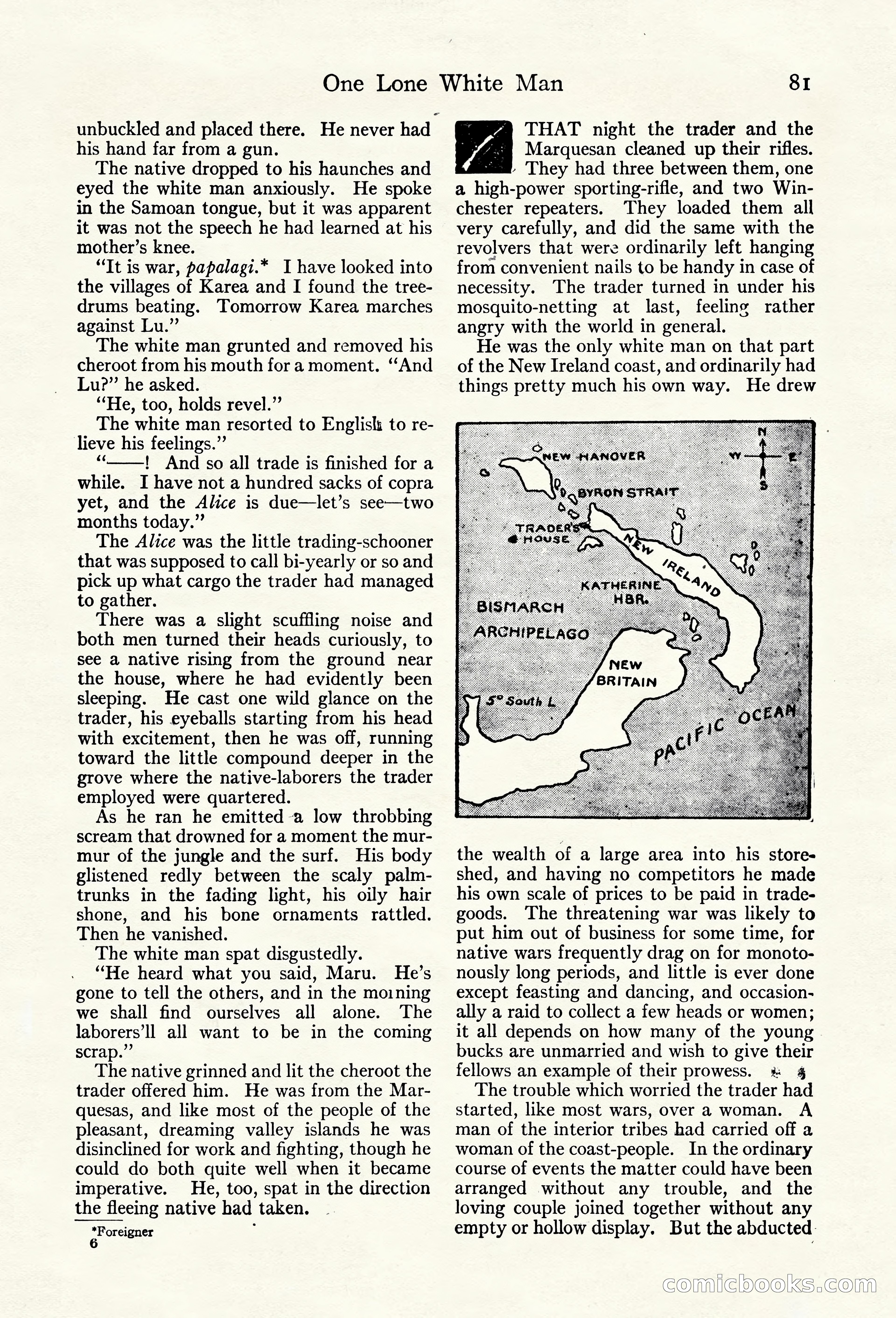
A restored page from Pulp Fiction, 1922. Page through the whole issue in the reader above.
📄 Transcribed text from this page (OCR, searchable)
Machine-transcribed from the original scan — historical spelling and the odd misread are preserved.
One Lone White Man - unbuckled and placed there. He never had his hand far from a gun. The native dropped to his haunches and eyed the white man anxiously. He spoke in the Samoan tongue, but it was apparent it was not the speech he had learned at his mother’s knee. “It is war, papalagi.* I have looked into the villages of Karea and I found the tree- drums beating. Tomorrow Karea marches against Lu.” The white man grunted and removed his cheroot from his mouth for a moment. “And Lupe” he asked. ‘‘He, too, holds revel.” The white man resorted to Englisl: to re- lieve his feelings.”’ . And so all trade is finished for a while. I have not a hundred sacks of copra yet, and the Alice is due—let’s see—two months today.” The Alice was the little trading-schooner that was supposed to call bi-yearly or so and pick up what cargo the trader had managed to gather. There was a slight scuffling noise and both men turned their heads curiously, to see a native rising from the ground near the house, where he had evidently been sleeping. He cast one wild glance on the trader, his eyeballs starting from his head with excitement, then he was off, running toward the little compound deeper in the grove where the native-laborers the trader employed were quartered. As he ran he emitted a low throbbing scream that drowned for a moment the mur- mur of the jungle and the surf. His body glistened redly between the scaly palm- trunks in the fading light, his oily hair shone, and his bone ornaments rattled. Then he vanished. _ The white man spat disgustedly. “He heard what you said, Maru. He’s gone to tell the others, and in the moining we shall find ourselves all alone. The laborers’ll all want to be in the coming scrap.” The native grinned and lit the cheroot the trader offered him. He was from the Mar- quesas, and like most of the people of the pleasant, dreaming valley islands he was disinclined for work and fighting, though he could do both quite well when it became imperative. He, too, spat in the direction the fleeing native had taken. *Foreigner 6 pare | e 8I THAT night the trader and the fe Marquesan cleaned up their rifles. wam@ They had three between them, one a high-power sporting-rifle, and two Win- chester repeaters. They loaded them all very carefully, and did the same with the revolvers that were ordinarily left hanging from convenient nails to be handy in case of necessity. The trader turned in under his mosquito-netting at last, feeling rather angry with the world in general. He was the only white man on that part of the New Ireland coast, and ordinarily had things pretty much his own way. He drew the wealth of a large area into his store- shed, and having no competitors he made his own scale of prices to be paid in trade- goods. The threatening war was likely to put him out of business for some time, for native wars frequently drag on for monoto- nously long periods, and little is ever done except feasting and dancing, and occasion- ally a raid to collect a few heads or women; it all depends on how many of the young bucks are unmarried and wish to give their fellows an example of their prowess. % § The trouble which worried the trader had started, like most wars, over a woman. A man of the interior tribes had carried off a woman of the coast-people. In the ordinary course of events the matter could have been arranged without any trouble, and the loving couple joined together without any empty or hollow display. But the abducted. MICLOOOKS C@