
Pulp Fiction, 1922 · page 84 of 200
Adventure Magazine Cover — page 84: what you’re looking at
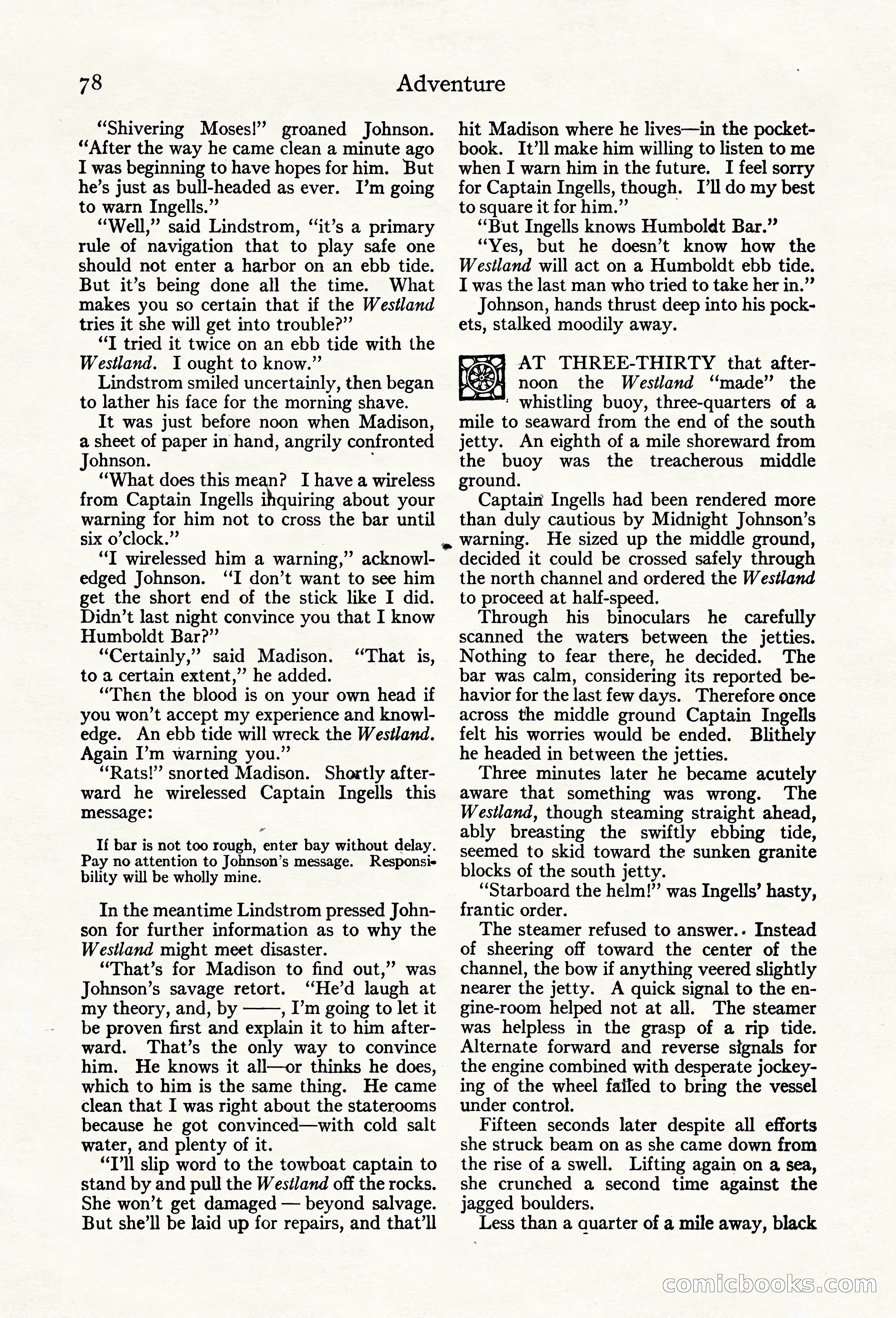
A restored page from Pulp Fiction, 1922. Page through the whole issue in the reader above.
📄 Transcribed text from this page (OCR, searchable)
Machine-transcribed from the original scan — historical spelling and the odd misread are preserved.
78 “Shivering Moses!’ groaned Johnson. ‘After the way he came clean a minute ago I was beginning to have hopes for him. But he’s just as bull-headed as ever. I’m going to warn Ingells.” “Well,” said Lindstrom, “it’s a primary rule of navigation that to play safe one should not enter a harbor on an ebb tide. But it’s being done all the time. What makes you so certain that if the Westland tries it she will get into trouble?” “T tried it twice on an ebb tide with the Westland. I ought to know.” Lindstrom smiled uncertainly, then began to lather his face for the morning shave. It was just before noon when Madison, a sheet of paper in hand, angrily confronted Johnson. “What does this mean? I have a wireless from Captain Ingells ihquiring about your warning for him not to cross the bar until six o’clock.” | “I wirelessed him a warning,” acknowl- edged Johnson. “I don’t want to see him get the short end of the stick like I did. Didn’t last night convince you that I know Humboldt Bar?” “Certainly,” said Madison. to a certain extent,” he added. “Then the blood is on your own head if you won’t accept my experience and knowl- edge. An ebb tide will wreck the Westland. Again I’m warning you.” “Rats!” snorted Madison. Shortly after- ward he wirelessed Captain Ingells this message: “That is, If bar is not too rough, enter bay without delay. Pay no attention to Johnson’s message. Responsie bility will be wholly mine. In the meantime Lindstrom pressed John- son for further information as to why the Westland might meet disaster. “That’s for Madison to find out,” was Johnson’s savage retort. “He’d laugh at my theory, and, by , I’m going to let it be proven first and explain it to him after- ward. That’s the only way to convince him. He knows it all—or thinks he does, which to him is the same thing. He came clean that I was right about the staterooms because he got convinced—with cold salt water, and plenty of it. “Tl slip word to the towboat captain to stand by and pull the Westland off the rocks. She won’t get damaged — beyond salvage. But she’ll be laid up for repairs, and that'll Adventure hit Madison where he lives—in the pocket- book. It’ll make him willing to listen to me when I warn him in the future. I feel sorry for Captain Ingells, though. I’ll do my best to square it for him.” ; “But Ingells knows Humboldt Bar.” “Yes, but he doesn’t know how the Westland will act on a Humboldt ebb tide. I was the last man who tried to take her in.” Johnson, hands thrust deep into his pock- ets, stalked moodily away. AT THREE-THIRTY that after- 4s noon the Westland ‘made’ the —" whistling buoy, three-quarters of a mile to seaward from the end of the south jetty. An eighth of a mile shoreward from the buoy was the treacherous middle ground. Captain Ingells had been rendered more than duly cautious by Midnight Johnson’s . warning. He sized up the middle ground, decided it could be crossed safely through the north channel and ordered the Westland to proceed at half-speed. Through his binoculars he carefully scanned the waters between the jetties. Nothing to fear there, he decided. The bar was calm, considering its reported be- havior for the last few days. Therefore once across the middle ground Captain Ingells felt his worries would be ended. Blithely he headed in between the jetties. Three minutes later he became acutely aware that something was wrong. The Westland, though steaming straight ahead, ably breasting the swiftly ebbing tide, seemed to skid toward the sunken granite blocks of the south jetty. “Starboard the helm!” was Ingells’ hasty, frantic order. The steamer refused to answer... Instead of sheering off toward the center of the channel, the bow if anything veered slightly nearer the jetty. A quick signal to the en- gine-room helped not at all. The steamer was helpless in the grasp of a rip tide. Alternate forward and reverse signals for the engine combined with desperate jockey- ing of the wheel failed to bring the vessel under control. Fifteen seconds later despite all efforts she struck beam on as she came down from the rise of a swell. Lifting again on a sea, she crunehed a second time against the jagged boulders. Less than a quarter of a mile away, black COMICLOO® Cc SS C@