
Pulp Fiction, 1922 · page 81 of 200
Adventure Magazine Cover — page 81: what you’re looking at
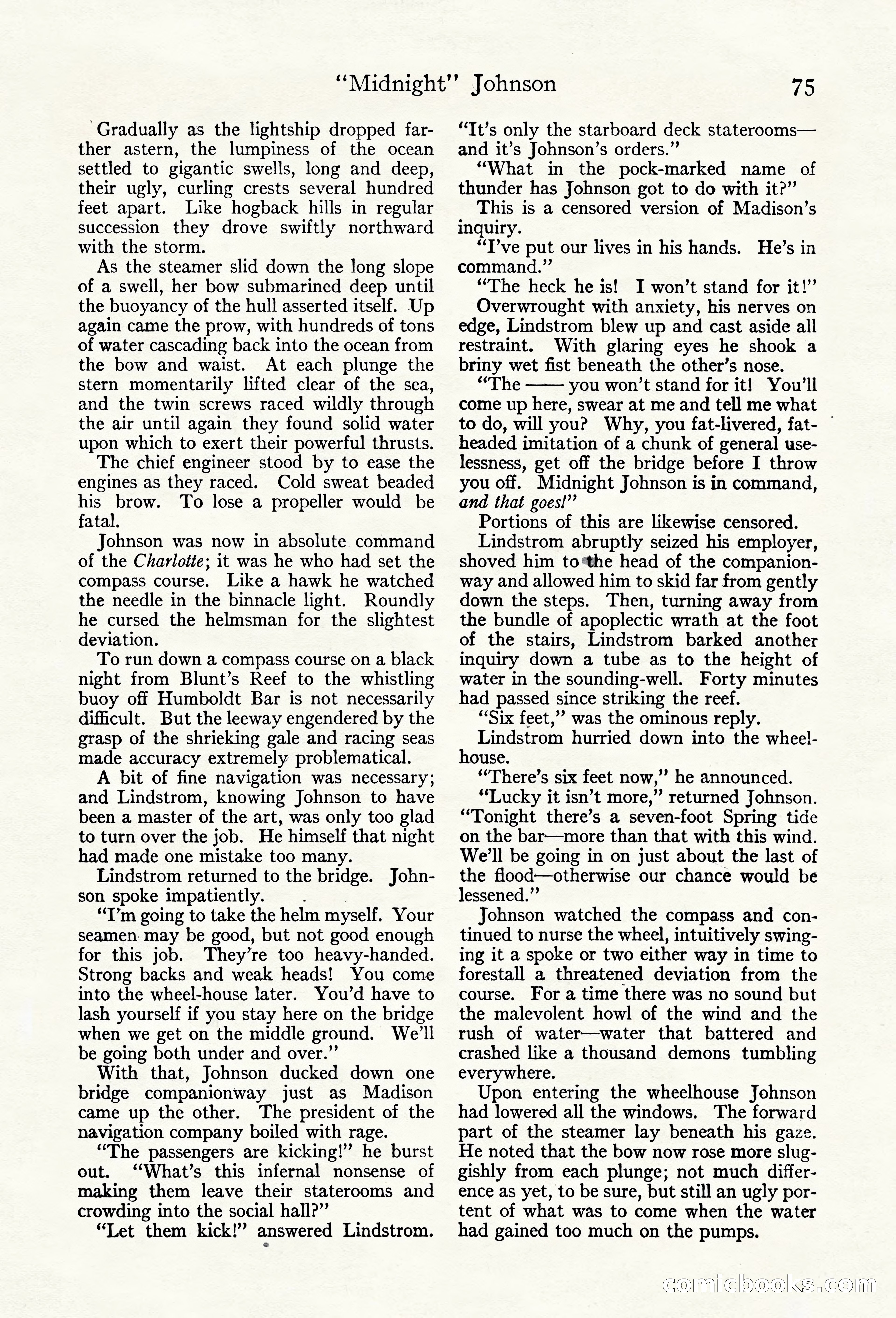
A restored page from Pulp Fiction, 1922. Page through the whole issue in the reader above.
📄 Transcribed text from this page (OCR, searchable)
Machine-transcribed from the original scan — historical spelling and the odd misread are preserved.
“Midnight”? Johnson ‘Gradually as the lightship dropped far- ther astern, the lumpiness of the ocean settled to gigantic swells, long and deep, their ugly, curling crests several hundred feet apart. Like hogback hills in regular succession they drove swiftly northward with the storm. As the steamer slid down the long slope of a swell, her bow submarined deep until the buoyancy of the hull asserted itself. Up again came the prow, with hundreds of tons of water cascading back into the ocean from the bow and waist. At each plunge the stern momentarily lifted clear of the sea, and the twin screws raced wildly through the air until again they found solid water upon which to exert their powerful thrusts. The chief engineer stood by to ease the engines as they raced. Cold sweat beaded his brow. To lose a propeller would be fatal. Johnson was now in absolute. command of the Charlotte; it was he who had set the compass course. Like a hawk he watched the needle in the binnacle light. Roundly he cursed the helmsman for the slightest deviation. To run down a compass course on a black night from Blunt’s Reef to the whistling buoy off Humboldt Bar is not necessarily dificult. But the leeway engendered by the grasp of the shrieking gale and racing seas made accuracy extremely problematical. A bit of fine navigation was necessary; and Lindstrom, knowing Johnson to have been a master of the art, was only too glad to turn over the job. He himself that night had made one mistake too many. Lindstrom returned to the bridge. John- son spoke impatiently. ; “T’m going to take the helm myself. Your seamen. may be good, but not good enough for this job. They’re too heavy-handed. Strong backs and weak heads! You come into the wheel-house later. You’d have to lash yourself if you stay here on the bridge when we get on the middle ground. We'll be going both under and over.” With that, Johnson ducked down one bridge companionway just as Madison came up the other. The president of the navigation company boiled with rage. “The passengers are kicking!” he burst out. ‘“‘What’s this infernal nonsense of making them leave their staterooms and crowding into the social hall?” “Let them kick!” answered Lindstrom. 75 “Tt’s only the starboard deck staterooms— and it’s Johnson’s orders.” “What in the pock-marked name of thunder has Johnson got to do with it?” This is a censored version of Madison’s inquiry. “T’ve put our lives in his hands. He’s in command.” “The heck he is! I won’t stand for it!” Overwrought with anxiety, his nerves on edge, Lindstrom blew up and cast aside all restraint. With glaring eyes he shook a briny wet fist beneath the other’s nose. ‘The you won’t stand for it! You'll come up here, swear at me and tell me what to do, will you? Why, you fat-livered, fat- — headed imitation of a chunk of general use- lessness, get off the bridge before I throw you off. Midnight Johnson is in command, and that goes!’ Portions of this are likewise censored. Lindstrom abruptly seized his employer, shoved him tothe head of the companion- way and allowed him to skid far from gently down the steps. Then, turning away from the bundle of apoplectic wrath at the foot of the stairs, Lindstrom barked another inquiry down a tube as to the height of water in the sounding-well. Forty minutes had passed since striking the reef. “Six feet,”’ was the ominous reply. Lindstrom hurried down into the whee!- house. ‘““There’s six feet now,” he announced. “Lucky it isn’t more,” returned Johnson. “‘Tonight there’s a seven-foot Spring tide on the bar—more than that with this wind. We'll be going in on just about the last of the flood—otherwise our chance would be lessened.” Johnson watched the compass and con- tinued to nurse the wheel, intuitively swing- ing it a spoke or two either way in time to forestall a threatened deviation from the course. For a time there was no sound but the malevolent howl of the wind and the rush of water—water that battered and crashed like a thousand demons tumbling everywhere. Upon entering the wheelhouse Johnson had lowered all the windows. The forward part of the steamer lay beneath his gaze. He noted that the bow now rose more slug- gishly from each plunge; not much differ- ence as yet, to be sure, but still an ugly por- tent of what was to come when the water had gained too much on the pumps. COMmMiCoook Cc (C@