
Pulp Fiction, 1922 · page 77 of 200
Adventure Magazine Cover — page 77: what you’re looking at
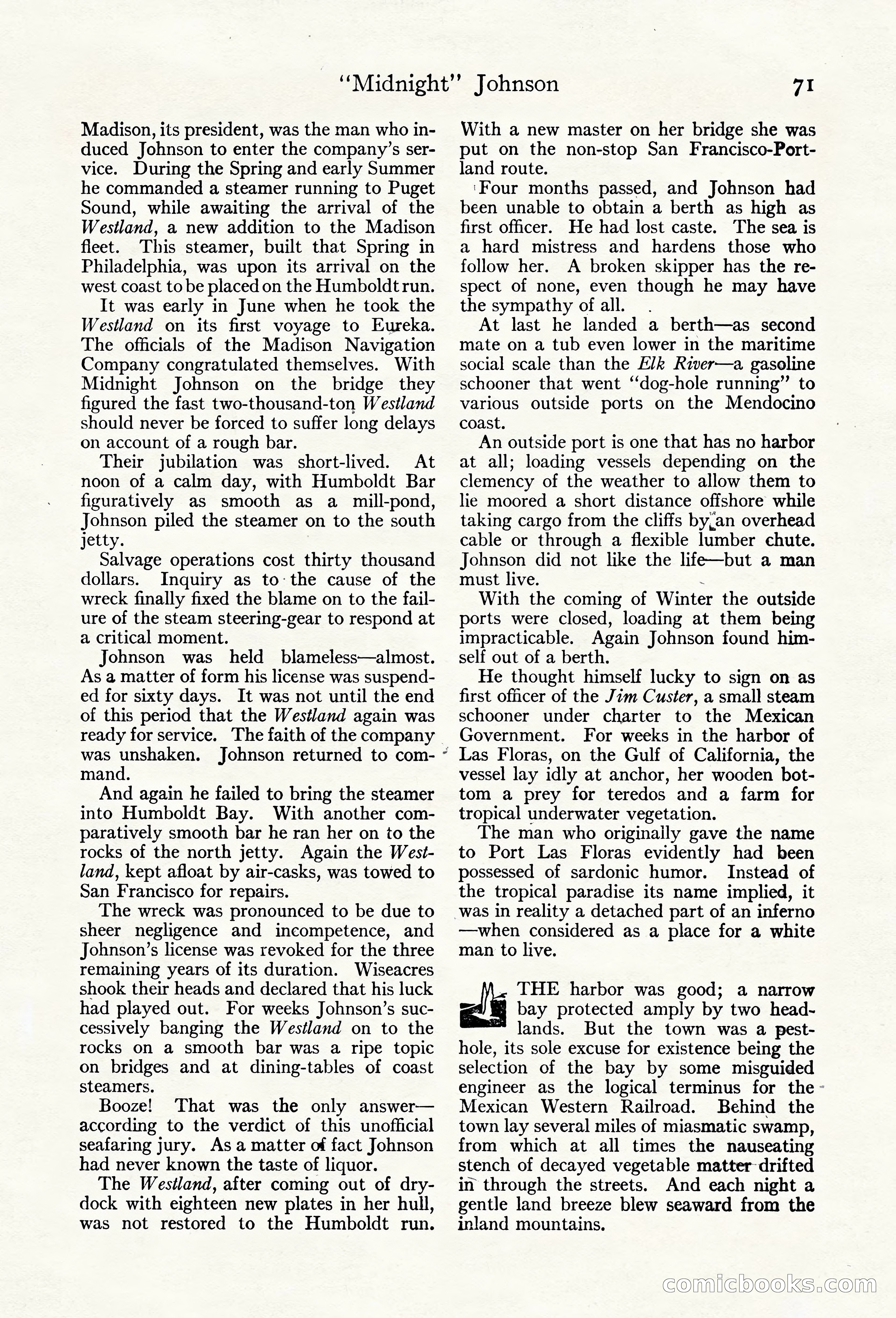
A restored page from Pulp Fiction, 1922. Page through the whole issue in the reader above.
📄 Transcribed text from this page (OCR, searchable)
Machine-transcribed from the original scan — historical spelling and the odd misread are preserved.
“Midnight” Johnson Madison, its president, was the man who in- duced Johnson to enter the company’s ser- vice. During the Spring and early Summer he commanded a steamer running to Puget Sound, while awaiting the arrival of the Westland, a new addition to the Madison fleet. This steamer, built that Spring in Philadelphia, was upon its arrival on the west coast to be placed on the Humboldt run. It was early in June when he took the Westland on its first voyage to Eureka. The officials of the Madison Navigation Company congratulated themselves. With Midnight Johnson on the bridge they figured the fast two-thousand-ton Westland should never be forced to suffer long delays on account of a rough bar. Their jubilation was short-lived. At noon of a calm day, with Humboldt Bar figuratively as smooth as a _ mill-pond, Johnson piled the steamer on to the south jetty. Salvage operations cost thirty thousand dollars. Inquiry as tothe cause of the wreck finally fixed the blame on to the fail- ure of the steam steering-gear to respond at a critical moment. Johnson was held blameless—almost. As a matter of form his license was suspend- ed for sixty days. It was not until the end of this period that the Westland again was ready for service. The faith of the company © was unshaken. Johnson returned to com- mand. And again he failed to bring the steamer into Humboldt Bay. With another com- paratively smooth bar he ran her on to the rocks of the north jetty. Again the West- land, kept afloat by air-casks, was towed to San Francisco for repairs. The wreck was pronounced to be due to sheer negligence and incompetence, and Johnson’s license was revoked for the three remaining years of its duration. Wiseacres shook their heads and declared that his luck had played out. For weeks Johnson’s suc- cessively banging the Westland on to the rocks on a smooth bar was a ripe topic on bridges and at dining-tables of coast steamers. Booze! That was the only answer— according to the verdict of this unofficial seafaring jury. As a matter of fact Johnson had never known the taste of liquor. The Westland, after coming out of dry- dock with eighteen new plates in her hull, was not restored to the Humboldt run. ¥ Cd 71 With a new master on her bridge she was put on the non-stop San Francisco-Port- land route. ‘Four months passed, and Johnson had been unable to obtain a berth as high as first officer. He had lost caste. The sea is a hard mistress and hardens those who follow her. A broken skipper has the re- spect of none, even though he may have the sympathy of all. . At last he landed a berth—as second mate on a tub even lower in the maritime social scale than the Elk River—a gasoline schooner that went ‘‘dog-hole running” to various outside ports on the Mendocino coast. An outside port is one that has no harbor at all; loading vessels depending on the clemency of the weather to allow them to lie moored a short distance offshore while taking cargo from the cliffs by,an overhead cable or through a flexible lumber chute. Johnson did not like the life—but a man must live. . With the coming of Winter the outside ports were closed, loading at them being impracticable. Again Johnson found him- self out of a berth. He thought himself lucky to sign on as first officer of the Jim Custer, a small steam schooner under charter to the Mexican Government. For weeks in the harbor of Las Floras, on the Gulf of California, the vessel lay idly at anchor, her wooden bot- tom a prey for teredos and a farm for tropical underwater vegetation. The man who originaily gave the name to Port Las Floras evidently had been possessed of sardonic humor. Instead of the tropical paradise its name implied, it was in reality a detached part of an inferno —when considered as a place for a white man to live. . THE harbor was good; a narrow alg bay protected amply by two head- lands. But the town was a pest- hole, its sole excuse for existence being the selection of the bay by some misguided engineer as the logical terminus for the - Mexican Western Railroad. Behind the town lay several miles of miasmatic swamp, from which at all times the nauseating stench of decayed vegetable matter drifted in through the streets. And each night a gentle land breeze blew seaward from the inland mountains. NOOK C©