
Pulp Fiction, 1922 · page 75 of 200
Adventure Magazine Cover — page 75: what you’re looking at
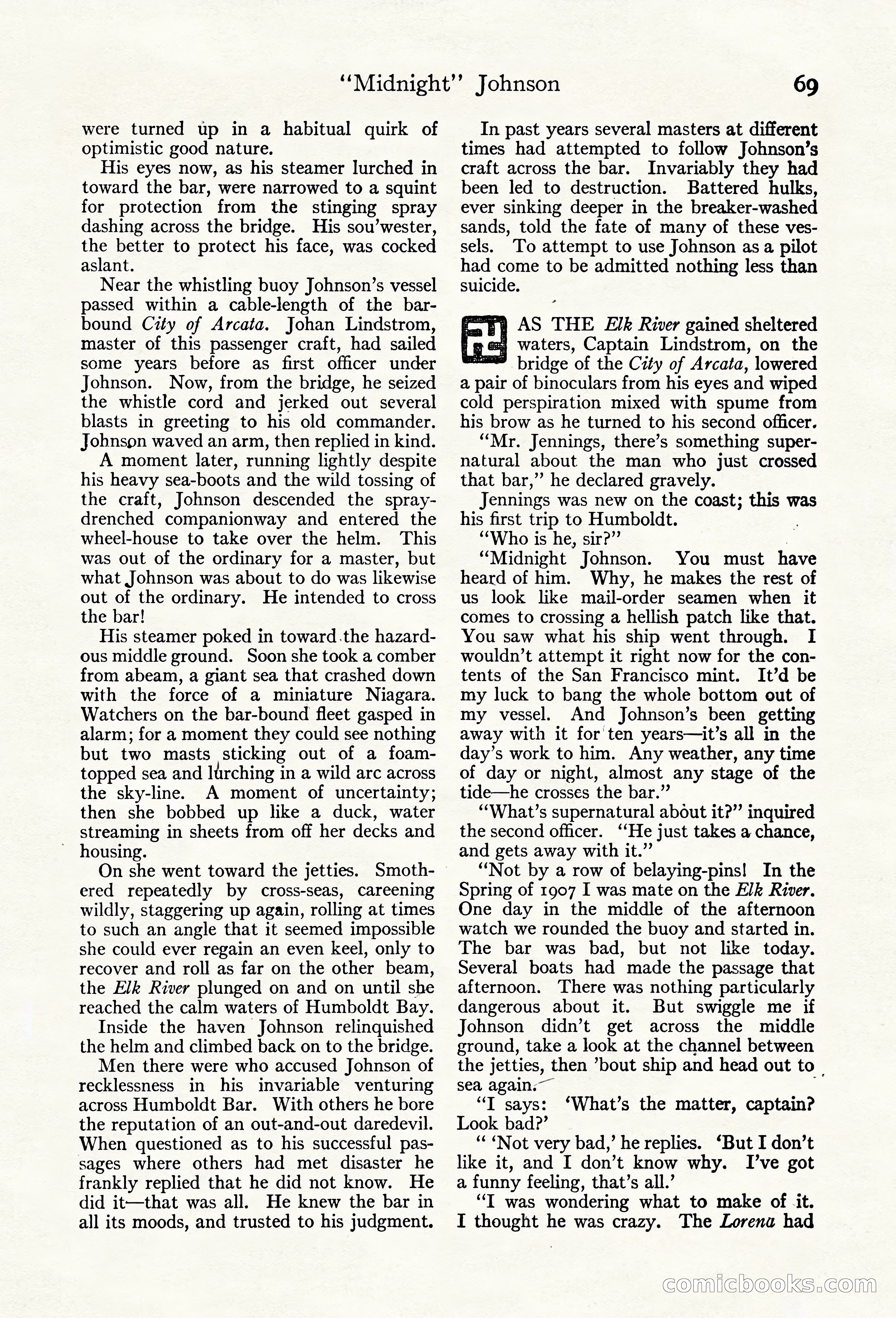
A restored page from Pulp Fiction, 1922. Page through the whole issue in the reader above.
📄 Transcribed text from this page (OCR, searchable)
Machine-transcribed from the original scan — historical spelling and the odd misread are preserved.
‘Midnight’? Johnson were turned up in a habitual quirk of optimistic good nature. His eyes now, as his steamer lurched in toward the bar, were narrowed to a squint for protection from the stinging spray dashing across the bridge. His sou’wester, the better to protect his face, was cocked aslant. Near the whistling buoy Johnson’s vessel passed within a cable-length of the bar- bound City of Arcata. Johan Lindstrom, master of this passenger craft, had sailed some years before as first officer under Johnson. Now, from the bridge, he seized the whistle cord and jerked out several blasts in greeting to his old commander. Johnson waved an arm, then replied in kind. A moment later, running lightly despite his heavy sea-boots and the wild tossing of the craft, Johnson descended the spray- drenched companionway and entered the wheel-house to take over the helm. This was out of the ordinary for a master, but what Johnson was about to do was likewise out of the ordinary. He intended to cross the bar! His steamer poked in toward.the hazard- ous middle ground. Soon she took a comber from abeam, a giant sea that crashed down with the force of a miniature Niagara. Watchers on the bar-bound fleet gasped in alarm; for a moment they could see nothing but two masts sticking out of a foam- topped sea and lurching in a wild arc across the sky-line. A moment of uncertainty; then she bobbed up lke a duck, water streaming in sheets from off her decks and ~ housing. On she went toward the jetties. Smoth- | ered repeatedly by cross-seas, careening wildly, staggering up again, rolling at times to such an angle that it seemed impossible she could ever regain an even keel, only to recover and roll as far on the other beam, the Elk River plunged on and on until she reached the calm waters of Humboldt Bay. Inside the haven Johnson relinquished the helm and climbed back on to the bridge. Men there were who accused Johnson of recklessness in his invariable venturing across Humboldt Bar. With others he bore the reputation of an out-and-out daredevil. When questioned as to his successful pas- sages where others had met disaster he frankly replied that he did not know. He did it—that was all. He knew the bar in all its moods, and trusted to his judgment. 69 In past years several masters at different times had attempted to follow Johnson’s craft across the bar. Invariably they had been led to destruction. Battered hulks, ever sinking deeper in the breaker-washed sands, told the fate of many of these ves- sels. To attempt to use Johnson as a pilot had come to be admitted nothing less than suicide. ca bW AS THE Elk River gained sheltered f es, waters, Captain Lindstrom, on the “me” bridge of the City of Arcata, lowered a pair of binoculars from his eyes and wiped cold perspiration mixed with spume from his brow as he turned to his second officer. “Mr. Jennings, there’s something super- natural about the man who just crossed that bar,” he declared gravely. Jennings was new on the coast; this was his first trip to Humboldt. ‘“Who is he, sir?”’ | “Midnight Johnson. You must have heard of him. Why, he makes the rest of us look like mail-order seamen when it comes to crossing a hellish patch like that. You saw what his ship went through. I wouldn’t attempt it right now for the con- tents of the San Francisco mint. It’d be my luck to bang the whole bottom out of my vessel. And Johnson’s been getting away with it for ten years—it’s all in the day’s work to him. Any weather, any time of day or night, almost any stage of the tide—he crosses the bar.” ‘“‘What’s supernatural about it?” inquired the second officer. ‘‘He just takes a chance, and gets away with it.” “Not by a row of belaying-pins! In the Spring of 1907 I was mate on the Elk River. One day in the middle of the afternoon watch we rounded the buoy and started in. The bar was bad, but not like today. Several boats had made the passage that afternoon. There was nothing particularly dangerous about it. But swiggle me if Johnson didn’t get across the middle ground, take a look at the channel between the jetties, then bout ship and head out to | sea again. “TI says: Look bad?’ “ ‘Not very bad,’ he replies. ‘But I don’t like it, and I don’t know why. I’ve got a funny feeling, that’s all.’ “T was wondering what to make of it. I thought he was crazy. The Lorena had ‘What’s the matter, captain? COnmmiclbooks C@