
Pulp Fiction, 1922 · page 69 of 200
Adventure Magazine Cover — page 69: what you’re looking at
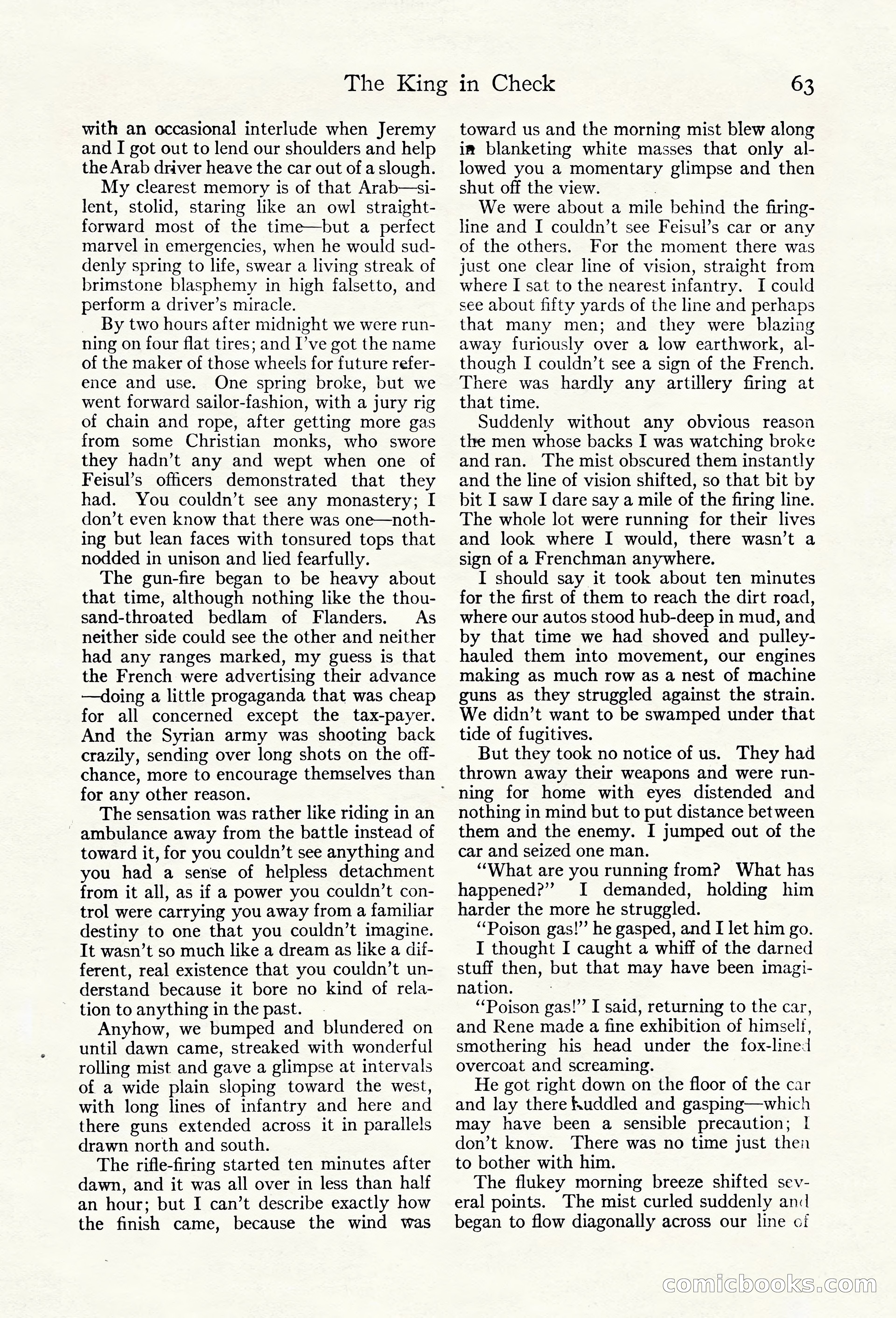
A restored page from Pulp Fiction, 1922. Page through the whole issue in the reader above.
📄 Transcribed text from this page (OCR, searchable)
Machine-transcribed from the original scan — historical spelling and the odd misread are preserved.
The King with an occasional interlude when Jeremy and I got out to lend our shoulders and help the Arab driver heave the car out of a slough. My clearest memory is of that Arab—si- lent, stolid, staring like an owl straight- forward most of the time—but a perfect marvel in emergencies, when he would sud- denly spring to life, swear a living streak of brimstone blasphemy in high falsetto, and perform a driver’s miracle. _ By two hours after midnight we were run- ning on four flat tires; and I’ve got the name of the maker of those wheels for future refer- ence and use. One spring broke, but we went forward sailor-fashion, with a jury rig of chain and rope, after getting more gas from some Christian monks, who swore they hadn’t any and wept when one of Feisul’s officers demonstrated that they had. You couldn’t see any monastery; I don’t even know that there was one—noth- ing but lean faces with tonsured tops that nodded in unison and lied fearfully. The gun-fire began to be heavy about that time, although nothing like the thou- sand-throated bedlam of Flanders. As neither side could see the other and neither had any ranges marked, my guess is that the French were advertising their advance —doing a little progaganda that was cheap for all concerned except the tax-payer. And the Syrian army was shooting back crazily, sending over long shots on the off- chance, more to encourage themselves than for any other reason. The sensation was rather like riding in an - ambulance away from the battle instead of toward it, for you couldn’t see anything and you had a sense of helpless detachment from it all, as if a power you couldn’t con- trol were carrying you away from a familiar destiny to one that you couldn’t imagine. It wasn’t so much like a dream as like a dif- ferent, real existence that you couldn’t un- derstand because it bore no kind of rela- tion to anything in the past. Anyhow, we bumped and blundered on until dawn came, streaked with wonderful rolling mist and gave a glimpse at intervals of a wide plain sloping toward the west, with long lines of infantry and here and there guns extended across it in parallels drawn north and south. The rifle-firing started ten minutes after dawn, and it was all over in less than half an hour; but I can’t describe exactly how the finish came, because the wind was in Check 63 toward us and the morning mist blew along im blanketing white masses that only al- lowed you a momentary glimpse and then shut off the view. | We were about a mile behind the firing- line and I couldn’t see Feisul’s car or any of the others. For the moment there was just one clear line of vision, straight from where I sat to the nearest infantry. I could see about fifty yards of the line and perhaps that many men; and they were blazing away furiously over a low earthwork, al- though I couldn’t see a sign of the French. There was hardly any artillery firing at that time. Suddenly without any obvious reason the men whose backs I was watching broke and ran. The mist obscured them instantly and the line of vision shifted, so that bit by bit I saw I dare say a mile of the firing line. The whole lot were running for their lives and look where I would, there wasn’t a sign of a Frenchman anywhere. I should say it took about ten minutes for the first of them to reach the dirt road, where our autos stood hub-deep in mud, and by that time we had shoved and pulley- hauled them into movement, our engines making as much row as a nest of machine guns as they struggled against the strain. We didn’t want to be swamped under that tide of fugitives. But they took no notice of us. They had thrown away their weapons and were run- ’ ning for home with eyes distended and nothing in mind but to put distance between them and the enemy. I jumped out of the car and seized one man. ‘“‘What are you running from? What has happened?” I demanded, holding him harder the more he struggled. “Poison gas!” he gasped, and I let him go. I thought I caught a whiff of the darned stuff then, but that may have been imagi- nation. “‘Poison gas!” I said, returning to the car, and Rene made a fine exhibition of himself, smothering his head under the fox-lined overcoat and screaming. He got right down on the floor of the car and lay there uddled and gasping—which may have been a sensible precaution; | don’t know. There was no time just then to bother with him. The flukey morning breeze shifted sev- eral points. The mist curled suddenly and began to flow diagonally across our line ci MICLOOOKS C©