
Pulp Fiction, 1922 · page 66 of 200
Adventure Magazine Cover — page 66: what you’re looking at
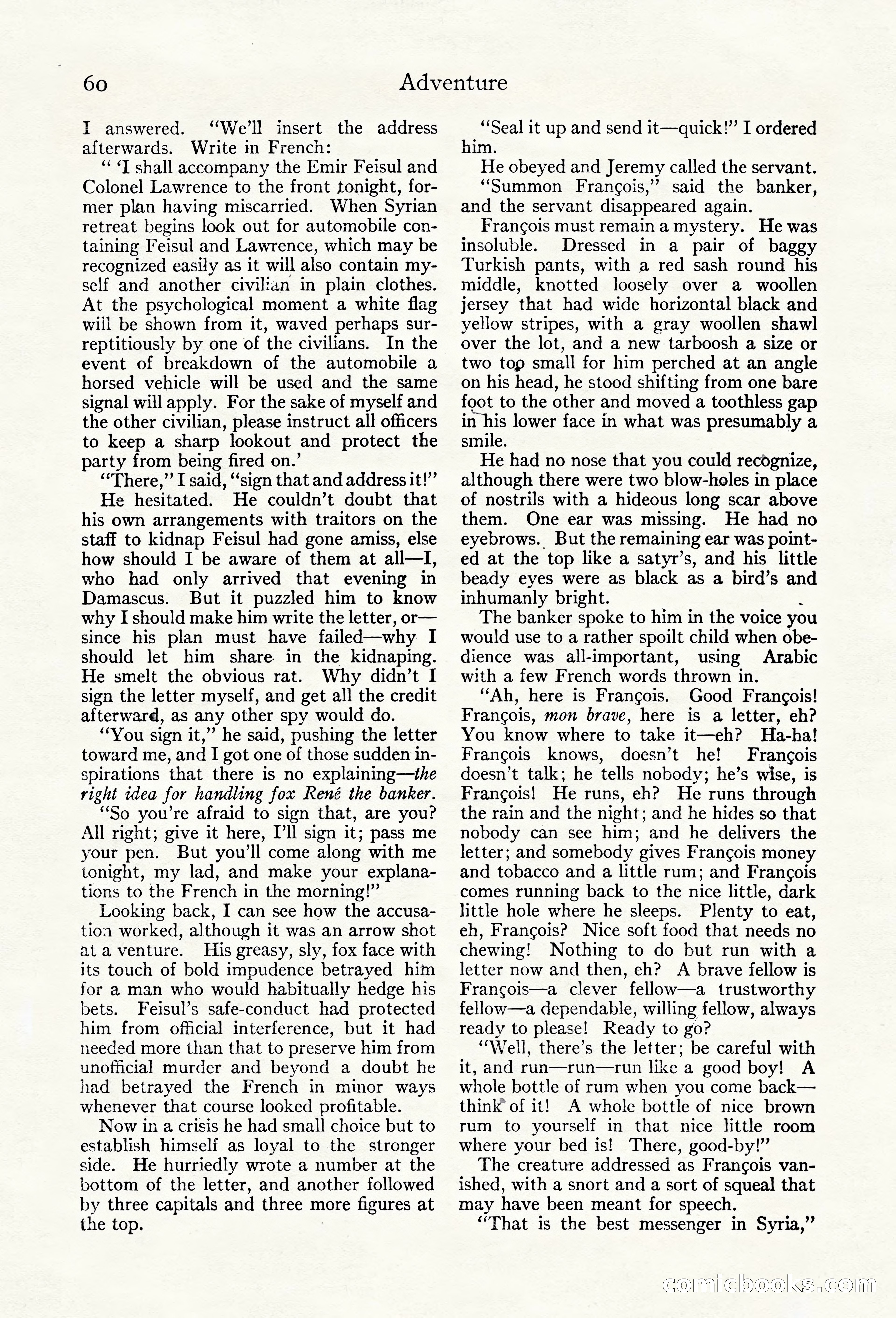
A restored page from Pulp Fiction, 1922. Page through the whole issue in the reader above.
📄 Transcribed text from this page (OCR, searchable)
Machine-transcribed from the original scan — historical spelling and the odd misread are preserved.
60 I answered. ‘‘We’ll insert the address afterwards. Write in French: ‘“«T shall accompany the Emir Feisul and Colonel Lawrence to the front tonight, for- mer plan having miscarried. When Syrian retreat begins look out for automobile con- taining Feisul and Lawrence, which may be recognized easily as it will also contain my- self and another civilian in plain clothes. At the psychological moment a white flag will be shown from it, waved perhaps sur- reptitiously by one of the civilians. In the event of breakdown of the automobile a horsed vehicle will be used and the same signal will apply. For the sake of myself and the other civilian, please instruct all officers to keep a sharp lookout and protect the party from being fired on.’ “‘There,’’ I said, “‘sign that and address it!” He hesitated. He couldn’t doubt that his own arrangements with traitors on the staff to kidnap Feisul had gone amiss, else how should I be aware of them at all—I, who had only arrived that evening in Damascus. But it puzzled him to know why I should make him write the letter, or— since his plan must have failed—why I should let him share in the kidnaping. He smelt the obvious rat. Why didn’t I sign the letter myself, and get all the credit afterward, as any other spy would do. “You sign it,” he said, pushing the letter toward me, and I got one of those sudden in- spirations that there is no explaining—the right wea for handling fox René the banker. ‘“‘So you’re afraid to sign that, are you? All right; give it here, Ill sign it; pass me your pen. But you’ll come along with me tonight, my lad, and make your explana- tions to the French in the morning!”’ Looking back, I can see how the accusa- tion worked, although it was an arrow shot ataventure. His greasy, sly, fox face with its touch of bold impudence betrayed him for a man who would habitually hedge his bets. Feisul’s safe-conduct had protected him from official interference, but it had needed more than that to preserve him from unofficial murder and beyond a doubt he had betrayed the French in minor ways whenever that course looked profitable. Now in a crisis he had small choice but to establish himself as loyal to the stronger side. He hurriedly wrote a number at the bottom of the letter, and another followed by three capitals and three more figures at the top. Adventure “Seal it up and send it—quick!”’ I ordered him. He obeyed and Jeremy called the servant. ‘Summon Francois,” said the banker, and the servant disappeared again. Francois must remain a mystery. He was insoluble. Dressed in a pair of baggy Turkish pants, with a red sash round his middle, knotted loosely over a woollen jersey that had wide horizontal black and yellow stripes, with a gray woollen shawl over the lot, and a new tarboosh a size or two top small for him perched at an angle on his head, he stood shifting from one bare foot to the other and moved a toothless gap in his lower face in what was presumably a smile. He had no nose that you could recognize, although there were two blow-holes in place of nostrils with a hideous long scar above them. One ear was missing. He had no eyebrows. But the remaining ear was point- ed at the top like a satyr’s, and his little beady eyes were as black as a bird’s and inhumanly bright. The banker spoke to him in the voice you would use to a rather spoilt child when obe- dience was all-important, using Arabic with a few French words thrown in. ‘“‘Ah, here is Francois. Good Francois! Francois, mon brave, here is a letter, eh? You know where to take it—eh? Ha-ha! Francois knows, doesn’t he! Francois doesn’t talk; he tells nobody; he’s wise, is Francois! He runs, eh? He runs through the rain and the night; and he hides so that nobody can see him; and he delivers the letter; and somebody gives Francois money and tobacco and a little rum; and Francois comes running back to the nice little, dark little hole where he sleeps. Plenty to eat, eh, Francois? Nice soft food that needs no chewing! Nothing to do but run with a letter now and then, eh? A brave fellow is Francois—a clever fellow—a trustworthy fellow—a dependable, willing fellow, always ready to please! Ready to go? “Well, there’s the Jetter; be careful with it, and run—run—run like a good boy! A whole bottle of rum when you come back— think of it! A whole bottle of nice brown rum to yourself in that nice lttle room where your bed is! There, good-by!” The creature addressed as Francois van- ished, with a snort and a sort of squeal that may have been meant for speech. “That is the best messenger in Syria,” COmiclbooks (C©