
Pulp Fiction, 1922 · page 30 of 200
Adventure Magazine Cover — page 30: what you’re looking at
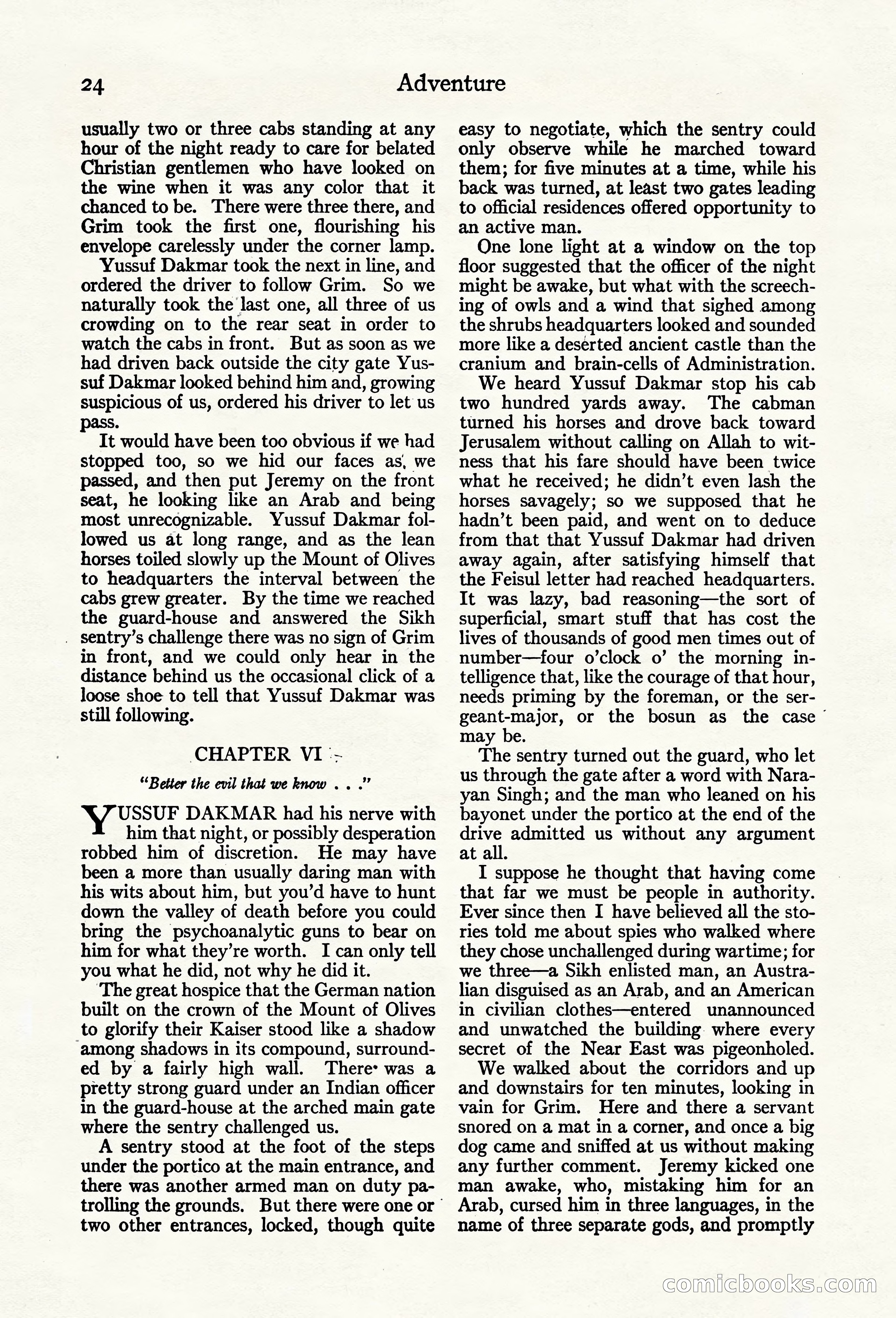
A restored page from Pulp Fiction, 1922. Page through the whole issue in the reader above.
📄 Transcribed text from this page (OCR, searchable)
Machine-transcribed from the original scan — historical spelling and the odd misread are preserved.
24 usually two or three cabs standing at any hour of the night ready to care for belated Christian gentlemen who have looked on the wine when it was any color that it chanced to be. There were three there, and Grim took the first one, flourishing his envelope carelessly under the corner lamp. Yussuf Dakmar took the next in line, and ordered the driver to follow Grim. So we naturally took the last one, all three of us crowding on to the rear seat in order to watch the cabs in front. But as soon as we had driven back outside the city gate Yus- suf Dakmar looked behind him and, growing suspicious of us, ordered his driver to let us ass. It would have been too obvious if we had stopped too, so we hid our faces as, we passed, and then put Jeremy on the front seat, he looking like an Arab and being most unrecognizable. Yussuf Dakmar fol- lowed us at long range, and as the lean horses toiled slowly up the Mount of Olives to headquarters the interval between the cabs grew greater. By the time we reached the guard-house and answered the Sikh . sentry’s challenge there was no sign of Grim in front, and we could only hear in the distance behind us the occasional click of a loose shoe to tell that Yussuf Dakmar was still following. CHAPTER VI :- “Better the evil that we know .. .” USSUF DAKMAR had his nerve with him that night, or possibly desperation robbed him of discretion. He may have been a more than usually daring man with his wits about him, but you’d have to hunt down the valley of death before you could bring the psychoanalytic guns to bear on him for what they’re worth. I can only tell you what he did, not why he did it. ‘The great hospice that the German nation built on the crown of the Mount of Olives to glorify their Kaiser stood like a shadow among shadows in its compound, surround- ed by a fairly high wall. There* was a pretty strong guard under an Indian officer In the guard-house at the arched main gate where the sentry challenged us. A sentry stood at the foot of the steps under the portico at the main entrance, and there was another armed man on duty pa- trolling the grounds. two other entrances, locked, though quite But there were one or Adventure easy to negotiate, which the sentry could only observe while he marched toward them; for five minutes at a time, while his back was turned, at least two gates leading to official residences offered opportunity to an active man. One lone light at a window on the top floor suggested that the officer of the night might be awake, but what with the screech- ing of owls and a wind that sighed among the shrubs headquarters looked and sounded more like a deserted ancient castle than the cranium and brain-cells of Administration. We heard Yussuf Dakmar stop his cab two hundred yards away. The cabman turned his horses and drove back toward Jerusalem without calling on Allah to wit- ness that his fare should have been twice what he received; he didn’t even lash the horses savagely; so we supposed that he hadn’t been paid, and went on to deduce from that that Yussuf Dakmar had driven away again, after satisfying himself that the Feisul letter had reached headquarters. It was lazy, bad reasoning—the sort of superficial, smart stuff that has cost the lives of thousands of good men times out of number—four o’clock o’ the morning in- telligence that, like the courage of that hour, needs priming by the foreman, or the ser- geant-major, or the bosun as the case ™ may be. The sentry turned out the guard, who let us through the gate after a word with Nara- yan Singh; and the man who leaned on his bayonet under the portico at the end of the drive admitted us without any argument at all. I suppose he thought that having come that far we must be people in authority. Ever since then I have believed all the sto- ries told me about spies who walked where they chose unchallenged during wartime; for we three—a Sikh enlisted man, an Austra- lian disguised as an Arab, and an American in civilian clothes—entered unannounced and unwatched the building where every secret of the Near East was pigeonholed. We walked about the corridors and up and downstairs for ten minutes, looking in vain for Grim. Here and there a servant snored on a mat in a corner, and once a big dog came and sniffed at us without making any further comment. Jeremy kicked one man awake, who, mistaking him for an Arab, cursed him in three languages, in the name of three separate gods, and promptly COnmmiclbooks C@